49 works in this view — arrow keys or swipe to move between them.
Dance in Art
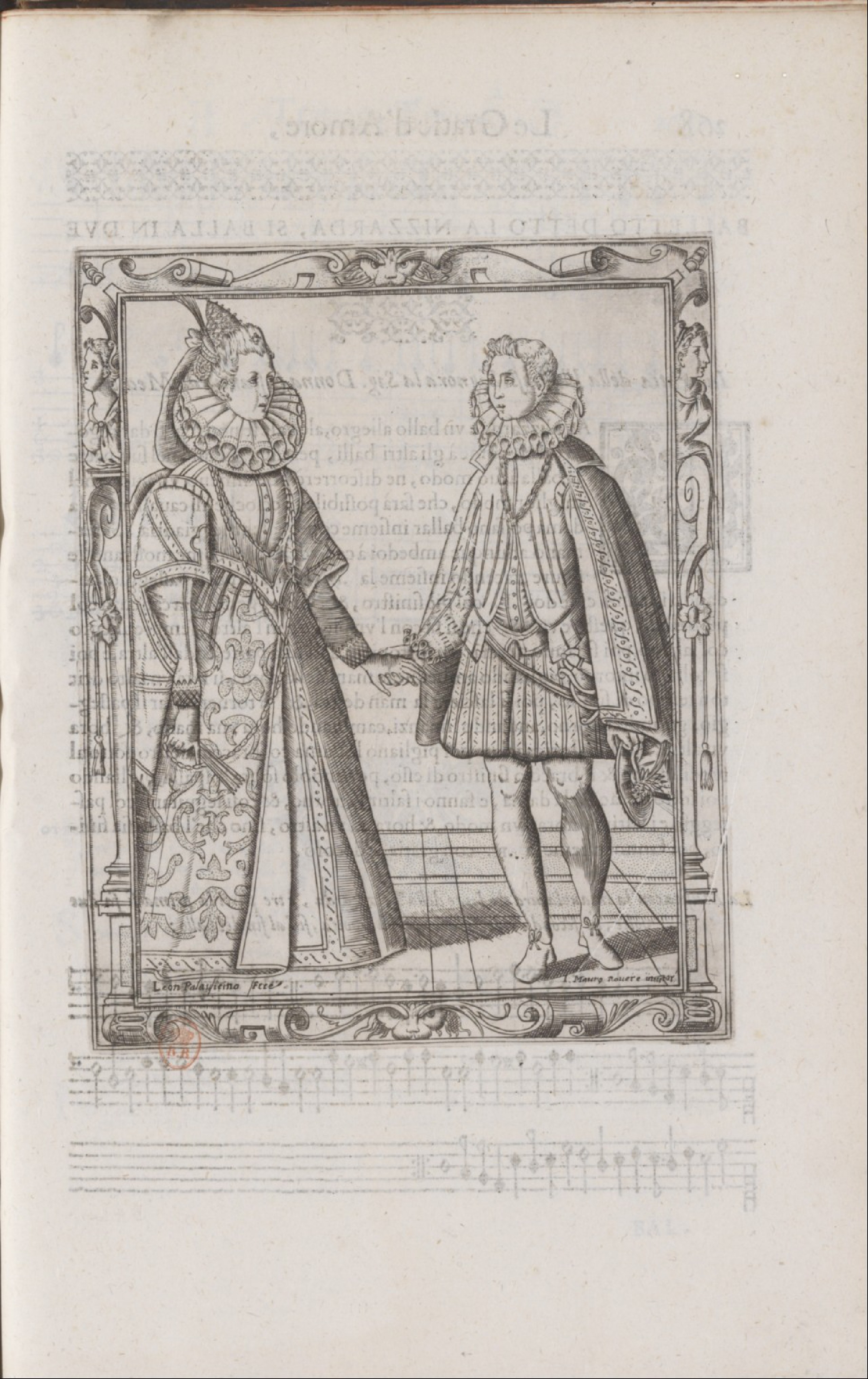
Negri — Dance Plate (plate 22)
Cesare Negri (il Trombone)
- Medium:
- Engraving
- Dance:
- Notation/Choreography
- Era:
- Pre-1700 (Renaissance/Baroque)
- Collection:
- Le Gratie d'Amore (1602)
- Source:
- Library of Congress
- Rights:
- Public domain — free to use, share and adapt.
- Recorded as:
- Public Domain
For historians of Renaissance dance, this plate is a primary source for the actual appearance, dress codes, and social positioning within courtly paired dances. For dancers and choreographers, it preserves the visual memory of a lost performance tradition and demonstrates how much Renaissance dance relied on formal, ritualized approach and greeting—the dance was as much about courtship protocol and social hierarchy as about footwork. Negri's plates remain among the most reliable visual records of how Renaissance dancers actually stood, dressed, and addressed one another.
What you are looking at
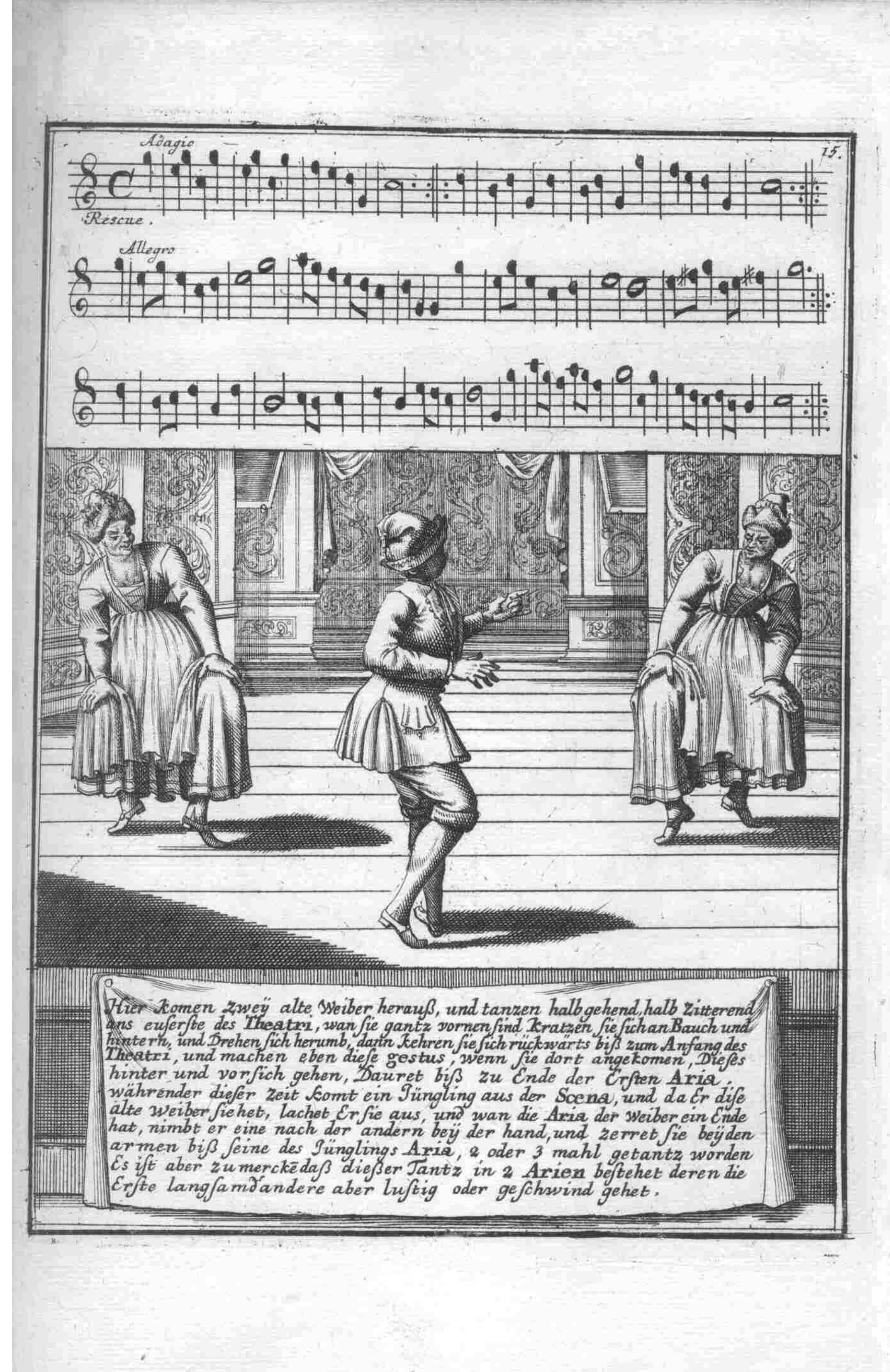
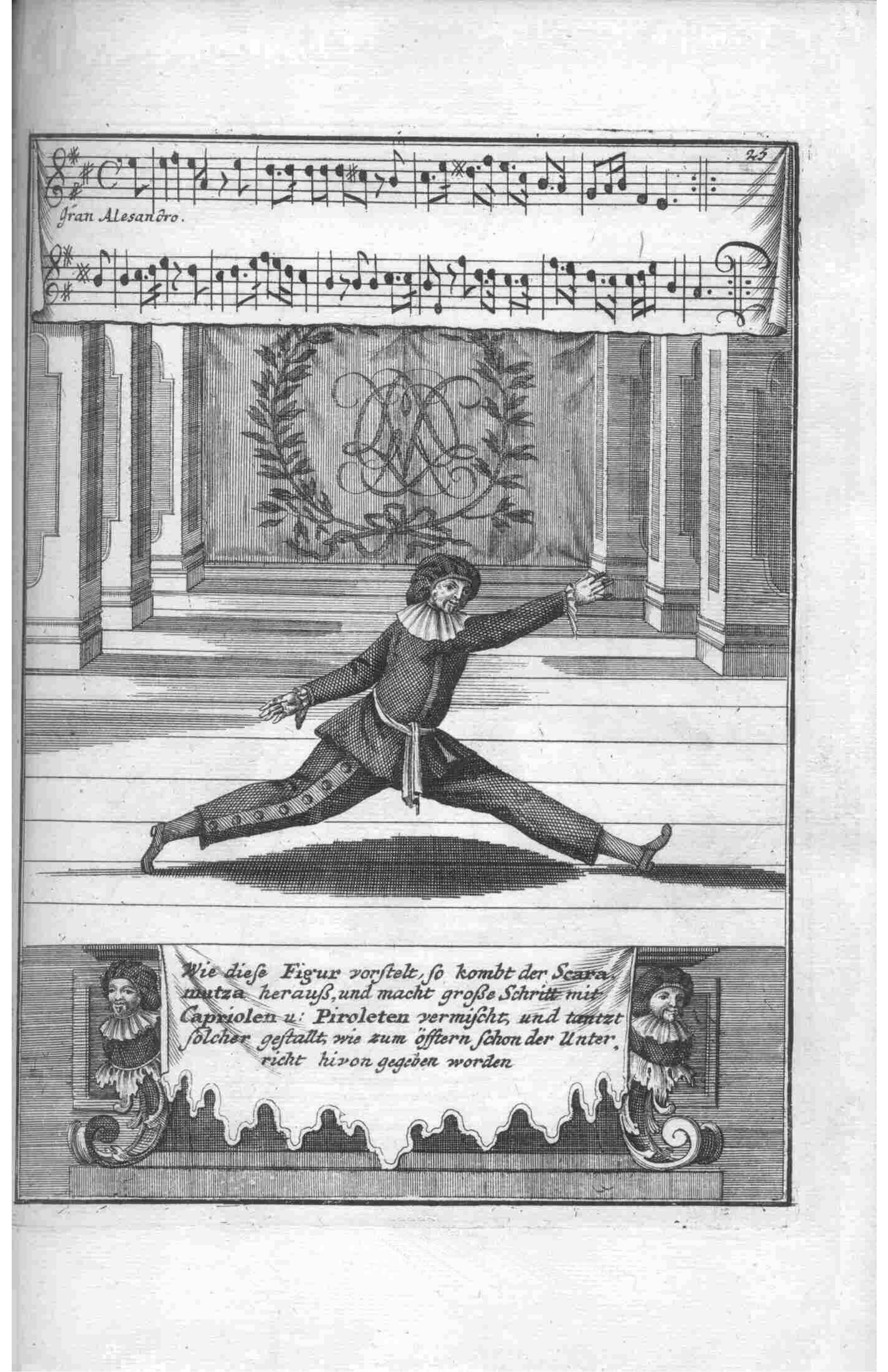
An engraved plate from Cesare Negri's dance treatise shows a man and woman in elaborate Renaissance court dress, positioned as if mid-conversation or greeting rather than in active movement. The woman stands at left in a richly patterned gown with long sleeves, a high collar, and a stiffened ruff at the neck; her hair is styled up with ornamental detail. The man at right wears short breeches, a fitted doublet, and a draped cloak; his legs are bare below the knee, and he stands in a relaxed contrapposto. Both figures are rendered with careful attention to textile detail—brocade, embroidery, pleats—and positioned within an ornamental Renaissance border frame. The background is plain, emphasizing the figures and their dress as the subject. The composition is formal and frontal, documenting a moment of courtship etiquette or the opening gesture of a dance.
The dancing
The woman holds her body upright with weight centered, her hands positioned at waist level in a composed, modest stance. The man leans slightly toward her, his weight on one leg in a casual but attentive pose, with one arm extended or gesturing. Neither figure is captured mid-step or in vigorous motion; instead, the artist has frozen a moment of social interaction—the moment before or after movement, or the formal presentation required by court etiquette. Their spatial relationship is intimate but decorous, separated by a few feet and facing one another at a slight angle.
The dance depicted
This plate documents a paired figure or opening position from a Renaissance Italian court dance, most likely a pavane, galliard, or allemande as described in Negri's *Le Gratie d'Amore* treatise. The image prioritizes the geometry of courtship—the spatial relationship, the quality of attention, the formal address—over the kinetic content of footwork. What we see is the structured social grammar of Renaissance dance, in which a man's approach, the woman's receptiveness, and the mutual acknowledgment of status and intention were as important as the steps themselves. The absence of visible stepping or arm-lifting suggests the artist was illustrating a court position rather than capturing mid-movement energy.
How it was made
This is an engraving, a print medium that allowed Negri's treatise to circulate widely in multiple copies and to reach students and dancing masters across Italy and Europe. Engraving required precise line work and strong contrast, which here serves the clarity of the costume documentation—every seam, pleat, and jeweled detail is legible. The ornamental border frame and the careful composition declare this a serious instructional document intended for educated courtly readers, not a quick sketch or broadsheet. The technique's precision made it ideal for anatomical and choreographic instruction, allowing viewers to study proportions, posture, and the drape of fabric at leisure.
About this work
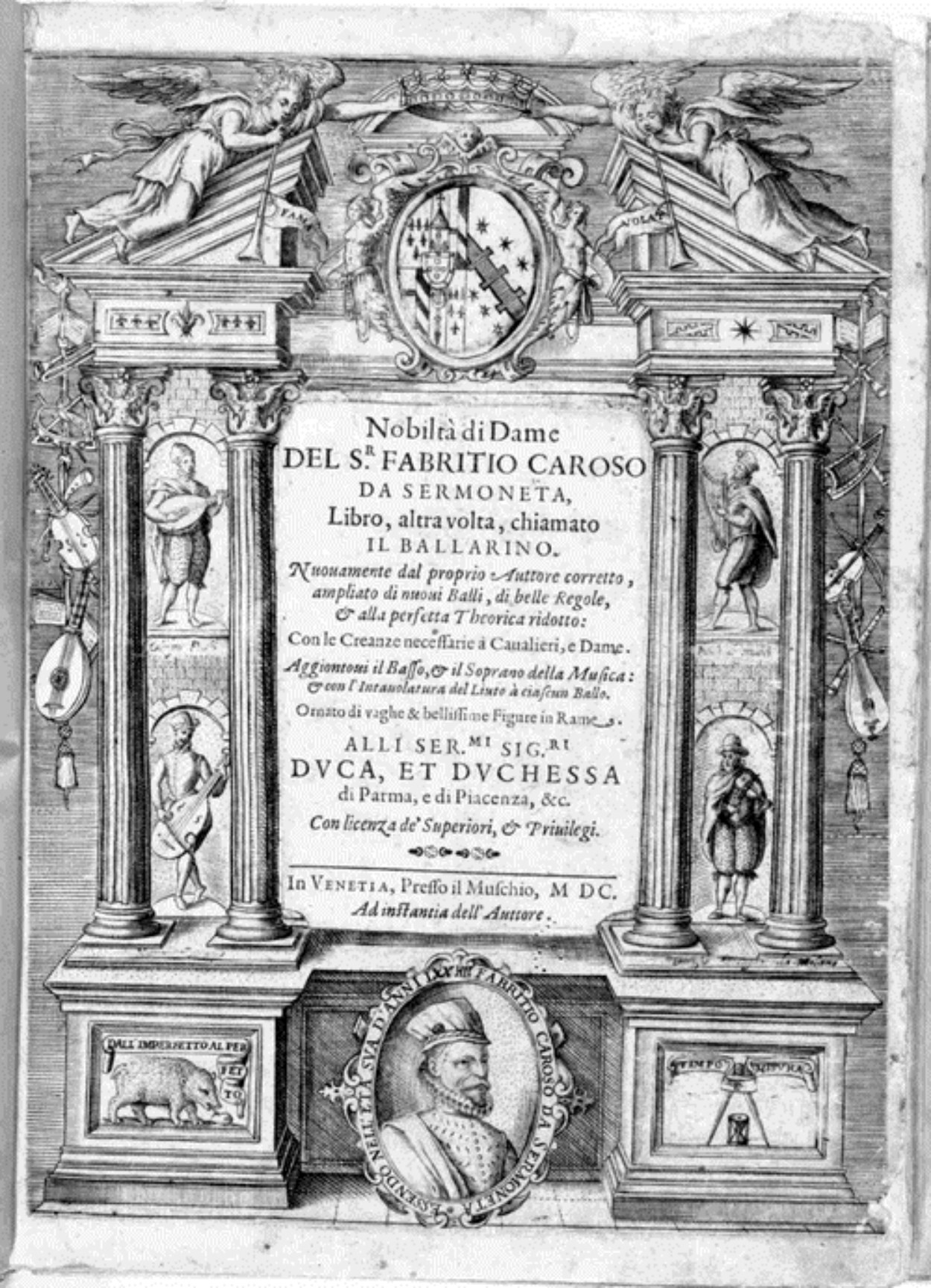
This is an instructional plate from Cesare Negri's *Le Gratie d'Amore* (Milan, 1602/1604), the most comprehensive and prestigious dance treatise of the Renaissance. It documents a paired opening position or greeting from a court dance, presenting both the step pattern and the social choreography of Renaissance courtship through careful attention to dress, posture, and spatial relationship. The work sits between dance notation and fashion documentation, using the couple figure as a vehicle for teaching both movement and deportment. Negri's treatise was a definitive text for dance masters of the period, and its plates were copied and studied for generations; this particular image exemplifies his approach to recording the visual and kinetic grammar of court dance through the couple form.
How to look at it
Notice the precise moment the artist has chosen: not a leap or a quick step, but a moment of address and receptiveness. The man's leaning posture and the woman's composed stillness create an asymmetry that was central to Renaissance courtly dance—the man was expected to display attention and initiative, while the woman maintained formal composure. Study the feet and legs: the man's relaxed weight distribution and the woman's closed stance tell you this is a moment of greeting or transition rather than active stepping. The costume detail is not merely decorative—it documents the actual dress code required for court dancing and tells you something about the social rank and gender roles embedded in the dance itself.
The artist
Cesare Negri, known as 'il Trombone,' was the most celebrated dancing master of late-sixteenth-century Milan and taught at courts throughout Italy and France. He published *Le Gratie d'Amore* in 1602 (with a revised edition in 1604), which became the definitive compendium of Italian Renaissance courtly dance. Unlike earlier treatises, Negri's work combined detailed text descriptions with engraved plates showing paired figures in full costume, making it both a technical manual and a status symbol for the courts that could afford it. His approach—marrying verbal instruction with visual documentation of the couple form—set the standard for dance treatises of the seventeenth century.
The period
The Renaissance court dance was at the height of its formalization and prestige in the early seventeenth century, just as the newer Italian dances (like the canaries and correnti) were beginning to challenge the older pavane-and-galliard repertory. Negri's treatise was published at a moment when dance manuals themselves were becoming more lavish and more widely circulated, reflecting both the growing professionalization of dancing masters and the increasing appetite among the nobility for printed instruction in courtly behavior. The ornamental border and careful costume detail in his plates reflect the broader Renaissance investment in proportion, perspective, and the visual documentation of social ritual.
Where it lives
This plate is from *Le Gratie d'Amore*, Cesare Negri's 1602 dance treatise published in Milan. The work is held by the Library of Congress. The treatise survives in multiple copies and editions and was extensively reprinted and translated, making it one of the most circulated dance manuals of the Renaissance and early Baroque periods.
Dance in this work
Questions about this work
Is this a painting or a print?
This is an engraving, a printmaking technique that allowed the treatise to be reproduced in multiple copies. Each plate was carefully engraved by hand into a metal surface, which was then inked and pressed onto paper. This made it possible for dancing masters and courtiers across Europe to own a copy of Negri's instructions.
What dance is being shown?
The specific dance title is inscribed in the original plate (though difficult to read in reproduction). Negri's treatise documents dozens of dances, from the formal pavane and galliard to the more lively canary and corrente. This plate shows a paired opening position or salutation—a moment that was part of many different court dances rather than a single dance itself.
Why are there so many details of the clothing?
Renaissance court dance was inseparable from fashion and social display. The way you dressed, the way you moved, and your awareness of proportion and decorum were all part of being a courtier. By showing the exact cut of the gown, the style of the ruff, and the length of the breeches, Negri was also documenting the social rules and visual standards of the court.
How do we know how to perform these dances if Negri's plates don't show footwork?
The plates worked in combination with the text. Negri's detailed written descriptions of steps, timing, and weight distribution accompanied each plate. A dancing master would read the words and consult the image to understand both the step pattern and the formal, composed quality that was expected in court dancing.
More Notation/Choreography artwork