49 works in this view — arrow keys or swipe to move between them.
Dance in Art
Courtly Couple — Plate 1
Gregorio Lambranzi
- Medium:
- Copper-plate engraving
- Dance:
- Notation/Choreography
- Era:
- 1700s (Enlightenment/Minuet Era)
- Collection:
- Nuova e curiosa scuola de' balli theatrali (1716)
- Source:
- Library of Congress
- Rights:
- Public domain — free to use, share and adapt.
- Recorded as:
- Public Domain
This is one of the earliest and most reliable visual and notational records of how Baroque courtly dances were actually performed. Lambranzi's plates are among the very few sources that combine music, precise figuration, and theatrical context, making them invaluable to historians and reconstructors of period dance. For dancers and choreographers today, this image offers direct evidence of posture, spacing, arm carriage, and the relationship between music and movement in a foundational courtly form.
What you are looking at
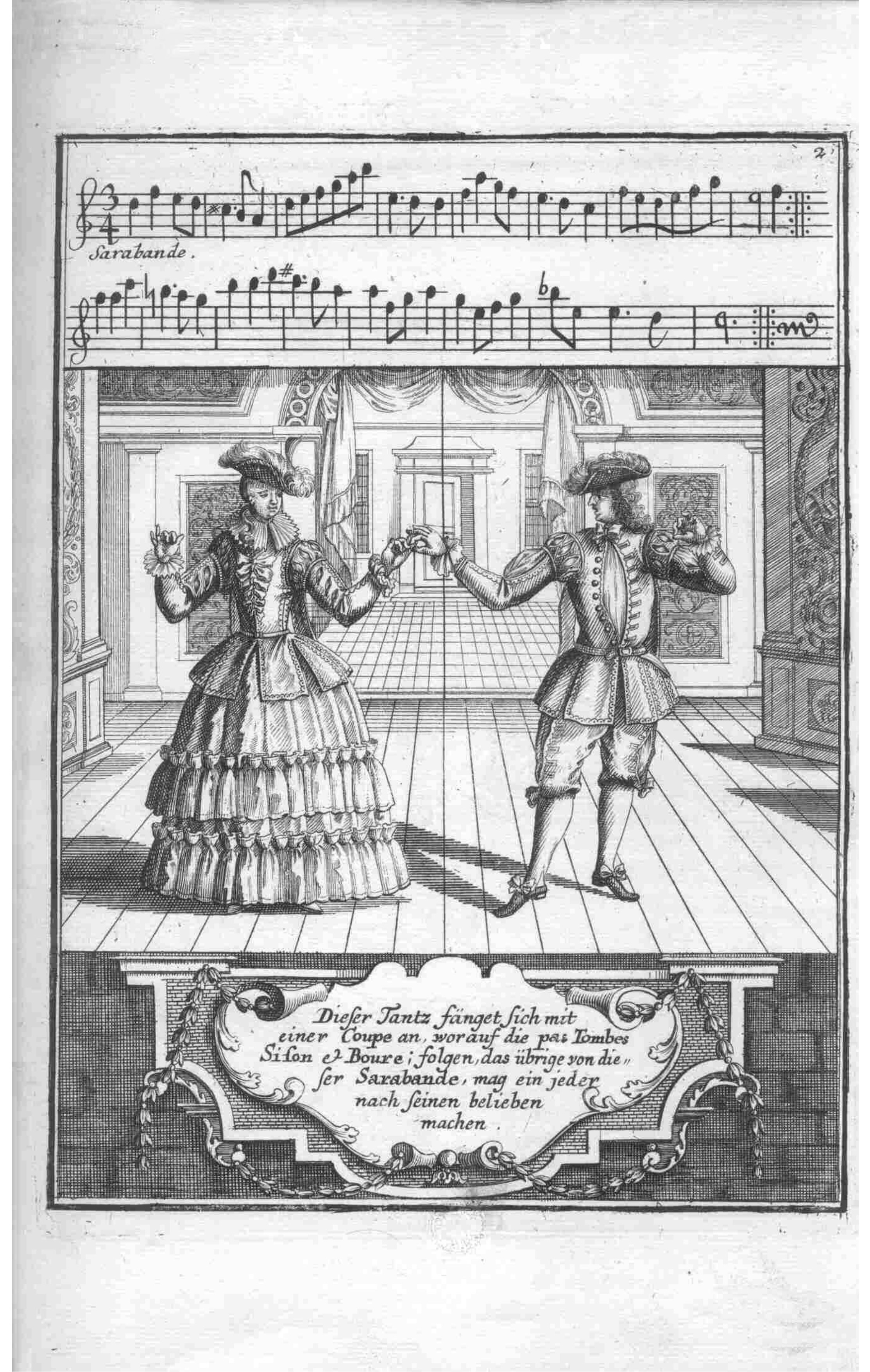
A man and woman in elaborate Baroque courtly dress face each other on a tiled stage floor within a columned interior space draped with ornate fabrics. The woman wears a richly decorated jacket over a voluminous skirt with deep horizontal pleats or flounces at the hem; the man wears a fitted jacket with decorative buttons, knee breeches, and shoes with heels. Both wear elaborate hats with feathers or plumes. They are posed with arms raised and bent, bodies upright and facing each other across a short distance. The setting is a formal theatrical interior with a receding checkerboard floor, framed by ornamental pilasters and swag drapery overhead. The perspective and architectural detail suggest this is a court dance or theatrical performance staged indoors, lit by an even illumination characteristic of the engraved medium.
The dancing
The two dancers occupy the center of the composition in a symmetrical arrangement, with bodies held vertically and arms positioned at shoulder height with elbows bent—a posture characteristic of formal courtly dances of the period. The woman's weight appears centered, her raised arms framing her body with hands at face level. The man adopts a similar stance, creating a mirror-like symmetry across the space between them. Their separation suggests they are performing movements within a shared choreographic phrase rather than in direct physical contact. The elevated posture, the careful positioning of the arms, and the formal distance between the figures all suggest a codified, learned dance rather than social improvisation.
The dance depicted
The musical notation at the top of the engraving identifies this as a Sarabande, one of the most important courtly dances of the Baroque era. The Sarabande was a slow, stately dance in triple meter with characteristic emphasis on the second beat, typically performed in pairs or as a solo showcase. The musicians' poses, upright carriage, and moderate distance between partners are consistent with documented Sarabande practice. This plate is one of a series illustrating theatrical-dance instruction, and the formal stage setting suggests these are professional or courtly performers demonstrating the dance's proper execution rather than depicting social dancing. The Sarabande's association with nobility and its role as a standard item in the theatrical-dance repertory of the early 18th century are both evident in the elevated, dignified presentation.
How it was made
This is a copper-plate engraving, a technique that allowed fine detail and wide circulation of instructional material. Engraving's capacity for precise linear work is evident in the careful rendering of architectural elements, fabric textures (particularly the woman's pleated skirt), and the musical notation at the top. The technique produced prints that could be distributed in multiple copies, making this part of an instructional manual rather than a unique artwork. The clarity of line and the consistent tonality suggest a professional engraver, and the pairing of music with image indicates this was designed for readers who could read notation—a literate, educated audience learning or studying dance.
About this work
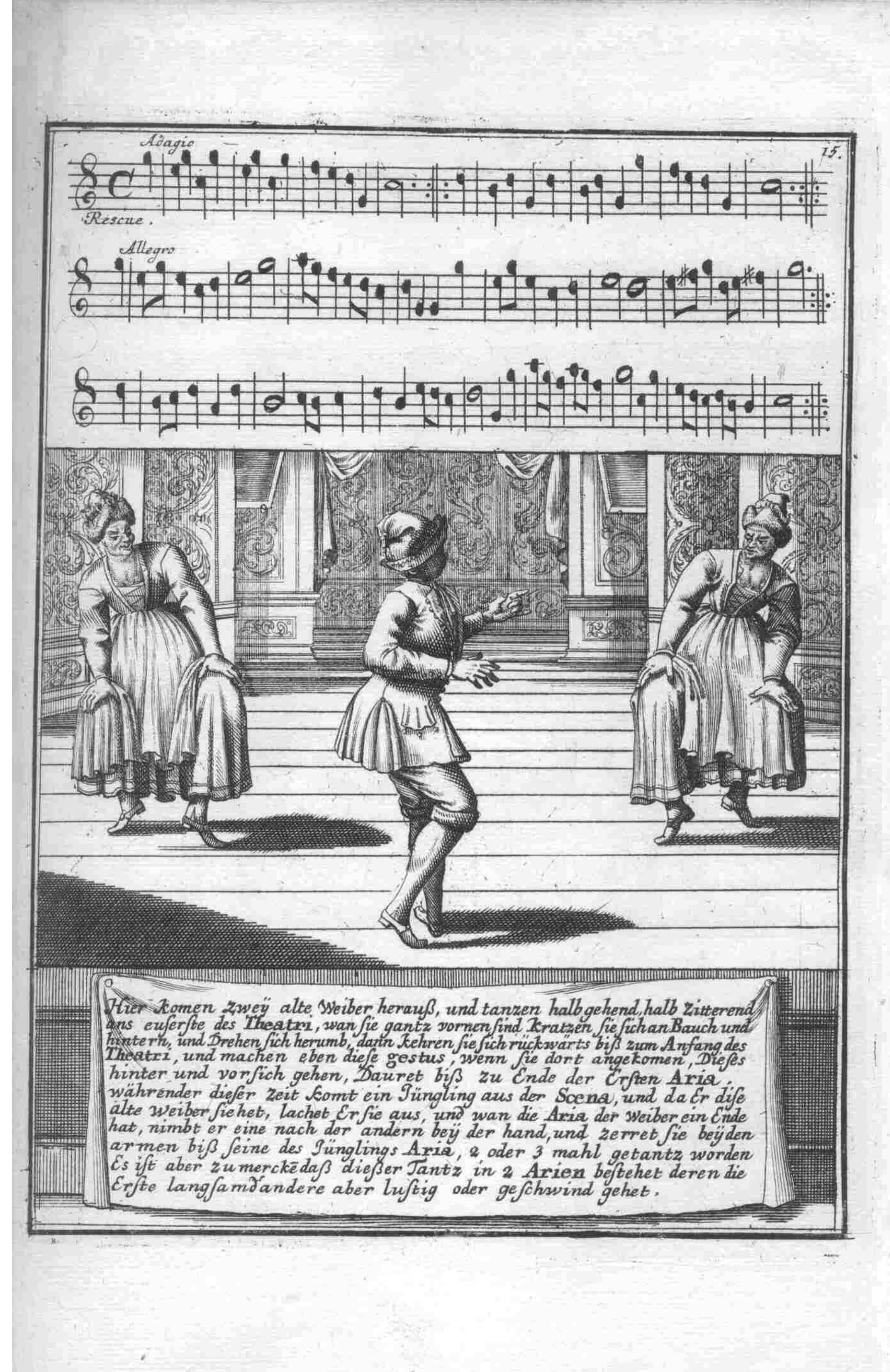
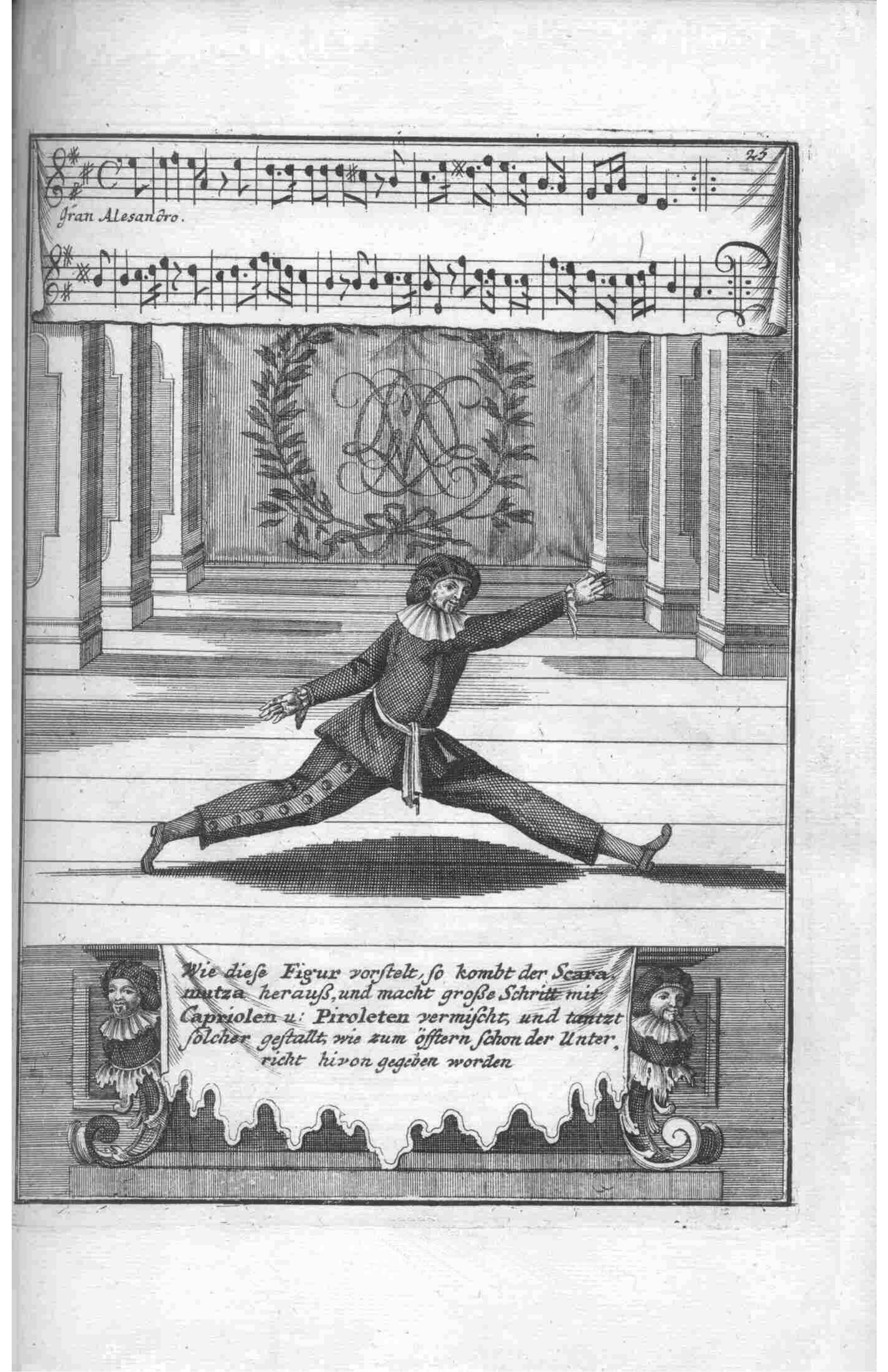
This is Plate 1 from Gregorio Lambranzi's *Nuova e curiosa scuola de' balli theatrali* (Nuremberg, 1716), one of the most influential dance instruction manuals of the Baroque era. Each plate pairs a musical phrase with an engraved image of a dancer or pair in costume, positioned on a theatrical stage and shown in a key attitude or moment of the choreography. The work documents the Sarabande, a central form of courtly dance that required refined posture, controlled movement, and musical sophistication. Lambranzi's manual served both as a teaching text for professional dancers and as a record of fashionable court dances for a literate European audience. The engraving's clarity, the precision of the costume detail, and the inclusion of musical notation all point to a work designed for study and emulation by serious students of dance.
How to look at it
Observe the posture and arm position as the key information here: the upright spine, the elevated arms with bent elbows, and the symmetrical stance are all defining features of Baroque courtly movement. Notice how the distance between the dancers and their mirror-like positioning suggest a choreography of complementary or responsive gestures rather than a closed embrace. The musician's notation at the top is not decorative—read it to understand the structure and phrasing of the Sarabande. The stage setting, with its perspectival depth and formal columns, frames the dance as a theatrical spectacle, not a casual social event; this tells you about the Sarabande's status and the kind of training required to perform it correctly.
The artist
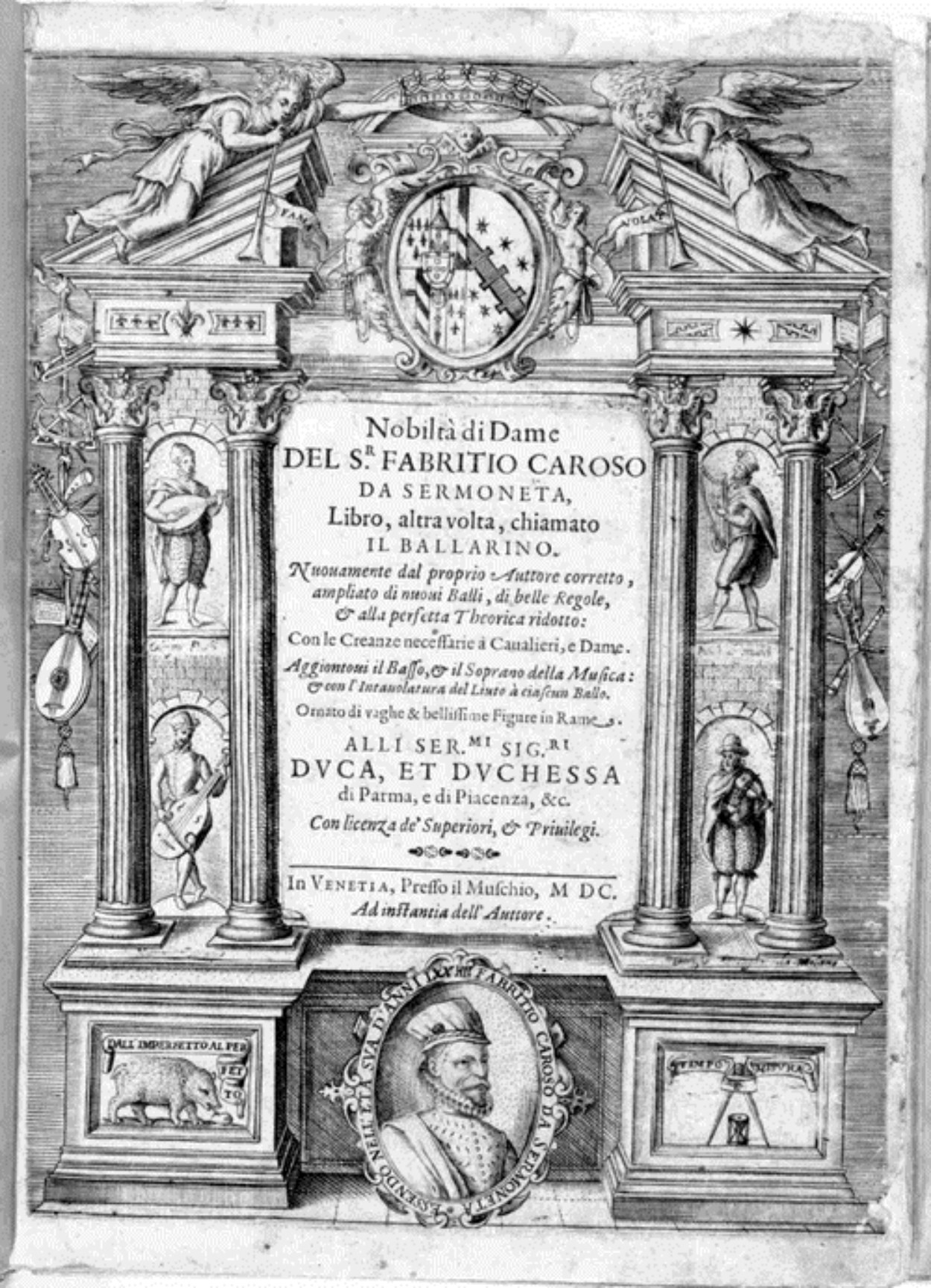
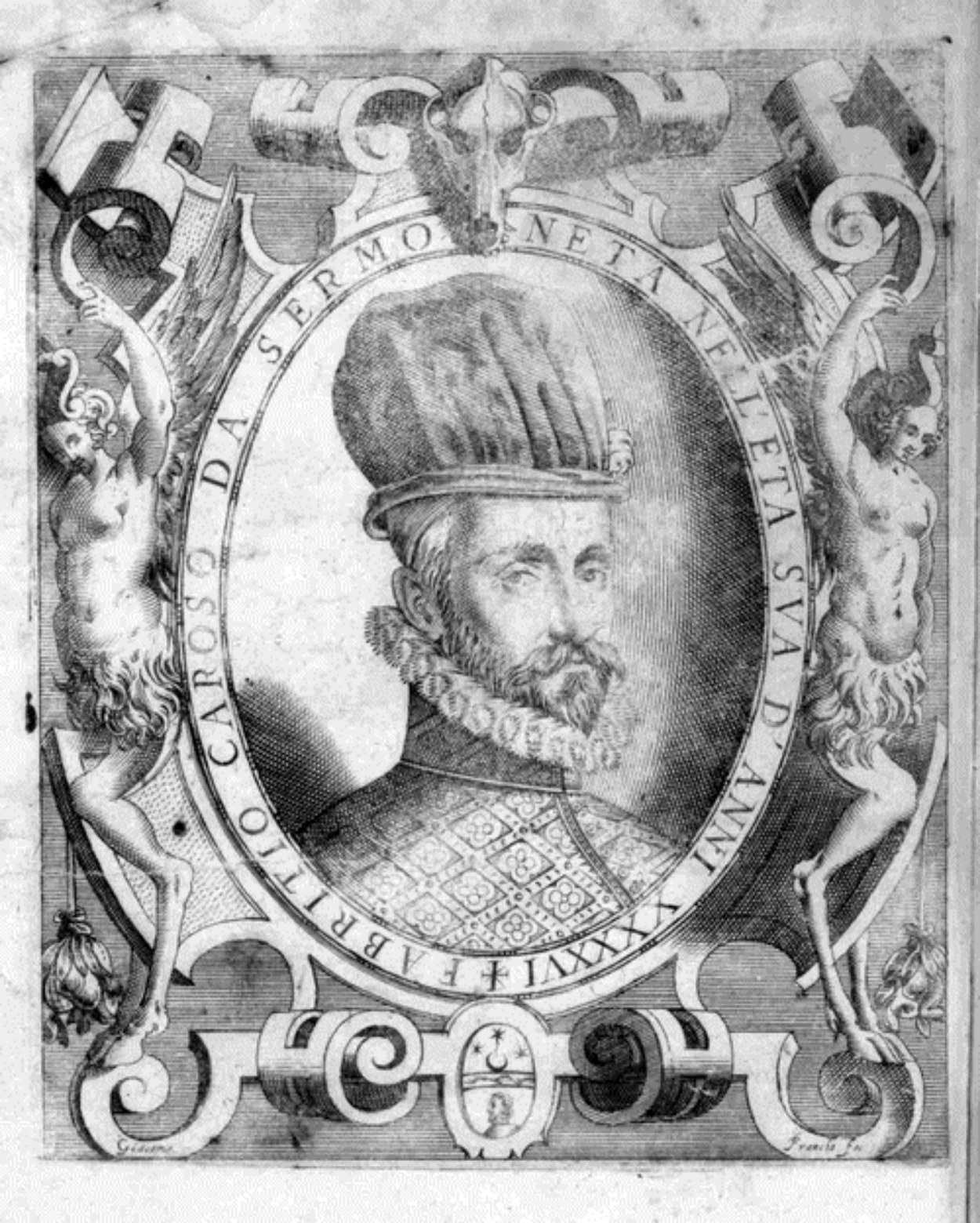
Gregorio Lambranzi (1650–1728) was an Italian dancing master and choreographer active in the late Baroque period. His *Nuova e curiosa scuola de' balli theatrali*, published in Nuremberg in German and Italian editions, represents the culmination of his career as both a practical instructor and a theorist of dance. The manual includes 52 plates, each illustrating a different choreographed piece or movement study, accompanied by music notation. Lambranzi worked in a tradition of choreographic documentation that included Fabrizio Caroso and Cesare Negri, but his work is distinguished by the precision of its stage direction, its theatrical focus, and its incorporation of music. The manual was addressed to both professional dancers and educated amateurs, and it circulated widely across Europe throughout the 18th century.
The period
The Sarabande originated in Spain or the Spanish colonies in the 16th century and was adopted into French and Italian court dances during the 17th century, where it became a slow, dignified form associated with nobility. By the early 18th century, when Lambranzi published his manual, the Sarabande was an established standard in the theatrical-dance repertory and in the suite of courtly dances (often following an Allemande and Courante). The period was one of intense formalization and codification of dance: the court of Louis XIV had established ballet as an art form with a fixed vocabulary, and dancing masters across Europe were producing instructional texts to standardize and document correct practice. Lambranzi's work sits at the intersection of this pedagogical impulse and the theatrical use of dance in spoken drama, opera, and ballet de cour. The engraving's style and the architectural setting reflect the aesthetic of formal Baroque theater and courtly display.
Where it lives
This plate is from the first edition of *Nuova e curiosa scuola de' balli theatrali*, published in Nuremberg in 1716. The work is held in the Library of Congress and has been digitized as part of their collections. Lambranzi's manual was republished and translated multiple times during the 18th century, attesting to its importance as a standard teaching text.
Dance in this work
Questions about this work
What is a Sarabande?
The Sarabande is a slow courtly dance in triple meter, originating in Spain but adopted into French and Italian court practice in the 17th century. It is performed with an upright, dignified carriage, and is characterized by emphasis on the second beat of the measure. By the early 18th century, it was a standard item in both courtly and theatrical-dance repertories, often appearing as the third movement of a dance suite.
Who was Gregorio Lambranzi?
Lambranzi (1650–1728) was an Italian dancing master and choreographer whose *Nuova e curiosa scuola de' balli theatrali* is one of the most important Baroque dance manuals. It includes 52 engraved plates, each showing a different choreographed piece with music notation, designed to teach and document correct practice. His work circulated widely and influenced dance teaching across Europe for much of the 18th century.
How do we know what these dances actually looked like?
Sources like Lambranzi's manual are precious because they combine visual depiction with music notation, showing both the moment of the movement and its musical phrasing. Combined with written descriptions in other dance manuals, they allow modern reconstructors to reconstruct Baroque dances with reasonable accuracy. However, the engraving freezes a moment, and we cannot see the full continuity of movement; the notation shows structure but not all detail.
Was this a social dance or a professional performance?
By Lambranzi's time, the Sarabande functioned in both contexts: it was a courtly dance performed in court settings, and it also appeared in theatrical works such as operas and ballets. This particular image appears to show a theatrical demonstration—the stage setting, the costume, and the formal presentation suggest it is a professional dancer's or dancing master's teaching example rather than a casual social event.
More Notation/Choreography artwork