49 works in this view — arrow keys or swipe to move between them.
Dance in Art
Solo Dancer — Plate 2
Gregorio Lambranzi
- Medium:
- Copper-plate engraving
- Dance:
- Notation/Choreography
- Era:
- 1700s (Enlightenment/Minuet Era)
- Collection:
- Nuova e curiosa scuola de' balli theatrali (1716)
- Source:
- Library of Congress
- Rights:
- Public domain — free to use, share and adapt.
- Recorded as:
- Public Domain
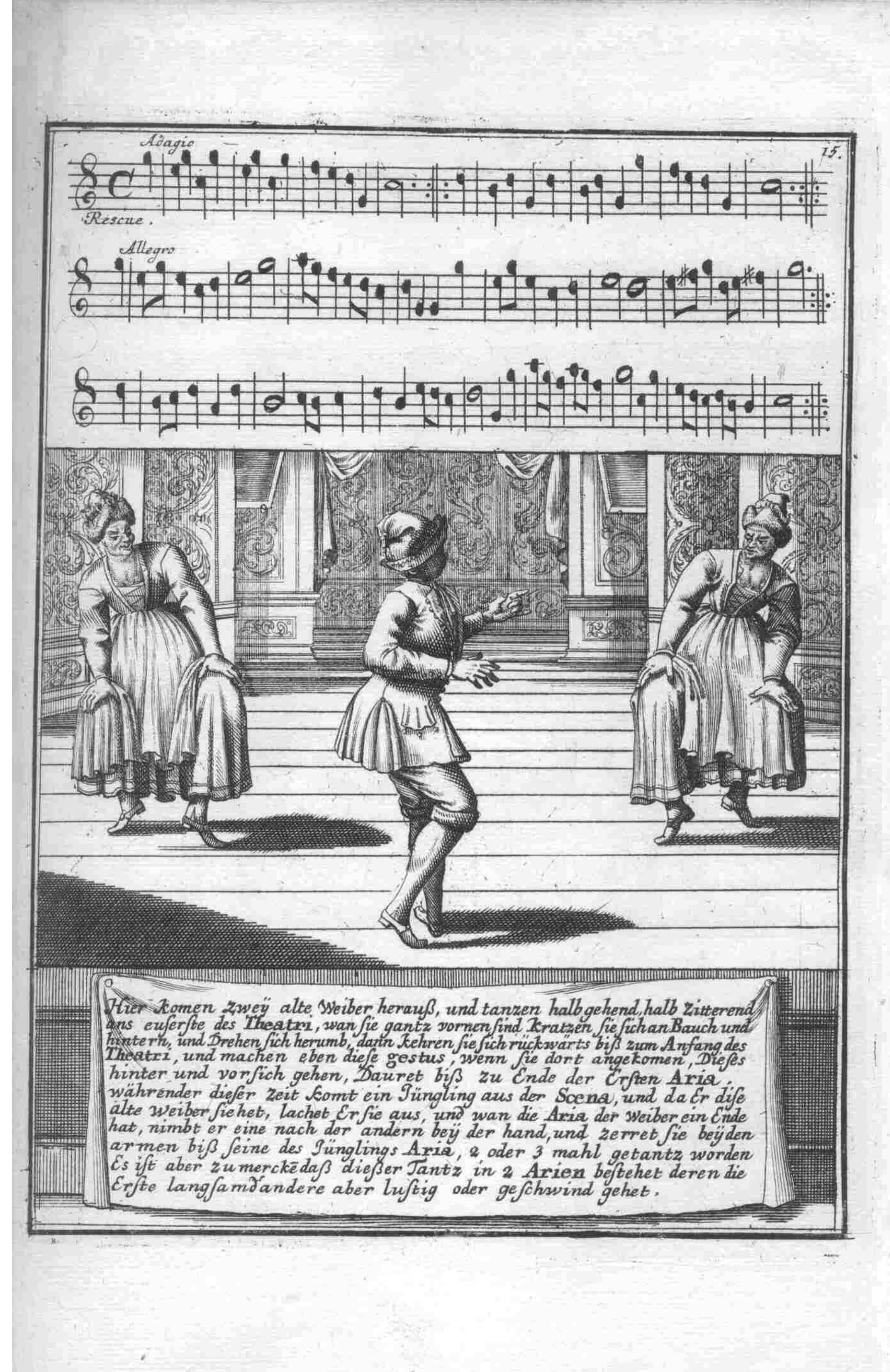
Lambranzi's *Scuola* is one of the most detailed surviving sources for how professional dancers actually moved and dressed in the early 18th century. This particular plate demonstrates the technical demands and aesthetic values of the period—the upright posture, turned-out legs, controlled arm positions, and expressive use of the upper body that defined theatrical excellence. For historians, this engraving is a rare visual and notational record of a specific choreographic text and performance tradition.
What you are looking at
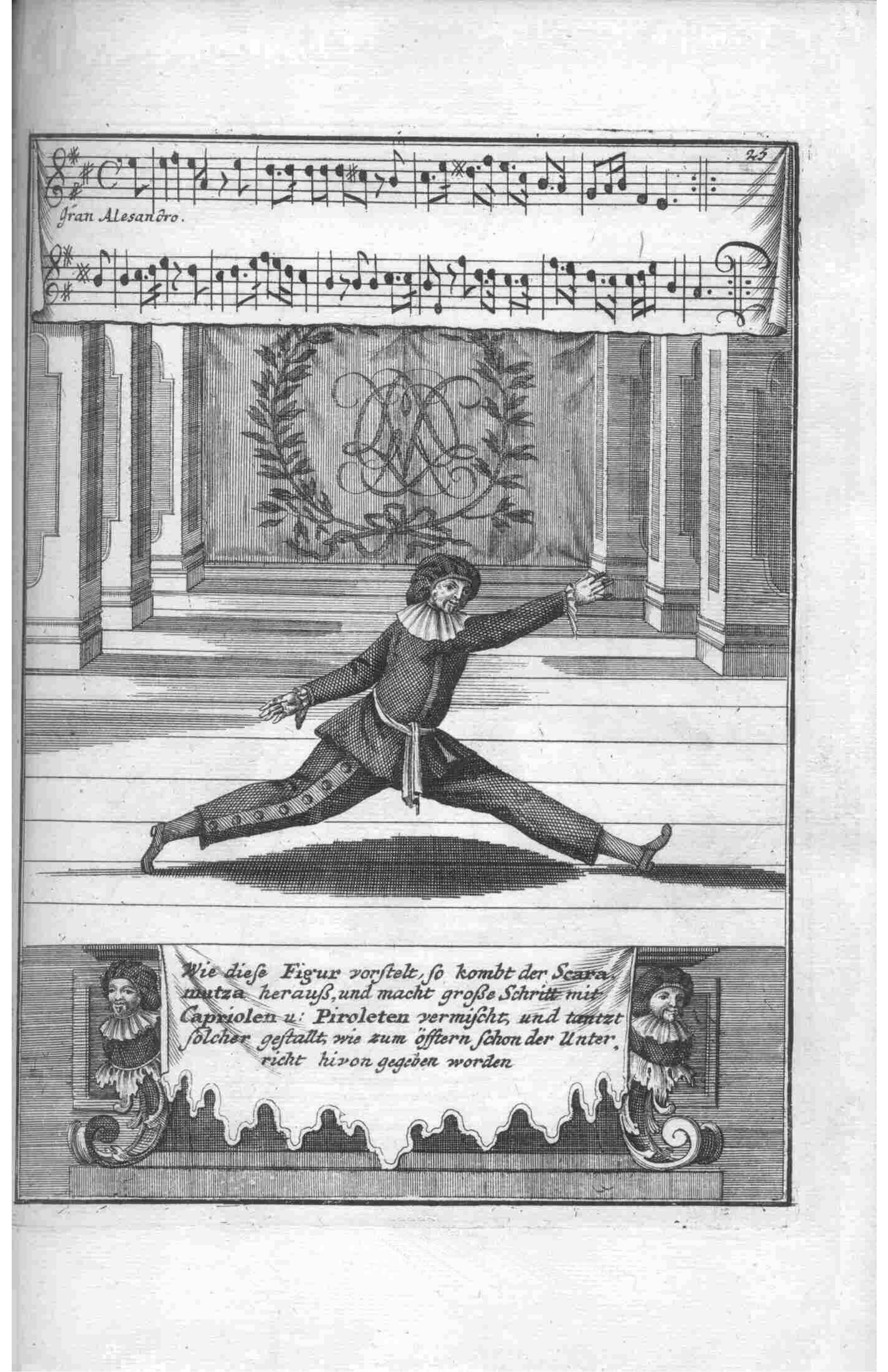
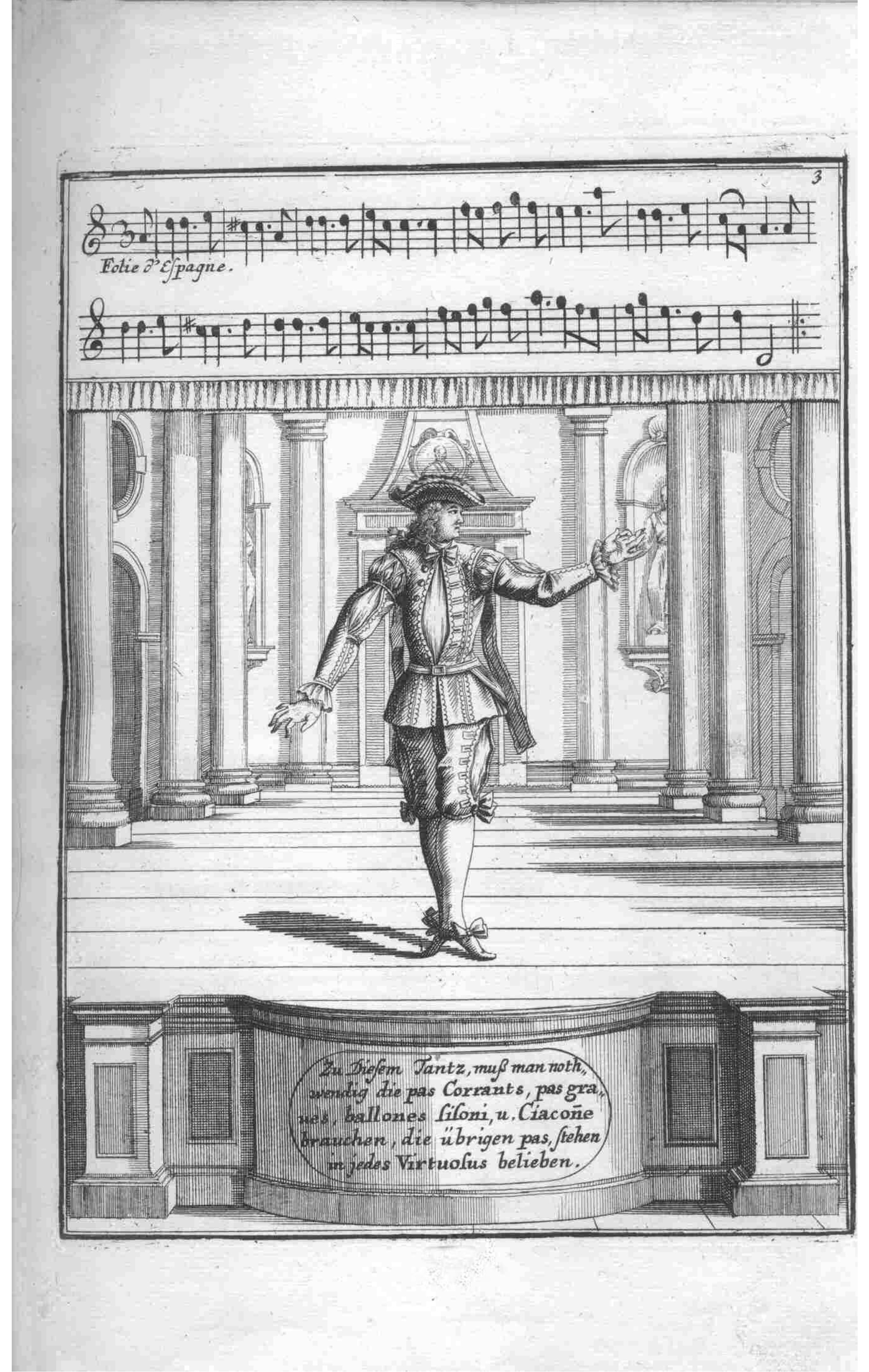
A male dancer in aristocratic theatrical costume stands mid-performance on a narrow stage framed by painted classical architecture. The backdrop shows a colonnade of fluted Corinthian columns receding in perspective, with arched openings and a distant figure visible through the central arch—a typical pastoral stage set of the early 18th century. The dancer wears a embroidered coat with decorative buttons, knee breeches, and heeled shoes; his posture is open and confident, one arm extended toward the viewer in an expressive gesture while the other is held near his body. A tricorn hat crowns his curled hair. Above the scene, two staves of musical notation labeled "Eclie 2d Espagne" provide the choreographic accompaniment; below, a German text in a cartouche addresses the technique and virtue required of the dancer. The engraving is delicate and precise, with fine parallel lines creating volume and shadow.
The dancing
A single male dancer occupies the stage in a three-quarter pose, weight shifted onto his back leg with the front leg extended in an open, demonstrative position. Both arms are raised and separated—one reaching toward the audience in an expressive arc, the other held at mid-body—suggesting a moment of rhetorical address or ornamental port de bras. His torso is upright and turned; his chin lifted. The stance and arm carriage are consonant with the turned-out, controlled aesthetic of 18th-century court and theatrical dancing, where extension and clarity of line were paramount.
The dance depicted
This is a theatrical dance of the early Baroque period, most likely a solo variation or entrée from a stage ballet or intermezzus performed in the German-speaking territories around 1716. The notation at the top—labeled "Eclie 2d Espagne" (perhaps "Éclair" or another variant)—connects the image to Lambranzi's dance notation system. The open, demonstrative arm positions and upright carriage align with the French technique that dominated European theatrical dance in this era. The caption emphasizes the virtue and skill required, suggesting this was aspirational material for professional dancers and a record of actual court or theatrical performance practice.
How it was made
This is a copper-plate engraving, a technique that allowed precise linear rendering and wide circulation in printed books. Lambranzi's manual paired musical notation with engraved images of dancers in costume performing on stage—an innovative documentary approach to capturing choreography and performance style. The engraving medium produced sharp detail and fine tonal gradation through cross-hatching, making it ideal for recording the subtleties of costume, musculature, and spatial composition. This work would have reached a European audience of dance masters, court patrons, and performers.
About this work
This plate from Gregorio Lambranzi's *Nuova e curiosa scuola de' balli theatrali* (1716) is both a technical manual and a visual archive of early 18th-century theatrical dance practice. It documents a male dancer executing an espagnole, a form of expressive character solo, in the highly formalized idiom of Baroque court and stage dancing. The coupling of musical score with costumed figure on an architectural stage set was Lambranzi's systematic method of recording choreography before the advent of modern notation systems. Each plate captured a moment of actual or idealized performance, making the book a window into how trained dancers moved, held their bodies, and interpreted music through gesture and carriage in the era of Baroque and early Rococo theater.
How to look at it
Notice the dancer's posture and carriage: despite the open, expressive arm gesture toward the viewer, his body remains perfectly aligned and controlled, with no trace of weight shifting or loss of balance. This is the hallmark of Baroque theatrical style—virtuosity expressed through clarity of line and stillness of torso, not through movement or momentum. The architectural setting and the formal stance suggest that this is a moment of display or rhetorical address, not transition between steps. The inscription below emphasizes that such skill requires virtue and constant practice, a reminder that this seemingly simple pose represents years of training and discipline.
The artist
Gregorio Lambranzi was an Italian dancing master and theorist active in the early 18th century, based in Nuremberg. His *Nuova e curiosa scuola de' balli theatrali* (New and Curious School of Theatrical Dances), published in 1716 with engravings by Lambranzi and others, was one of the first systematic attempts to document theatrical dance technique and choreography through notation and image. The work combined verbal instruction, musical notation, and precisely observed figure studies, reflecting Lambranzi's conviction that dance could be systematized and taught like other courtly accomplishments. The book circulated widely in German-speaking Europe and influenced dance pedagogy well into the 18th century.
The period
In 1716, European theatrical dance was in transition between the French Baroque style that had dominated the 17th century and the lighter, more playful Rococo aesthetic emerging in the 1730s–40s. Professional dancers trained in the French technique—characterized by turned-out legs, high elevation, and ornamental arm work—were performing in court ballets, theatrical intermezzos, and commercial stage productions across German, Italian, and French cities. At the same time, dance masters were beginning to document and codify their art through notation systems. Lambranzi's visual-notational approach was part of a broader Enlightenment impulse to systematize and preserve knowledge, including the performing arts.
Where it lives
This engraving is plate 2 from Gregorio Lambranzi's *Nuova e curiosa scuola de' balli theatrali* (Nuremberg: [publisher], 1716), a printed book of dance instruction and performance documentation. The Library of Congress holds a copy of this edition. Each plate in the work pairs a musical composition with an engraved figure of a dancer in theatrical costume.
Dance in this work
Questions about this work
How was this dance choreography recorded before modern notation?
Lambranzi's method combined three elements: a musical score at the top (representing the timing and phrasing), a precisely engraved image of a dancer in a characteristic pose or moment, and a written caption below. This visual-notational hybrid allowed dance masters to communicate both the music and the body position to trained dancers who could interpret the image and reconstruct the movement. The engravings thus served as memory aids and teaching tools rather than as complete step-by-step choreographic records.
What does 'Eclie 2d Espagne' mean?
The label likely refers to a specific dance type or movement sequence in Lambranzi's system—possibly an éclair (flash or sparkle) or a second variation of a Spanish-style character dance. 'Espagne' (Spain) suggests a national or character dance type, which were popular in theatrical performances of the era. The notation allows the reader to locate the corresponding music and movement instructions elsewhere in the manual.
Why is the dancer shown alone on an empty stage?
Solo dances and variations were a central feature of Baroque theatrical performance. Even when dancing occurred as part of an ensemble or dramatic narrative, professional dancers performed showpiece solos to display their skill and virtuosity. Lambranzi's single-figure format isolates the technique and body position for the reader's study, much like anatomical or figure-study plates in other instructional books.
What does the German text below say?
The caption in the cartouche addresses the technical and moral demands of the dance: the dancer must not skip the passacaille or other foundational step, and must follow the proper technique in order to be believed as a skilled and virtuous performer. This reflects the period's view of dance as a discipline requiring both physical mastery and moral seriousness.
More Notation/Choreography artwork