49 works in this view — arrow keys or swipe to move between them.
Dance in Art
Comic Character — Plate 6
Gregorio Lambranzi
- Medium:
- Copper-plate engraving
- Dance:
- Notation/Choreography
- Era:
- 1700s (Enlightenment/Minuet Era)
- Collection:
- Nuova e curiosa scuola de' balli theatrali (1716)
- Source:
- Library of Congress
- Rights:
- Public domain — free to use, share and adapt.
- Recorded as:
- Public Domain
This is one of the era's most important choreographic documents: Lambranzi's manual is one of the few comprehensive records of how theatrical dances were actually structured and performed in the early 18th century. For historians and dancers, it provides concrete evidence of technique, timing, costume, and spatial relationship that no written description alone could convey. For artists and scholars of visual culture, it exemplifies the early modern marriage of dance, music, and visual representation—the idea that a single page could transmit a complete performance to a skilled reader.
What you are looking at
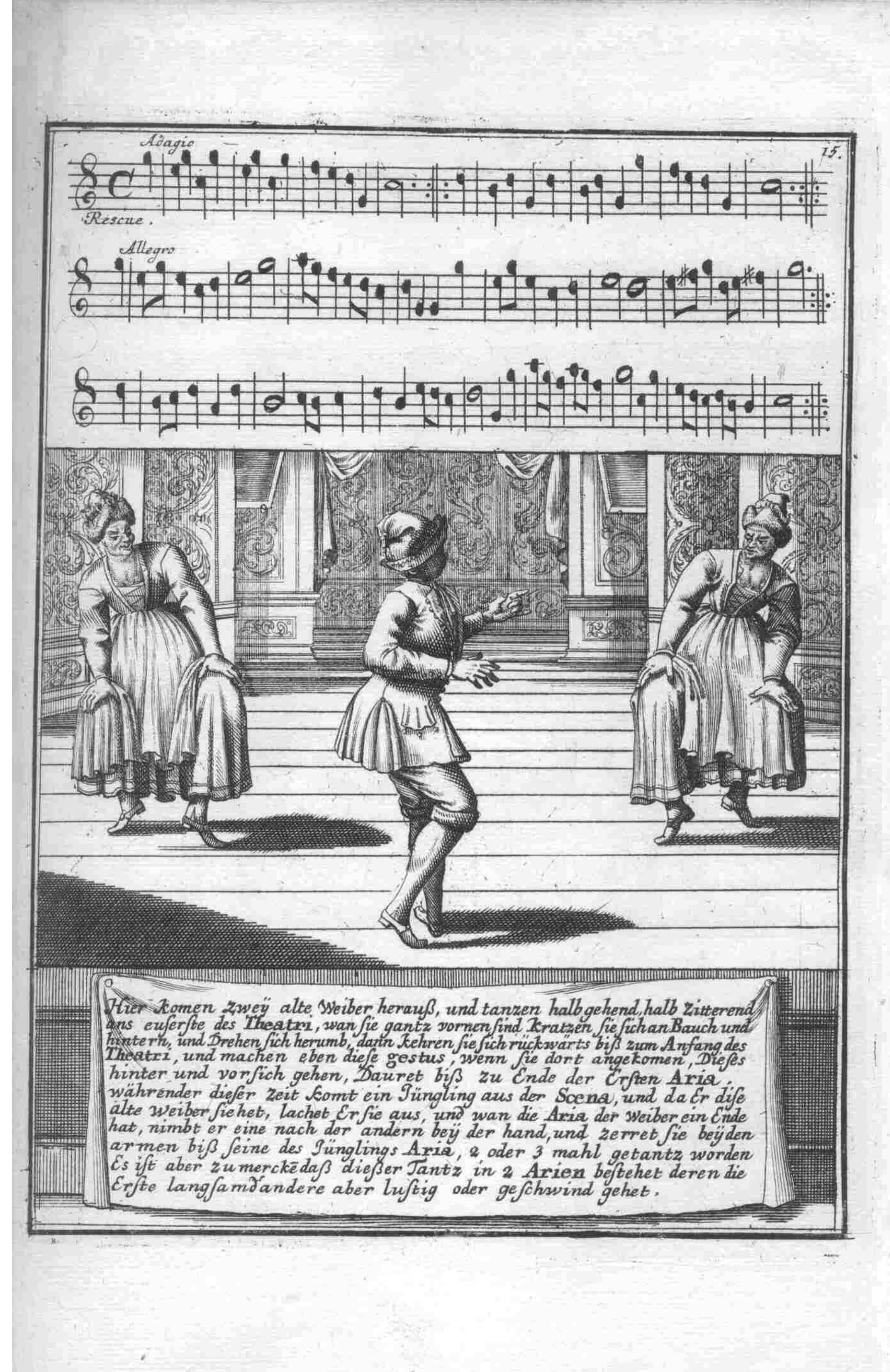
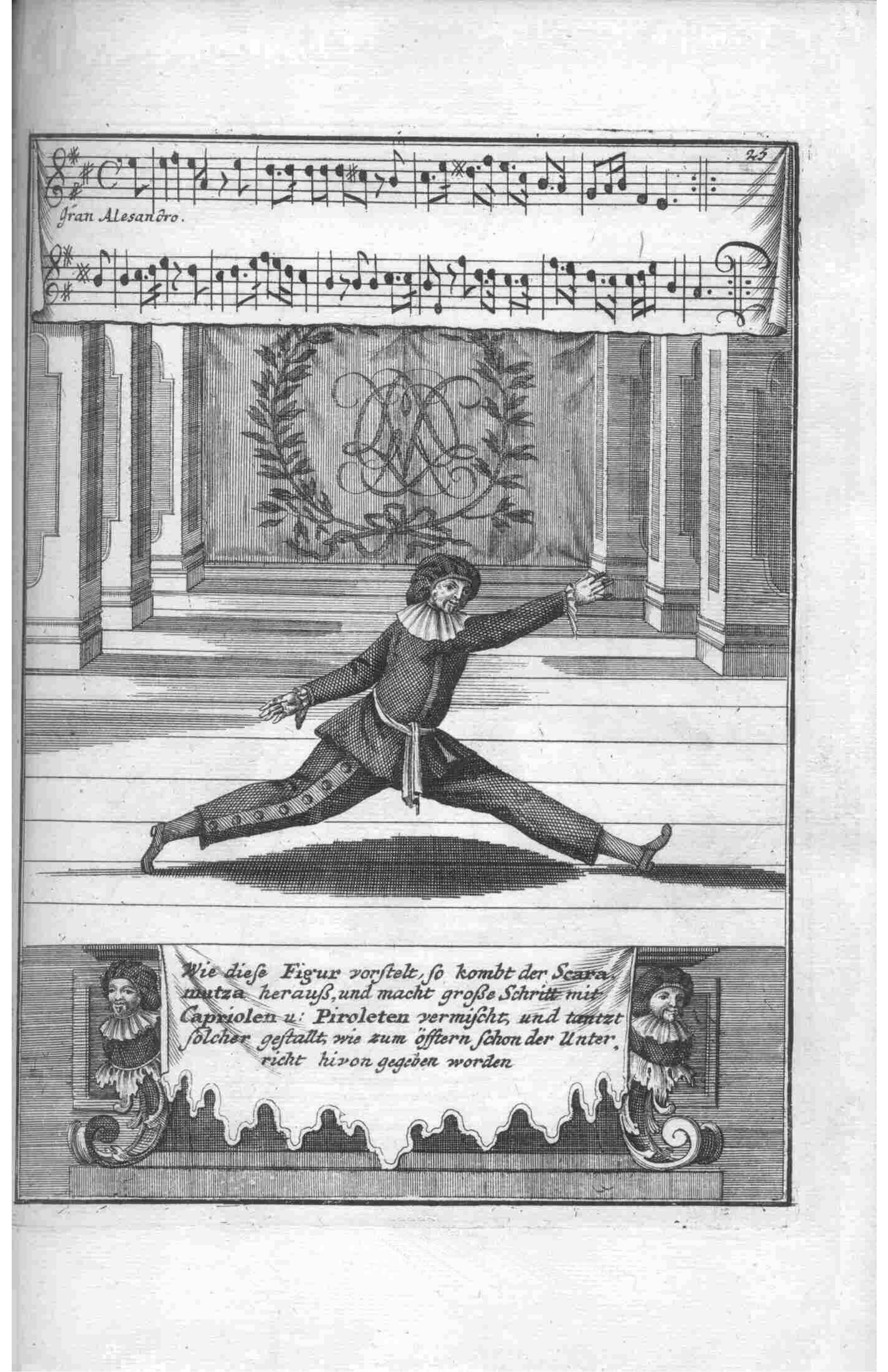
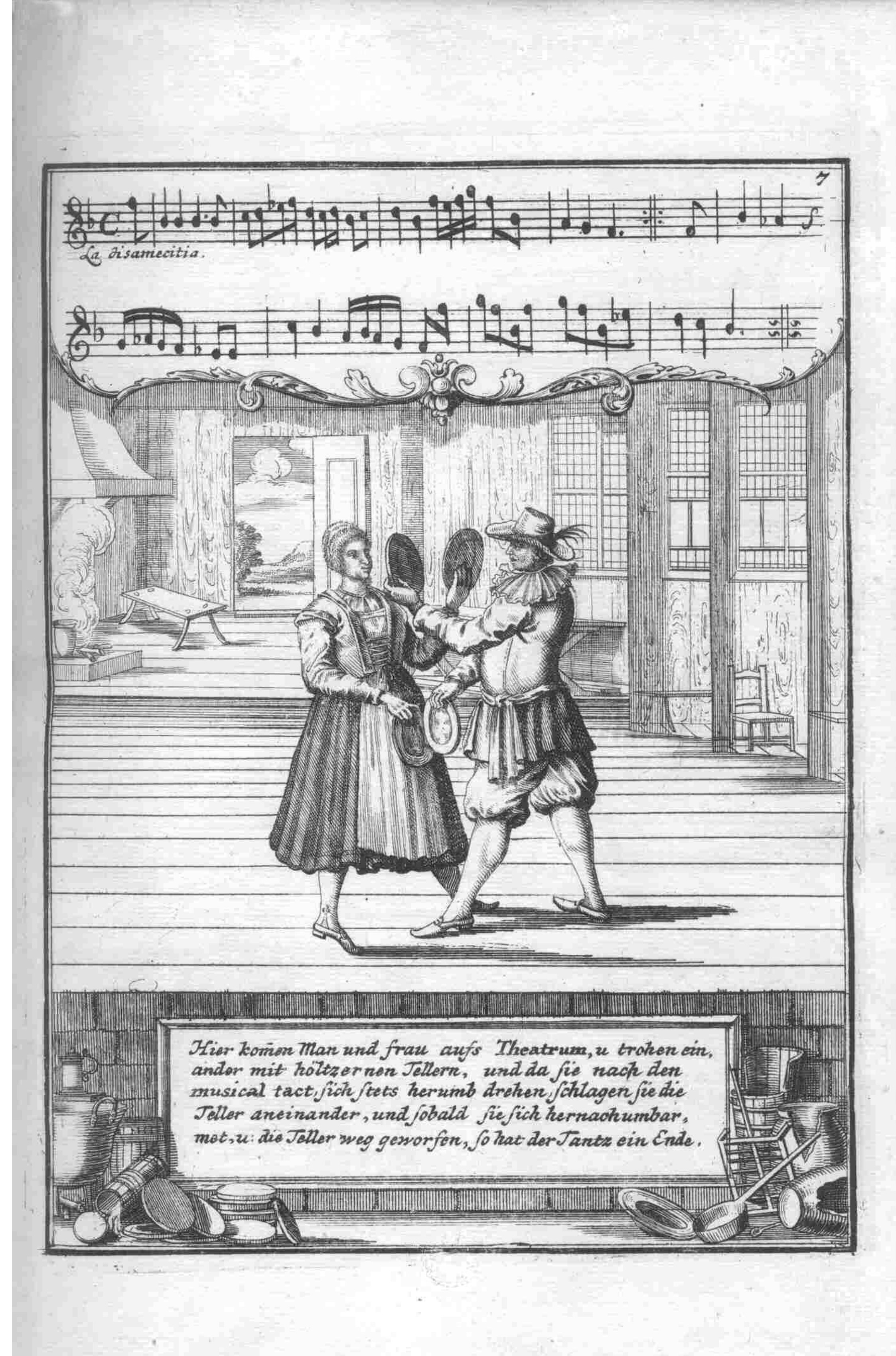
A man and woman are positioned in the center of a curtained theatrical stage. The woman, on the left, wears a long pleated dress with long sleeves and holds what appears to be a fan or small object in her hands; she stands in an upright, composed posture. The man, on the right, is costumed in a doublet with puffed sleeves, fitted breeches, and a feathered hat; he leans toward the woman in an exaggerated, theatrical gesture of courtship or mockery, his body bent at the waist in a comic bow or advance. The stage setting is elaborate: behind them, a painted backdrop shows a distant landscape with sky; to the sides, classical architectural elements—pilasters, draped curtains, and tall gridded windows—frame the performance space. The composition captures a moment of social interaction, likely comic or romantic, rendered in the formal theatrical vocabulary of early 18th-century stagecraft. Musical notation appears at the top of the page, indicating this is a choreographic record paired with its score.
The dancing
The woman maintains an upright frame with a formal, somewhat reserved bearing—her arms held at her sides or with hands engaged with a small prop, her posture vertical and stable. The man's body is sharply bent forward from the hips in a dramatic inclination, his weight shifted and his upper body angled toward his partner in a gesture that reads as courtship, solicitation, or comic pleading. Their spatial relationship suggests a dialogue in motion rather than a unified couple in a closed hold. The exaggeration of the man's gesture and the woman's restrained response suggest this is character dance or comic partnering rather than ballroom courtship.
The dance depicted
This is a theatrical character dance from the early 18th-century commedia dell'arte tradition, as indicated by the costuming, the comic gesture, and the stage setting. The image shows a moment of codified theatrical interaction—likely a formal suite of movement and counter-movement—rather than narrative action. The notation at the top indicates this is a step or choreographic phrase documented in a dance manual, suggesting that even comic character work in the theater was notated, taught, and preserved as a formal technique. The pair appears to be performing a dance of flirtation or conquest, with the man's exaggerated forward inclination and the woman's composed reception forming the structural opposition around which the choreography turns.
How it was made
This is a copper-plate engraving, printed as a page within a bound choreographic manual. The technique allows fine linear detail: the cross-hatching on fabrics and architectural surfaces creates depth and texture, while the crisp lines of the staff notation above remain legible and precise. The engraving was designed to be reproducible and widely distributed—this is a page from *Nuova e curiosa scuola de' balli theatrali*, published in Nuremberg in 1716, which would have served as a reference text for dance masters, actors, and choreographers across Europe. Each plate combines image and notation on a single page, making the work simultaneously a visual record and a readable score.
About this work
This page from Gregorio Lambranzi's influential dance manual documents a moment in early 18th-century theatrical dance: a character pair in a posed moment of comic courtship. The work is structured as a choreographic record—a marriage of musical notation, visual representation, and theatrical setting that preserved both the look and the sequence of fashionable stage dances for a professional and educated audience. It belongs in a gallery of dance in art because it is simultaneously a primary source for how dance was actually performed, a record of how dance was taught and transmitted, and a document of the aesthetic values of the Baroque theater—the balance of formal technique, narrative clarity, and comic expression that characterized theatrical dance before the rise of ballet as a dominant genre.
The image shows not just the dance but the entire apparatus of its documentation and circulation: the notated music, the described setting, the costumed figures, and the caption in German below all work together to transmit a complete and reproducible performance. This is how dance was preserved and shared before film or notation systems—through engraved pages that combined visual and musical information for a educated, mostly professional audience.
How to look at it
Notice the precision of the gesture: every element of the man's costume—the angle of his hat, the set of his shoulders, the bend of his knees—is rendered with equal attention, suggesting that all of these were part of the choreographed unit. The woman's stillness is equally deliberate; her composed bearing against his exaggeration is the essential opposition that structures the dance. Look at how the stage setting—the architecture, the drapery, the painted backdrop—frames both figures equally, making them part of a theatrical composition rather than a naturalistic moment. The musical notation at the top is not decorative; it is the actual score for the movement shown below, and reading the image with that notation in mind suggests how dance and music were understood as a single unified phenomenon.
The artist
Gregorio Lambranzi was a dance master and choreographer active in early 18th-century Europe. His *Nuova e curiosa scuola de' balli theatrali* (1716) is recognized as one of the most significant dance manuals of the period, documenting theatrical and social dances with a level of detail unusual for its time. The manual was published in Nuremberg and was widely circulated among dance professionals; it was later translated and reprinted, indicating its influence and authority. Lambranzi's work represents the professionalization of dance pedagogy in the early 18th century—the codification and notation of dances as reproducible techniques rather than improvised or loosely transmitted practices.
The period
The early 18th century was a moment of rapid systematization in dance. The minuet had emerged as the dominant courtly dance form; theatrical dance on the professional stage was increasingly dominated by French technique and Italian movement vocabulary, transmitted through court connections and professional touring. At the same time, commedia dell'arte remained a vital force in European theater, and character dances—comic, grotesque, or stylized versions of social dances—were a major part of theatrical performance. Lambranzi's manual captures this hybrid moment: it documents both courtly and theatrical forms, both social dances and character work, all within a single systematic framework. The coupling of notation and visual representation reflects the influence of French dance notation systems (Raoul-Auger Feuillet's notation, published in 1700, was the model), which had made dance teachable across distance and time.
Where it lives
This is a page from *Nuova e curiosa scuola de' balli theatrali* (Nuremberg, 1716), one of the most significant illustrated dance manuals of the early modern period. The work is held in the Library of Congress and has been digitized as part of their historical collections. As one of the plates in a systematic manual, this image was designed to be consulted, copied, and transmitted—it is a teaching document, not a unique artwork.
Dance in this work
Questions about this work
Is this a real dance or just a theatrical scene?
It is both. The page documents a theatrical character dance—a stylized, choreographed interaction between a comic male figure and a formal female figure, likely derived from commedia dell'arte. The musical notation and the systematic placement within a dance manual confirm that this is a reproducible, teachable choreographed sequence, not a spontaneous moment. But it is also a scene: the dance tells a narrative of courtship, seduction, or comic pursuit through the relationship between the two figures.
What does the German text at the bottom say?
The caption describes a moment in a theatrical scene where a man and woman, costumed with wooden sticks and masks or other properties, perform a dance after a musical signal, moving together with comic intent; the man's exaggerated gesture is the key element. (The exact translation would require a specialist in early 18th-century German, but the visual content makes the meaning clear.)
How is this dance different from what we see in ballet?
This is a character dance rooted in comedic theatrical tradition and commedia dell'arte, not in the technique of ballet. The movement vocabulary emphasizes gesture, expression, and relationship over the turned-out positions and lifted verticality of ballet. The man's bent-forward posture and exaggerated inclination would be foreign to classical ballet technique. This represents an older theatrical tradition that was being systematized and recorded just as ballet was beginning to establish itself as the dominant form.
Why are both the music and the dance shown together?
In the early 18th century, dance and music were inseparable—there was no choreography without music, and the steps themselves were often understood as visual equivalents of musical phrases. By showing notation and image together, Lambranzi's manual allowed a reader to understand both the timing and the shape of the movement simultaneously. This was the standard way of transmitting dance knowledge before film.
More Notation/Choreography artwork