46 works in this view — arrow keys or swipe to move between them.
Dance in Art
Dance Lesson — Plate 101
Gregorio Lambranzi
- Medium:
- Copper-plate engraving
- Dance:
- Notation/Choreography
- Era:
- 1700s (Enlightenment/Minuet Era)
- Collection:
- Nuova e curiosa scuola de' balli theatrali (1716)
- Source:
- Library of Congress
- Rights:
- Public domain — free to use, share and adapt.
- Recorded as:
- Public Domain
This image demonstrates how professional dance instruction was codified and standardized in print during the early 18th century, establishing the possibility of precise technical transmission across distance and time. For dancers and historians, it documents the exact form and teaching method of a foundational position before the codification of classical ballet technique, showing that formal turnout and upright posture were already central to theatrical training.
What you are looking at
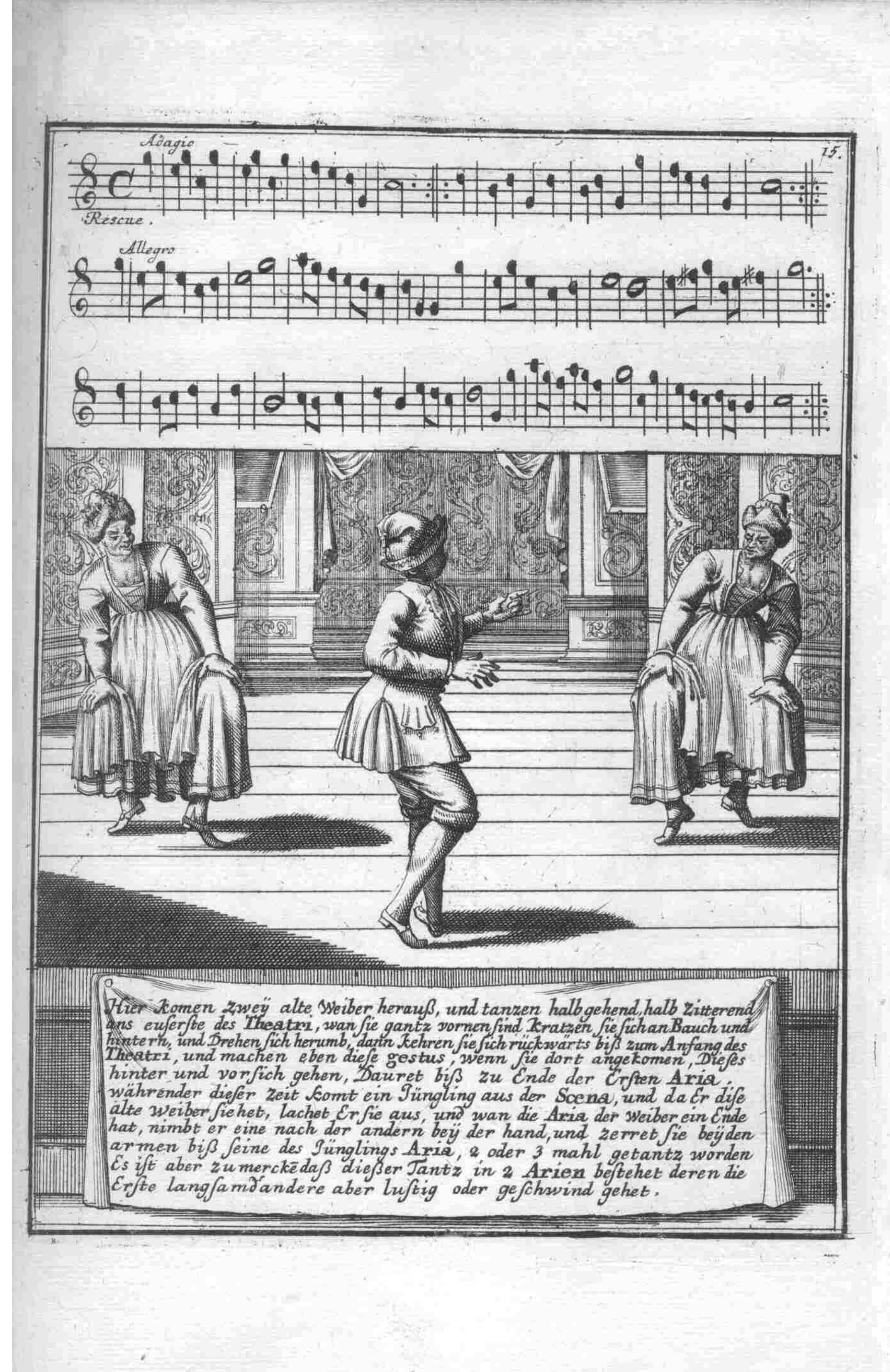
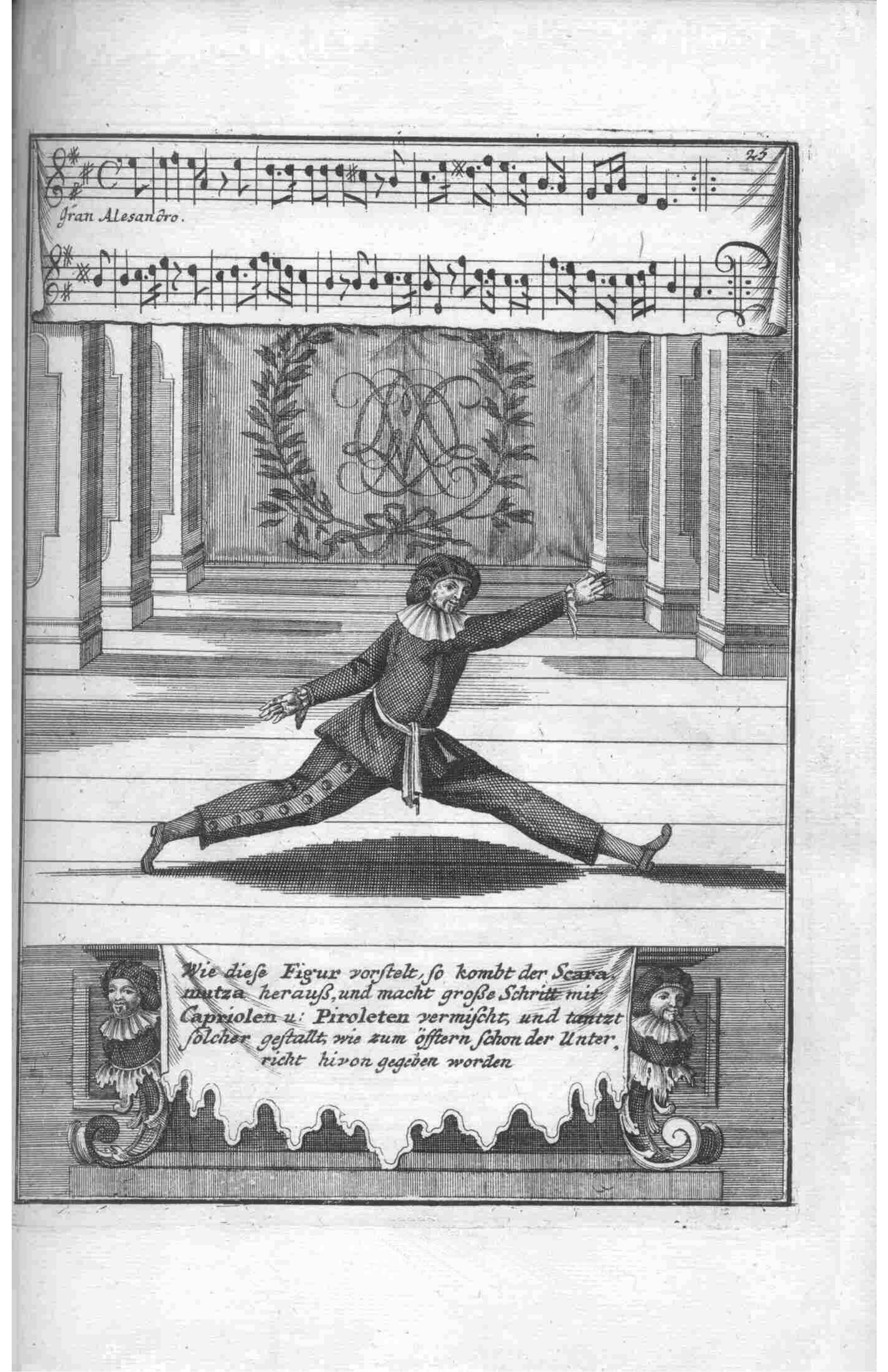
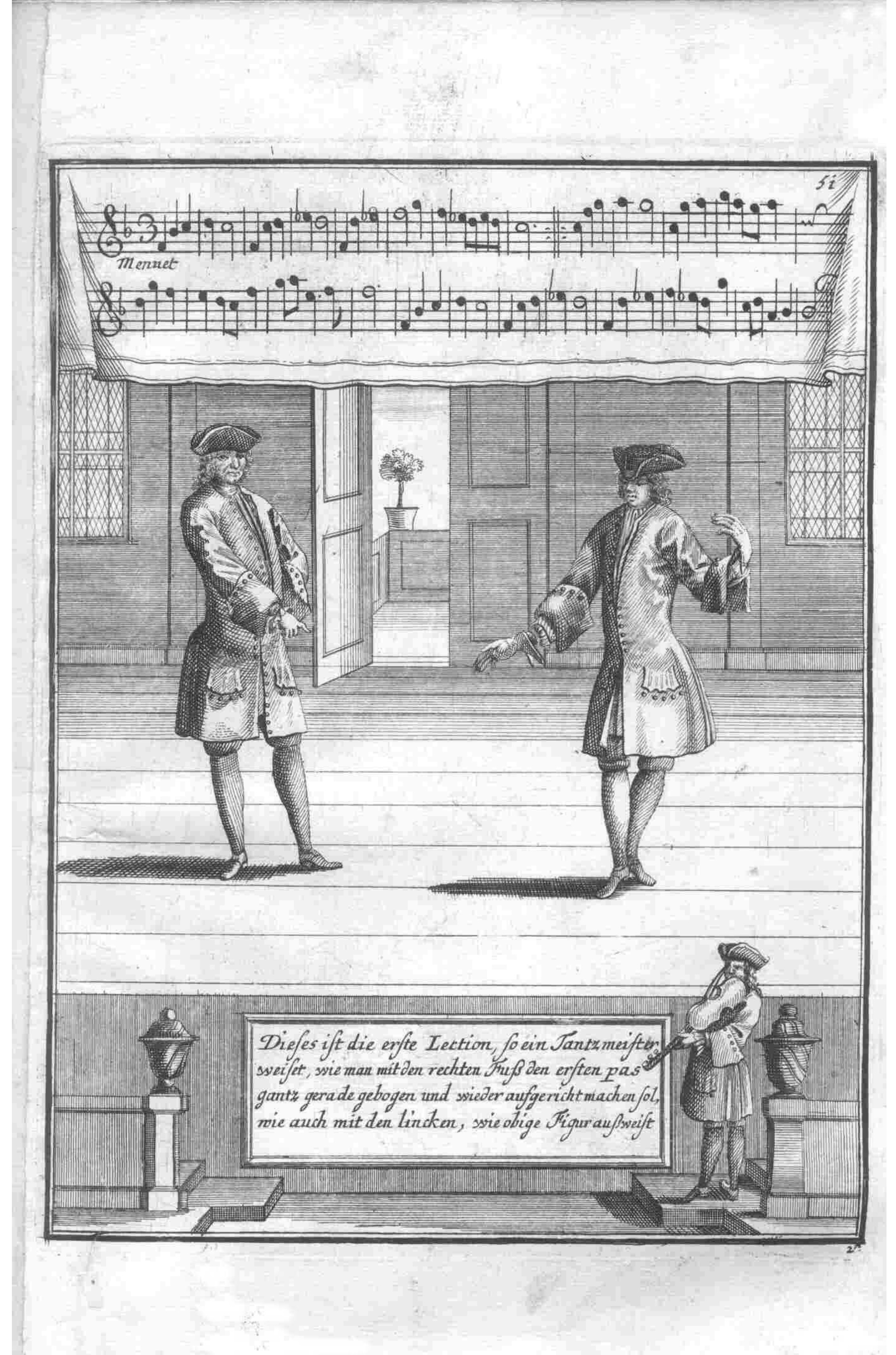
A dance master instructs a pupil in a theatrical interior with a patterned floor and classical columns. Two male figures in period dress—breeches, jackets, and tricorn hats—face each other in an enclosed stage space with draped curtains. The figure on the left stands in a relaxed posture, while the instructor on the right gestures with one arm extended, demonstrating or correcting the student's position. A potted plant sits on a pedestal in the background, visible through an open doorway. The engraving includes musical notation at the top—a minuet in two parts—and a German caption below identifying this as the first lesson in dance instruction, specifying that the student should stand with the right foot forward in first position and maintain proper posture with the left foot turned outward.
The dancing
Both figures stand upright in contrapposto, weight distributed to support formal court posture. The student's legs are relatively straight with feet turned outward; the instructor's right arm is raised in an explanatory gesture. Neither figure is in a dancing position but rather a teaching moment—the student receiving correction. The distance between them, approximately two feet, suggests an instructional relationship rather than partnered movement.
The dance depicted
This is a pedagogical image from a dance manual, not a depiction of dance performance. The caption explicitly identifies it as the *erste Lection* (first lesson) for a Tanzmeister (dance master). The lesson concerns first position and basic posture, fundamental to formal theatrical dance training in the early 18th century. This is teaching material rather than choreography—its purpose was to instruct students in the proper stance before any movement begins.
How it was made
A copper-plate engraving, a labor-intensive and expensive process that produced sharp, clear lines and fine detail. The precision of the engraving allowed reproduction of specific, teachable bodily positions and architectural setting. Engravings in this period circulated among dance professionals and educated audiences through printed books; this work's inclusion in a comprehensive manual (*Nuova e curiosa scuola*) meant it reached dance masters across Europe who could own, reference, and teach from it.
About this work
This is Plate 101 from Gregorio Lambranzi's 1716 *Nuova e curiosa scuola de' balli theatrali*, an illustrated dance manual published in Nuremberg that became one of the era's most influential handbooks for theatrical dance instruction. The plate pairs musical notation (a minuet) with a visual demonstration of the foundational first position, showing a dance master correcting a student's stance. The work belongs to a tradition of printed dance pedagogy that made professional technique reproducible and distributable, transforming dance from an oral tradition to one that could be studied from books.
Lambranzi's manual was designed for dance professionals—masters, performers, and serious students—rather than casual dancers. Each of its 101 plates presents a step, position, or figure with accompanying music and engraved figure, making it a technical encyclopedia of early 18th-century theatrical dance vocabulary.
How to look at it
Notice that the artist has chosen a teaching moment, not a dancing moment—the student is being corrected, not executing a step. The raised arm of the instructor is a pedagogical gesture, drawing attention to proper form. The symmetry of the composition and the stillness of both figures emphasize clarity over action; the goal is to make the position legible to a reader studying the manual. The open posture and formal stance, emphasized by the regular floor and architectural framing, make the body's alignment the subject of the image rather than its motion.
The artist
Gregorio Lambranzi (fl. early 18th century) was a Nuremberg-based dance master and author. His *Nuova e curiosa scuola de' balli theatrali* (New and Curious School of Theatrical Dances), first published in Nuremberg in 1716 with engravings by an unnamed artist or artists, became the most comprehensive and widely circulated dance manual of its time. The work combines Lambranzi's knowledge as a performer and instructor with the visual precision of copper-plate engraving, creating a hybrid object—part instruction book, part reference work, part performance manual. German and Italian editions circulated; the work was eventually translated and reprinted in other languages, establishing Lambranzi as a major figure in the professionalization of dance pedagogy.
The period
This was created during the height of the Baroque court dance era, when minuet, French dances, and Italian balli dominated aristocratic and theatrical practice. By 1716, formal dance technique was increasingly specialized: court dances and theatrical dances were distinct practices, both requiring professional instruction and precise bodily discipline. The publication of comprehensive manuals like Lambranzi's reflects a broader shift toward systematizing and recording dance knowledge rather than relying entirely on oral transmission from master to student. Dance was professionalizing, becoming a subject of theoretical and technical writing, and engraving technology made it possible to freeze and distribute specific positions and movements across Europe. This was also the period when dance notation systems (like Beauchamp-Feuillet notation, which would appear in the same publication) were being refined to allow even greater precision in recording choreography.
Where it lives
This plate is from the 1716 Nuremberg edition of *Nuova e curiosa scuola de' balli theatrali*, held in the Library of Congress. The work was published as a bound manual and circulated among dance professionals, teachers, and patrons of dance; individual plates were sometimes extracted, framed, and used as teaching aids.
Dance in this work
Questions about this work
What is first position?
First position, shown here, involves standing with feet turned outward (turned out) and heels together or nearly together. The body is upright and the weight is balanced. This is the foundational stance for formal theatrical dance in the European tradition and remains the basis of ballet technique today. Lambranzi's manual teaches that this position must be learned and maintained before any step or movement is possible.
Why is a dance manual engraved?
Engraving was the finest reproductive technology available in 1716. It allowed the artist to render precise details of posture, dress, and setting with sharp lines that remained clear through multiple printings. A student or teacher could purchase the bound manual and refer to it repeatedly. Engraving was expensive, making the manual a luxury item for professionals, but it was cheaper than hiring a master to travel.
Is this a minuet?
The music notation at the top is a minuet, the style of music that accompanied this position and figures in the lesson. The minuet was the most prestigious social and theatrical dance of the Baroque era. However, this plate specifically shows the foundational posture before any minuet step begins—the student must master standing still before dancing.
Who was Gregorio Lambranzi?
Lambranzi was an early 18th-century Nuremberg dance master whose 1716 manual became the most comprehensive printed guide to theatrical and social dance of the Baroque era. Very little is known of his biography, but his manual's influence was vast; it was reprinted, translated, and cited by later dance masters across Europe. He represents the moment when dance technique began to be codified in print.
More Notation/Choreography artwork