45 works in this view — arrow keys or swipe to move between them.
Dance in Art
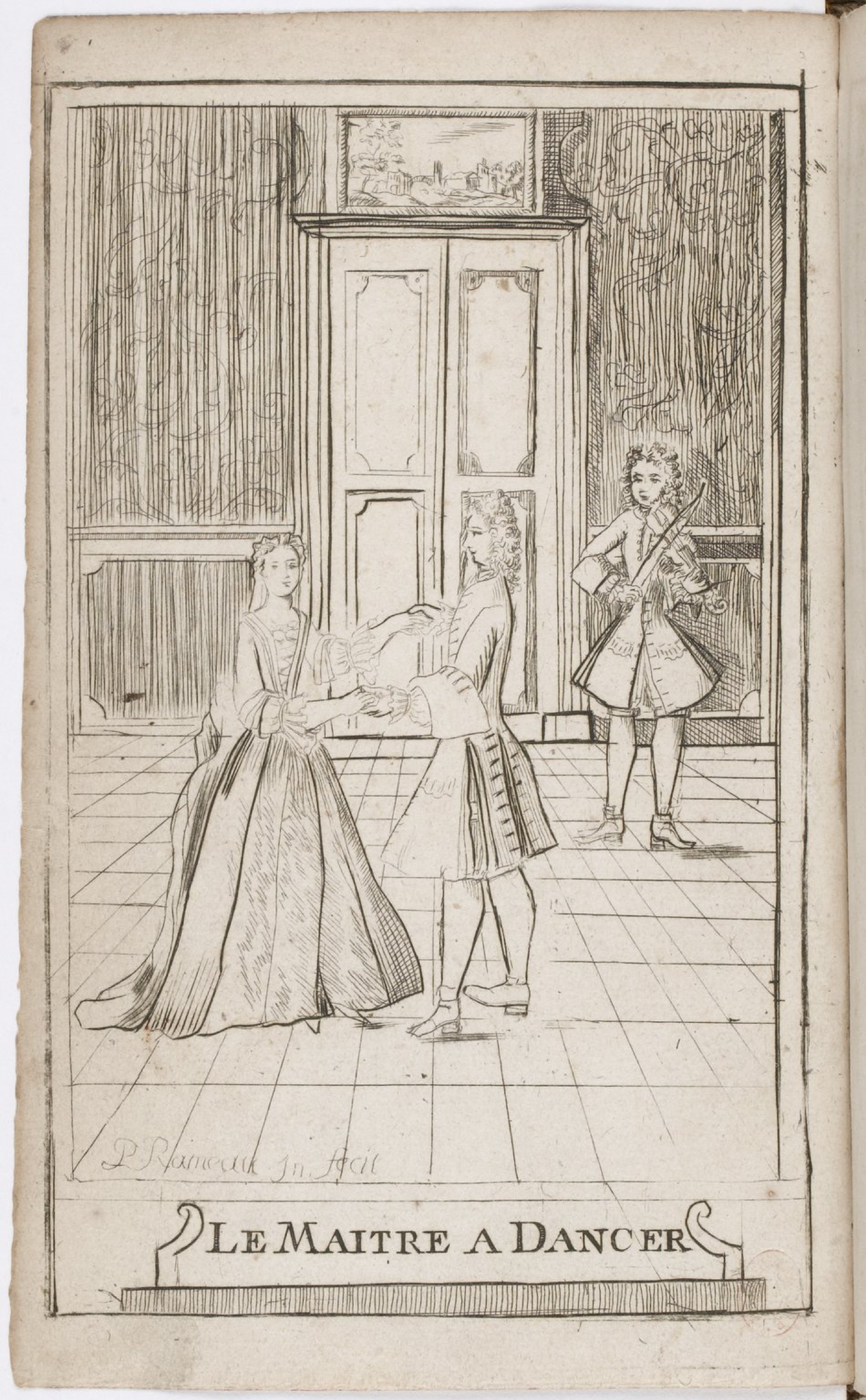
Frontispiece
Pierre Rameau
- Medium:
- Engraving
- Dance:
- Notation/Choreography
- Era:
- 1700s (Enlightenment/Minuet Era)
- Collection:
- Le Maître à danser (1725)
- Source:
- Library of Congress
- Rights:
- Public domain — free to use, share and adapt.
- Recorded as:
- Public Domain
This is primary visual evidence for how French Baroque dance technique was understood and taught at the moment the written notation system was being codified. The posture and bearing shown here became the standard against which all European courtly dance was measured for the next 75 years. For historians and dancers, the image is invaluable: it shows not how people danced in performance, but how they were trained to move, making it a rare window into the pedagogical practices behind one of the most influential dance styles in Western history.
What you are looking at
A formal interior of a townhouse or palace, with tall paneled walls and a coffered ceiling. Three figures occupy a polished parquet floor: a woman in a full-skirted gown sits or reclines on the left, her posture graceful and composed; a man in breeches, coat, and heeled shoes faces her in the center, holding what appears to be a scroll or document; a third figure, a young man in fashionable dress with curled hair, stands to the right in an attitude of observation or instruction. A doorway with six panels and a landscape painting above it punctuates the wall behind them. The engraving is finished with fine parallel hatching that models form and suggests the quality of light in an interior space. The scene reads as a moment of instruction or demonstration—the title *Le Maître à danser* (The Dancing Master) confirms this is a teaching scene, with the standing figure likely the master and the seated or posed figures his pupils.
The dancing
The male figure in the center displays an upright, elegant posture with weight forward on one leg in a stance that suggests a balletic first or fifth position. His arm extends with control; the other rests at his side with studied composure. The woman's pose is receptive rather than active—she is positioned to receive or observe instruction. The standing young man on the right adopts a confident contrapposto, one leg bent, weight shifted, suggesting a moment of ease between instruction. All three carry themselves with the deliberate formality of courtly deportment: shoulders back, head erect, movement economical and controlled. The spatial arrangement—master distinct from pupils, attention directed toward demonstration—is pedagogical.
The dance depicted
This is French Baroque court dance of the early 18th century, most likely the minuet or a related courtly form, depicted as a teaching moment rather than a performance. The postures and proportions align with Rameau's own treatise on technique: upright carriage, turned-out legs, precise arm placement, and the elegant bearing required for court dancing in this period. The image documents not a moment of dancing itself but the instruction of dancing, making it a rare visual record of how technique was transmitted. Rameau's *Le Maître à danser* (Paris, 1725) is one of the two most important pedagogical sources for French Baroque dance technique, and this frontispiece serves as a visual definition of the correct male dancer's bearing and posture.
How it was made
This is an engraving—a intaglio print made by incising lines into a copper plate and inking the recessed lines. The technique allows for fine detail and precise linear control, visible here in the rendering of fabric texture, architectural perspective, and facial features. Engravings were the primary medium for illustrated dance treatises in this period: they were durable, could be produced in multiple copies from a single plate, and the linear nature of the medium suits the anatomical instruction that the image conveys. As a book illustration—the frontispiece to a widely circulated pedagogical text—this work was seen by anyone who purchased or consulted Rameau's treatise, making it one of the most influential dance images of the era.
About this work
This frontispiece from Pierre Rameau's foundational dance treatise *Le Maître à danser* (Paris, 1725) depicts a formal lesson in French Baroque courtly dance. The image presents an idealized vision of instruction: a composed male dancer demonstrates correct posture and bearing while a female pupil and a young male observer attend. The engraving is not a snapshot of actual movement but a prescriptive image—a visual definition of the correct dancer's body, carriage, and comportment in the style that dominated European courts in the early 18th century. Rameau's treatise was one of two canonical written sources for Baroque dance technique (alongside Feuillet's *Chorégraphie*), and this image circulated as a model of excellence throughout the century.
How to look at it
Attend to the posture of the central male figure: the turned-out stance, the lifted carriage of the torso, the placement of the arms. These details were the subject of pages of written description in Rameau's text; here they are shown in a single image. Notice the scene of instruction itself—the arrangement of bodies, the role of the standing master, the attentive positioning of the pupils. This is not a moment of dance, but a moment of teaching, which is itself the subject of the image. The formal interior and the composed expressions reinforce the seriousness and dignity of the activity: this is not entertainment but education in the embodiment of courtly identity.
The artist
Pierre Rameau (fl. 1725) was a Parisian dancing master and author of *Le Maître à danser*, one of the two canonical treatises on French Baroque technique. Unlike Raoul-Auger Feuillet, whose *Chorégraphie* (1700) introduced a systematic notation for recording dances, Rameau focused on technique, posture, and the principles of movement. His treatise was illustrated with engravings that became visual standards for courtly bearing. Rameau's work circulated widely and was translated and adapted across Europe, making him a significant (if often uncredited) influence on the codification of Baroque dance technique. Little is known of his life beyond his role as a dance master and author.
The period
The *Le Maître à danser* was published in 1725, at a moment when French Baroque dance was at the height of its formal refinement. The preceding decades had seen the establishment of the Académie Royale de Danse (1661) and the development of Feuillet's notation system (1700), which allowed dances to be recorded and transmitted as written texts. Rameau's treatise appeared in this context of systematization: it offered written principles and visual models for the technique that underlay the notated dances. In painting and printmaking, this was the Rococo period in France—a moment of elegance, refinement, and attention to the details of courtly life. The engraved illustration was the dominant medium for technical instruction and artistic reproduction, and Rameau's treatise belongs to a rich tradition of didactic prints and books on dance, fencing, and deportment aimed at the aristocracy and merchant classes.
Where it lives
This is the frontispiece to Pierre Rameau's *Le Maître à danser*, published in Paris in 1725. The work is held in the Library of Congress. As a printed book illustration, it would have circulated in every copy of the treatise produced, making it one of the most widely seen dance images of the 18th century.
Dance in this work
Questions about this work
Is this showing an actual dance or a pose?
Neither, strictly. The image shows a moment of instruction—a dancing master demonstrating correct posture and bearing to pupils. It is a pedagogical image rather than a performance scene. The postures shown are the foundation for all the dances in Rameau's treatise, but the image itself documents how dancers were trained, not how they danced in a ball or theater.
What is the scroll the man is holding?
It is likely a diagram or notation—a reference to the written or graphic transmission of choreographic knowledge. Feuillet's notation system, which had been published 25 years earlier, used graphs to record dances. The scroll may allude to this, suggesting that the master's knowledge is not only embodied but written and transmissible.
Why is this image important to dance history?
Rameau's *Le Maître à danser* is one of the two most authoritative written sources on French Baroque dance technique (the other being Feuillet's *Chorégraphie*). This frontispiece was the visual definition of correct Baroque posture and deportment for the entire 18th century and beyond. It shows not how dances looked in performance, but the fundamental technique and carriage that underlay them—invaluable evidence for modern reconstruction and understanding.
What do the clothes tell us about the style?
The heeled shoes, the turn-out of the legs, the lifted chest, and the formal posture all point to French Baroque court dance. The woman's full skirt and the man's knee breeches and coat are consistent with early 18th-century aristocratic dress. The formality of the clothing reinforces the gravity and refinement of the dance practice being depicted.
More Notation/Choreography artwork