44 works in this view — arrow keys or swipe to move between them.
Dance in Art
The Court Ballroom
Pierre Rameau
- Medium:
- Engraving
- Dance:
- Notation/Choreography
- Era:
- 1700s (Enlightenment/Minuet Era)
- Collection:
- Le Maître à danser (1725)
- Source:
- Library of Congress
- Rights:
- Public domain — free to use, share and adapt.
- Recorded as:
- Public Domain
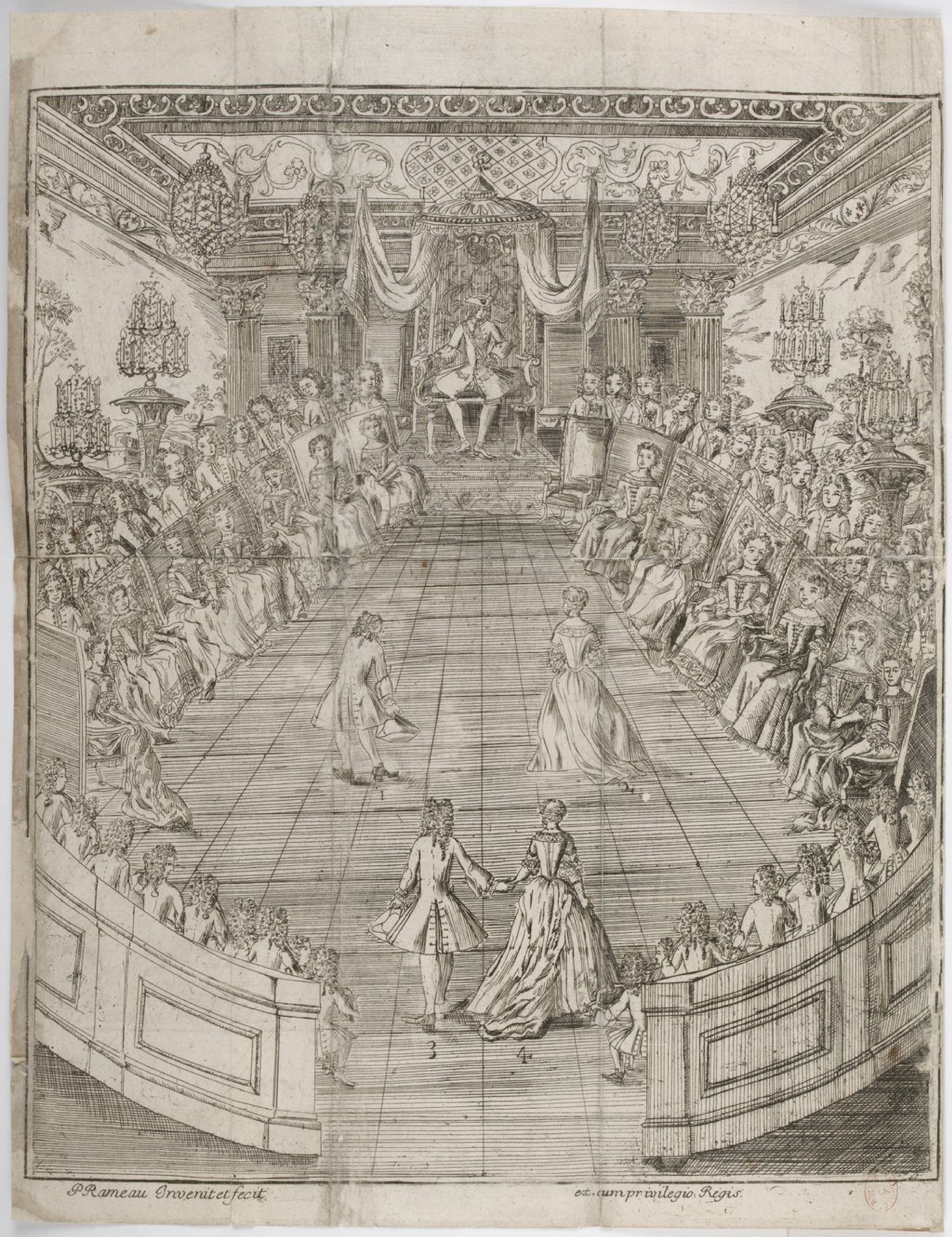
This is one of the earliest and most authoritative visual documents of how French Baroque court dance actually looked in practice and functioned socially. For dancers learning the minuet or studying period movement, it is primary evidence of posture, spacing, costume, and the ceremonial frame within which the dance took place. For historians, it is proof that court dance was a ranked, observational ritual as much as a performed skill.
What you are looking at
A formal court ballroom under a richly decorated barrel vault ceiling with ornamental plasterwork, tasseled swags, and hanging garlands. The floor recedes in perspective, lined on both sides with spectators seated on tiered benches arranged in strict hierarchical order—nobles and courtiers in elaborate dress, wigs, and jewels. In the foreground, a young couple in the center of the empty floor face each other in preparation or mid-performance: the man in a coat and breeches, the woman in a full-skirted gown with train. Behind them, advancing toward the dance floor, a second couple (identifiable as the host and hostess by their prominent placement) are about to begin their turn. At the far end, an elevated throne or dais is visible with attendants. The entire composition emphasizes the social ritual of the court dance: performance, observation, and rank.
The dancing
The dancing couple stands in an upright, formal carriage with arms and legs arranged in the geometric clarity of French Baroque technique. The man's posture is erect; the woman's torso is lifted, her skirts arranged to show the line of her legs and feet. Both figures exhibit the turnout and controlled placement characteristic of the period. Their positioning suggests the opening moment of a dance or a pause within one—the geometry is more important than momentum. The spectators maintain rigid, attentive postures, framing the dancers as the sole focus of the room.
The dance depicted
This engraving depicts a formal French court minuet or similar haute danse of the early 18th century, the social and aesthetic apex of Baroque ballroom culture. The minuet was the defining dance of Louis XIV and Louis XV courts, performed by nobility as both artistic display and social ritual. The image shows the dance as a theatrical performance within a social ceremony: two couples take turns occupying the center floor while the rest of the court observes in ranked order. The gestural restraint, upright carriage, and emphasis on geometric precision over dynamic movement are all consistent with Rameau's documented teaching. This is dance as courtship, status display, and display of training.
How it was made
The work is an engraving—a line-based print made by incising an image into a metal plate (copper or steel) and printing from the raised lines. The fine parallel hatching visible throughout (especially in the floor, ceiling, and fabric textures) is characteristic of engraving technique. This method allowed for precise, detailed reproduction at scale and was the standard vehicle for architectural and instructional illustration in the 18th century. The engraving's circulation in Rameau's *Le Maître à danser* means this image reached dancing masters, nobility, and serious students of dance across Europe—it was not a luxury unique print but an educational tool.
About this work
This engraving from Pierre Rameau's foundational dance treatise *Le Maître à danser* (1725) is a schematic representation of court ballroom protocol at the height of French Baroque culture. It documents not a single dance in motion but the entire social architecture within which the minuet and other haute danses were performed: the geometry of the space, the hierarchy of seating, the alternation of performers and audience, and the formal carriage and dress expected of noble dancers. Rameau's treatise was the first comprehensive written and illustrated system of French Baroque technique and remained influential for over a century. This plate is one of its most famous images, recognized immediately by historians as a definition of Enlightenment courtly dance.
The work sits at the intersection of dance history, social history, and art history. It shows dance not as a performer's private skill but as a public, ranked, and carefully prescribed social ritual. The engraving's precision and clarity made it reproducible and teachable—Rameau's point was to standardize and transmit technique, not to capture spontaneity.
How to look at it
Look first at the empty floor: the artist has chosen to show the moment just before or just after the active dance, when two figures stand in formal stillness while the court observes. This is not the height of movement but the moment of display and control. The perspective receding toward the throne emphasizes the ballroom as architecture as much as dance space. The ranked seating on both sides tells you that this was not a participatory group dance but a series of individual couples performing for an watching aristocracy. Notice the woman's skirts: they are full and arranged to be seen, not hindering the footwork but displaying it. The man's posture is erect and weight-centered, not leaning or lunging—this is restraint as a sign of training and status.
The artist
Pierre Rameau (c. 1674–after 1748) was a French dancing master and the author of *Le Maître à danser*, the most comprehensive and influential written treatise on French Baroque dance technique published in the early 18th century. He systematized the five positions of the feet, described port de bras (carriage of the arms), and codified the steps and rhythms of the minuet, courante, sarabande, and other dances. His treatise was translated into German and English and informed dance pedagogy for decades. Rameau was not primarily an artist or engraver; the illustrations in his book were produced by professional engravers working from his specifications. The plates were designed to be instructional and repeatable, not unique or precious.
The period
The early 18th century was the zenith of French court culture under Louis XV and the dominance of the minuet as the defining social dance of European nobility. The minuet had emerged in the late 17th century and by 1725 was the required accomplishment of any aristocrat. Dance was central to court life and to the education of noble children. At the same time, Enlightenment values of rational analysis and systematic instruction were reshaping how dance was taught and documented. Rameau's treatise appeared in this moment when dance was becoming a subject of written pedagogy and visual analysis rather than an oral tradition passed from master to pupil. The engraving medium itself—precise, reproducible, and suited to technical illustration—reflects the period's investment in codification and dissemination of knowledge.
Where it lives
This engraving is plate from *Le Maître à danser*, Pierre Rameau's treatise published in Paris in 1725. It is held in the Library of Congress collection (among other holding institutions). The work was a printed book, widely distributed, and this particular engraving is one of the most frequently reproduced plates from the treatise in dance historical scholarship.
Dance in this work
Questions about this work
Is this a real ballroom or a diagram?
It is a schematic representation designed to show the protocol and spatial arrangement of a court ball, not a record of a specific event. The perspective and proportions are exaggerated for clarity, and the level of detail (in the ceiling, the rank of spectators) is didactic rather than documentary. Rameau is teaching the reader how a court dance was structured and performed.
What dance is being performed?
The image does not depict a single identifiable dance in progress, but rather the formal setting and moment of performance typical of the minuet and other haute danses of the period. The postures and dress are consistent with Rameau's codified technique. The minuet was the dominant court dance of 1725.
Why are the spectators ranked and seated?
Court dancing was not democratic. Rank, precedence, and the order of performance were determined by social status. The spectators' seating arrangement reflects this hierarchy and emphasizes that court dance was as much about displaying status as about performing steps. Watching the dance was itself a ranked activity.
How was Rameau's book used?
It was the standard text for dance masters teaching aristocratic pupils across Europe. Students and teachers consulted the engraved plates to learn the positions of the feet, the carriage of the arms, and the arrangement of the dance floor. The book was both a technical manual and a guide to the social meaning and ceremony of court dance.
More Notation/Choreography artwork