42 works in this view — arrow keys or swipe to move between them.
Dance in Art
The Dancing Master and his Student
Pierre Rameau
- Medium:
- Engraving
- Dance:
- Notation/Choreography
- Era:
- 1700s (Enlightenment/Minuet Era)
- Collection:
- Le Maître à danser (1725)
- Source:
- Library of Congress
- Rights:
- Public domain — free to use, share and adapt.
- Recorded as:
- Public Domain
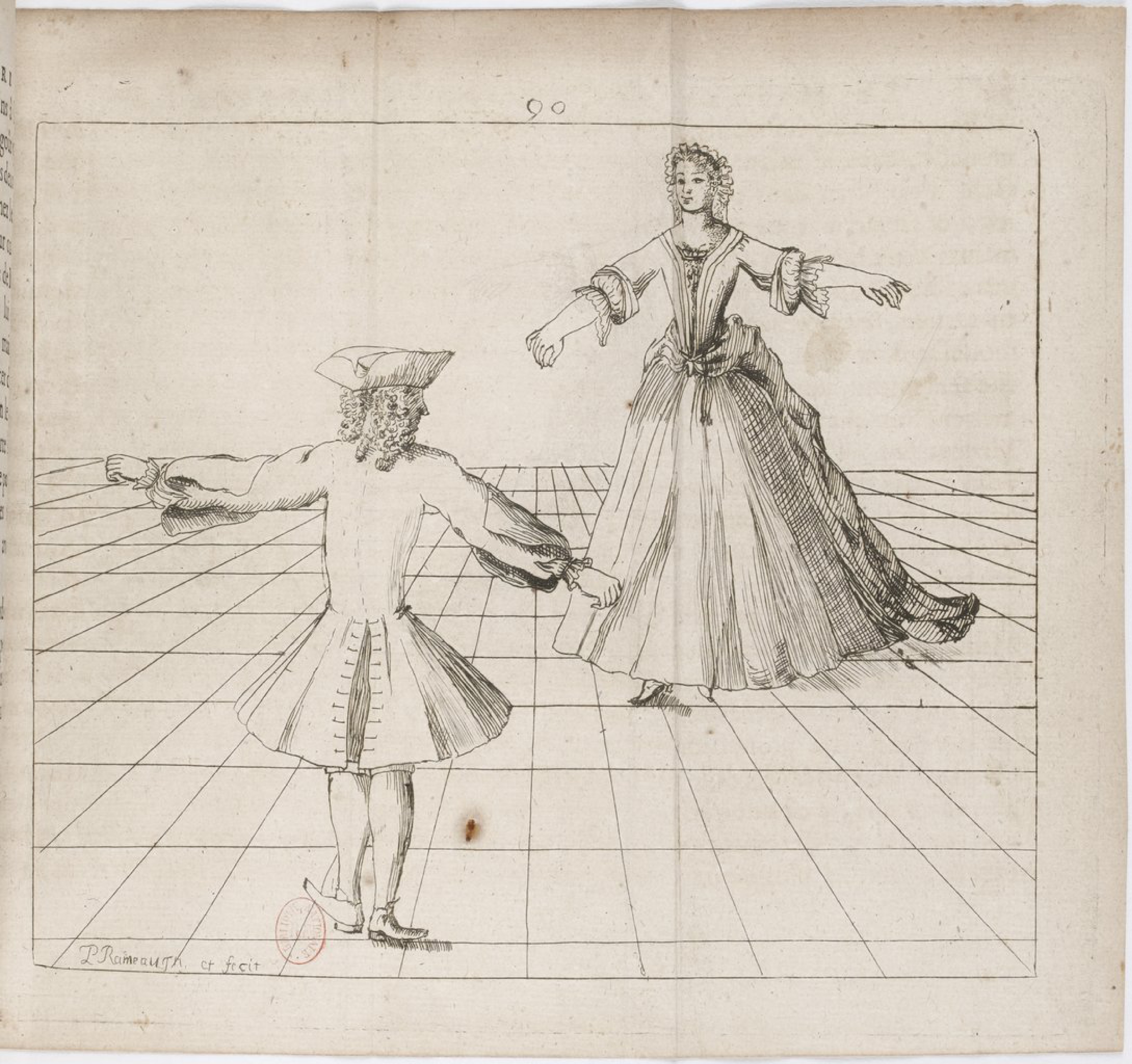
Rameau's manual is one of the few surviving sources that shows minuet technique in precise visual form, making this image invaluable evidence for reconstructing historical dance. The grid system was an innovation in dance notation—an attempt to encode spatial precision geometrically rather than verbally. For anyone studying how courtly dance was taught, performed, and understood, this engraving is foundational.
What you are looking at
Two figures occupy a receding gridded floor that emphasizes geometric perspective. On the left stands a male dancer in three-quarter view, wearing a tricorn hat, long coat with ornate buttons, knee breeches, and stockings. His posture is upright and formal, one arm extended with fingers spread in an elegant gesture. On the right, a female figure in an elaborate gown with a fitted bodice, full skirt with deep pleats, and voluminous sleeves faces outward in a complementary pose. Her arms are similarly positioned—one extended sideways with graceful hand position. Both figures maintain aristocratic bearing, their bodies aligned with the spatial grid beneath them. The engraving style is precise, with fine parallel lines creating volume in the fabrics and clear delineation of anatomy. The floor grid recedes sharply toward the horizon, a pedagogical device encoding the spatial discipline demanded by the dance.
The dancing
Both dancers maintain an upright, elongated carriage with the turned-out posture characteristic of courtly dance. The male dancer's arm extends from the shoulder with fingers spread in an open, presentational gesture; the female's mirrored position suggests a demonstration of reciprocal arm placement. Their stance implies weight held forward from the heel, typical of the period. No extreme turnout of the feet is visible, though both figures show the deliberate positioning expected of trained dancers. The spatial separation and parallel positioning suggest either a teaching demonstration or the opening attitude of a formal dance.
The dance depicted
This is demonstrably a minuet or minuet-derived court dance, depicted as a teaching moment. The title identifies the male figure as a dancing master instructing a student, the genre's central pedagogical relationship. Minuet technique emphasized the carriage of the body, port de bras (arm carriage), and precise floor placement—all visible here. The grid itself encodes the geometric precision the minuet demanded: dancers moved along prescribed paths, with step patterns related to musical phrases. This was the dominant social dance of aristocratic France in the 1720s and the primary subject of dance instruction manuals.
How it was made
This is an engraving, executed with fine cross-hatching and parallel lines to create tonal values and fabric texture. The technique allowed precise reproduction of detail—the lace cuffs, coat buttons, fabric pleats, and facial features are all sharply rendered. Engraving was the standard medium for dance instruction manuals of the period, permitting wide distribution and repeated impressions. The clarity and precision of the line suited the pedagogical purpose: the image needed to communicate exact positions and proportions to students learning from the manual without a living teacher.
About this work
This engraving from Pierre Rameau's *Le Maître à danser* (1725) depicts the central transaction of dance pedagogy in the Baroque era: a master demonstrating correct port de bras and stance to a student. The gridded floor is not merely decorative but a teaching tool, visualizing the geometric precision the minuet required. The image becomes a page of instruction, readable to any aristocrat learning courtly dance from the printed manual. It captures a moment of disciplined beauty—the elongated carriage, the graceful arm positions, the formal mutual regard—that defined elite dance practice in early 18th-century France. The work is among the most historically important documents of Baroque dance technique, offering rare visual evidence of how this movement was actually performed.
How to look at it
The viewer should attend to the parallel positioning of the two figures and the mirror relationship of their arms—this demonstrates the fundamental minuet principle that partners moved in symmetry and dialogue rather than in unison. Notice the upright carriage and the elongated line from head to foot, which was the minuet's signature aesthetic. Observe how the grid anchors both dancers in the same spatial system, suggesting that the minuet's beauty lay in its geometric precision. The engraving freezes the moment of demonstration rather than active dance, showing instead the held position and arm placement that the student was meant to study and replicate.
The artist
Pierre Rameau (c. 1674–c. 1748) was a prominent Parisian dancing master and the author of *Le Maître à danser*, one of the most influential dance instruction manuals of the 18th century. The book went through multiple editions and was translated across Europe, establishing Rameau as an authority on courtly dance pedagogy. He was not primarily a visual artist; the engravings in his manual were executed by professional engravers, but Rameau's precise specifications shaped them, ensuring they communicated his method accurately.
The period
The minuet was the dominant court dance across aristocratic Europe from the late 17th through the 18th century. By 1725, when Rameau published his manual, the dance was fully codified, taught through systematic instruction, and central to aristocratic social identity. The period saw an explosion of dance instruction manuals—partly because the minuet's geometric precision made it teachable through text and image, and partly because rising middle classes sought to acquire aristocratic manners. Rameau's work appeared during this peak of minuet culture, before the dance began to decline in popularity later in the century. Visually, the engraving reflects Baroque aesthetic values: formal composition, precise line, clear legibility, and the marriage of art and instruction.
Where it lives
This engraving appears in *Le Maître à danser* (Paris, 1725), one of the most widely distributed dance manuals of the 18th century. The work belongs to a category of practical instruction books: objects designed to be used, marked up, and consulted repeatedly, making individual copies' histories difficult to trace. The Library of Congress copy from which this image derives represents the standard printed version.
Dance in this work
Questions about this work
What is the grid on the floor?
The grid is a pedagogical device that visualizes the minuet's geometric precision. Baroque minuets moved along prescribed linear paths, with steps timed to music. The grid encodes this spatial logic, allowing a reader to trace the pathway of the dance across the floor. It was an early form of dance notation—not a notation of steps, but of the underlying spatial geometry.
How do we know this shows minuet technique?
The upright carriage, the specific arm positions (fingers spread, arms at shoulder height), the formal mutual regard of the dancers, and the teaching context all identify this as minuet instruction. The title and Rameau's stated subject matter confirm it. The minuet was the dominant court dance of this period, and *Le Maître à danser* was specifically a minuet manual.
Why would aristocrats need to learn minuet from a manual?
The minuet's complexity—its precise footwork, geometric patterns, and codified sequences—made it the subject of professional instruction. Aristocratic identity increasingly depended on displaying mastery of courtly manners, of which dance was a central component. Rameau's manual served elite families who could afford printed books and private instruction, teaching them the technique and style that demonstrated their social status.
Is this what minuet actually looked like when danced?
This shows a held teaching position—the posture and arm placement the student should achieve—rather than the minuet in motion. The minuet involved small, precise steps, dips, and turns executed to music, so the living dance was more animated than this static image. However, the carriage, bearing, and aesthetic seen here are authentic: Rameau's manual is based on actual practice.
More Notation/Choreography artwork