41 works in this view — arrow keys or swipe to move between them.
Dance in Art
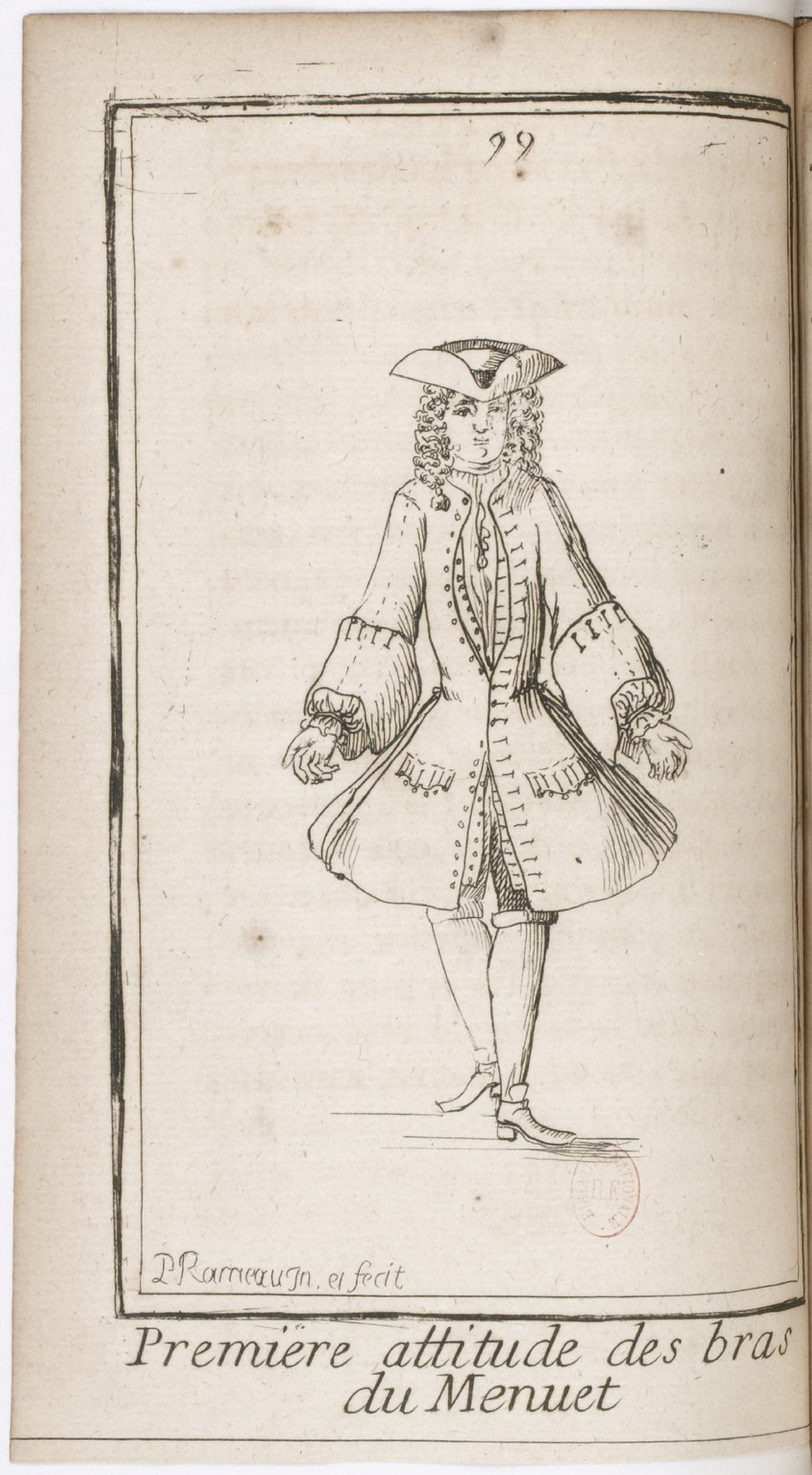
First Attitude of the Minuet
Pierre Rameau
- Medium:
- Engraving
- Dance:
- Notation/Choreography
- Era:
- 1700s (Enlightenment/Minuet Era)
- Collection:
- Le Maître à danser (1725)
- Source:
- Library of Congress
- Rights:
- Public domain — free to use, share and adapt.
- Recorded as:
- Public Domain
For historians of dance and body culture, this engraving documents the pedagogical method and aesthetic principles of Baroque court dance at a formative moment—when Rameau was codifying practices that had evolved over generations and that would influence European dance for decades to come. For dancers, it shows the extreme attention paid to arm position and carriage in the minuet: the arms were not afterthoughts but integral to the dance's aesthetic of refined elegance, requiring as much study and precision as the footwork itself.
What you are looking at
A single male dancer is depicted in three-quarter view against a plain background, shown in the formal court dress of early 18th-century France. He wears a richly decorated coat with buttons down the front, a knee-length skirt with deep pleats at the sides, and ornamental cuffs at the wrists. His legs are clad in close-fitting breeches and heeled shoes. His hair is styled in the fashionable long curls of the period, crowned with a tricorn hat. The dancer stands in an upright, dignified posture with his weight settled on one leg, his arms held in a specific position prescribed for the minuet: one arm extended outward at shoulder height with a gentle curve, the other held closer to the body. His gaze is directed forward with composure. The engraving is rendered in clean, precise lines characteristic of instructional dance illustration, with no background detail or shadow to distract from the body's position and deportment.
The dancing
The dancer presents an erect, refined carriage typical of Baroque court dance. His weight appears to be carried on his back leg, allowing the front leg to extend slightly forward in preparation for the minuet's characteristic small, gliding steps. The arm positions are the focus of the illustration: the raised arm is extended with a slight S-curve from shoulder to fingertips, palm facing downward in a graceful line; the lower arm maintains an open, presentable position. The posture demonstrates the principle of épaulement—a lifted chest and squared shoulders—essential to the aristocratic aesthetic of the minuet. There is only one figure, presented as an instructional model for students to observe and replicate.
The dance depicted
This is an instructional diagram of the minuet, the most prestigious and codified social dance of the Baroque and early Rococo periods. The minuet was danced by the aristocracy and required years of training to perform with the necessary precision and grace. Pierre Rameau's *Le Maître à danser* (1725) is one of the foundational dance manuals of the period, and this illustration shows the 'first attitude of the arms' (*première attitude des bras*)—one of several prescribed arm carriage positions that dancers were expected to master. The notation indicates this is an instructional image meant to teach the correct positioning, as part of Rameau's systematic codification of the dance's technique. The minuet was danced in couples, typically in a prescribed geometric path, and required precise coordination between footwork and the carriage of the arms and body.
How it was made
This is a line engraving, a technique that allowed precise, repeatable reproduction of complex gesture and costume detail. The fine cross-hatching visible in the fabric of the coat and the subtle modeling of the face and hands were achieved through careful burnishing and line work on a copper plate. Engraving was ideal for instructional manuals because it produced clean, readable images that could be printed many times for distribution to dance students and masters across Europe. The technique's precision made it possible to render the fine distinctions of arm angle and body position that were crucial to Rameau's pedagogical purpose. This particular print comes from *Le Maître à danser*, which was one of the most widely circulated and influential dance instruction books of its era.
About this work
This is a didactic engraving from Pierre Rameau's *Le Maître à danser*, one of the definitive instructional manuals for Baroque court dance. It illustrates the proper carriage and arm position required for the minuet, the dance form that dominated European aristocratic culture in the early 18th century. The image is not a representation of a moment in performance but rather a teaching tool—a static, idealized pose meant to be studied and imitated by dancers in training. It captures a specific pedagogical moment when dance instruction was becoming increasingly systematized and codified, with masters like Rameau documenting the precise rules and positions that governed even the smallest gesture.
The minuet represented the highest achievement in social dancing and carried deep social significance. To dance it well demonstrated breeding, education, and refinement. Rameau's manual was part of a broader effort to establish dance as a legitimate subject of systematic study and written transmission, rather than merely an oral tradition passed from master to student. This illustration stands as evidence of how seriously the aristocracy took the cultivation of bodily deportment.
How to look at it
Pay attention to the arm positions: notice how the raised arm curves gently rather than extending in a straight line, and how the hand is angled downward in a gesture of refined presentation rather than a functional grasp. The slight forward position of the front leg and the weight carried on the back leg show the minuet's characteristic small, controlled steps. Observe how the entire body is held in an upright, elongated line—no slouching, no casual weight distribution. This engraving freezes a moment of preparation or poise rather than dynamic motion; the dancer is presenting himself in the correct attitude, not captured mid-step. The absence of a partner or setting emphasizes that this is a diagram, a teaching tool, rather than a social scene.
The artist
Pierre Rameau (c. 1674–c. 1748) was a celebrated French dancing master and one of the most important theorists of Baroque dance. *Le Maître à danser*, published in Paris in 1725, was his most influential work and served as a standard reference for dance instruction throughout the 18th century. Rameau was known for his systematic approach to codifying dance technique and for his detailed descriptions of proper deportment, arm positions, and social etiquette. His manual included verbal descriptions, engravings, and geometric diagrams of dance patterns, making it one of the most comprehensive dance instruction books of its era. Rameau's work reflected the broader 18th-century Enlightenment impulse to rationalize and document knowledge systematically.
The period
The minuet dominated European aristocratic dance culture from approximately 1690 to 1780. It originated in France and became the standard opening dance at formal court and aristocratic social events. In the 1720s, when Rameau's manual was published, the minuet was at the height of its cultural prestige and codification. The dance required formal training and was a marker of social status—an essential accomplishment for any person of rank. Rameau's work appeared at a moment when dance instruction was becoming increasingly professionalized and when dance manuals were beginning to circulate more widely among the educated classes. The early 18th century also saw the rise of a more rational, written approach to documenting dance technique, reflecting broader Enlightenment values. This shift from oral tradition to written, illustrated codification was transforming how dance knowledge was preserved and transmitted.
Where it lives
This engraving is from *Le Maître à danser* (Paris, 1725), a foundational dance instruction manual. The work is part of the collection of the Library of Congress. It is one of a series of illustrations in the manual, each showing different attitudes of the arms and positions of the feet for the minuet and other dances of the period.
Dance in this work
Questions about this work
Why is this person standing still if it's a dance?
This is an instructional diagram, not a depiction of dancing in motion. Rameau's manual used static poses to teach the correct positions that dancers should assume during the minuet. Students would study this image to understand proper arm carriage, then practice the positions themselves before adding footwork and movement. Dance manuals of this period typically showed multiple still poses that, when linked together, created the dance.
What does 'attitude' mean in the title?
In 18th-century dance terminology, 'attitude' refers to a specific static position of the body or limbs—essentially a pose. Rameau's manual systematically presents different arm attitudes for the minuet, teaching dancers which positions were correct and aesthetically pleasing. This is the 'first' of several attitudes, suggesting Rameau prescribed a sequence of proper arm positions for the dance.
Why are the clothes so fancy?
These are the formal clothes required for minuet dancing in aristocratic contexts. The coat, breeches, heeled shoes, tricorn hat, and ribbons were the standard court dress of the 1720s. Proper attire was part of the minuet's social performance—the dance was as much about displaying refinement and status through dress and deportment as it was about the steps themselves.
Who would have used this book?
Rameau's manual was aimed at dancing masters, aristocratic students learning to dance, and educated people of rank who wanted to understand the principles of proper dance instruction. Dance masters would have used it as a reference text, and wealthy families might have purchased it for their children's instruction. The book was expensive and circulated among the educated elite across Europe.
More Notation/Choreography artwork