40 works in this view — arrow keys or swipe to move between them.
Dance in Art
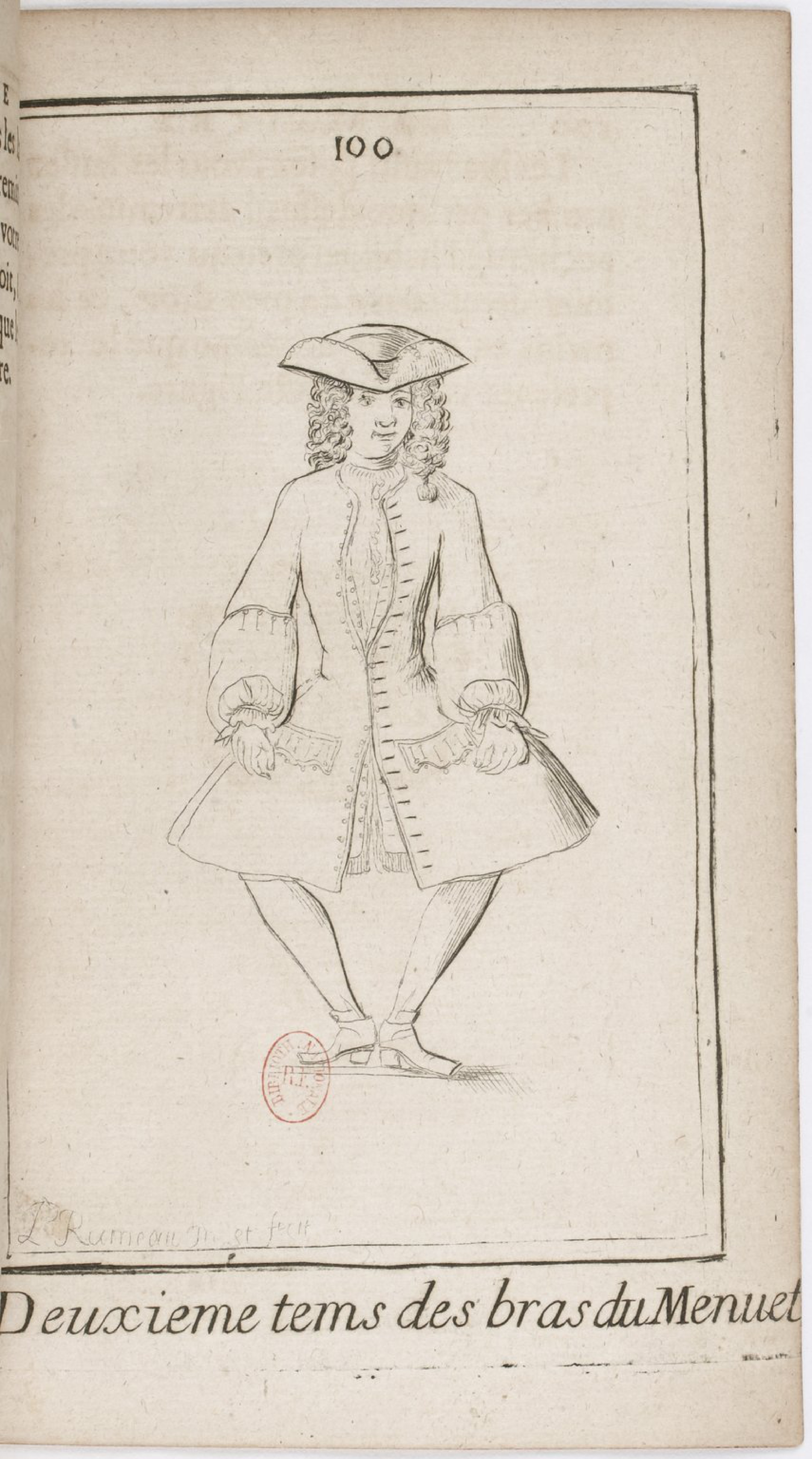
Second Beat of the Minuet's Arms
Pierre Rameau
- Medium:
- Engraving
- Dance:
- Notation/Choreography
- Era:
- 1700s (Enlightenment/Minuet Era)
- Collection:
- Le Maître à danser (1725)
- Source:
- Library of Congress
- Rights:
- Public domain — free to use, share and adapt.
- Recorded as:
- Public Domain
This image represents the moment when dance technique began to be standardized and visually documented as a teachable system rather than imitated from a master's body. Rameau's work was read across Europe and influenced how dance was understood as a subject of study; this single page shows how 18th-century France approached the problem of encoding movement into permanent form before photography or video existed.
What you are looking at
A single male dancer stands in a formal frontal pose against a plain background, wearing the fashionable dress of early 18th-century France: a fitted coat with decorative buttons down the front and ornamental cuffs, full breeches, stockings, and a tricorn hat. His curled hair falls to his shoulders in the period style. His arms are positioned at a specific intermediate moment in the minuet's choreography—the second beat—with both elbows bent and hands positioned at roughly waist height, palms facing inward in a delicate, controlled carriage. His legs are straight and composed, his weight evenly distributed. The engraving is rendered with fine hatching lines and shows the figure in three-quarter view, centered on the page with substantial white space around it. A small coat of arms appears at the foot of the page.
The dancing
The dancer's posture is upright and formal, with neither weight shifted to either leg. Both arms are raised to approximately waist height with elbows moderately bent, hands held close to the body in what is plainly a cultivated, restrained gesture. The arm position conveys refinement and control rather than expressive reach; the hands are nearly parallel to one another and the elbows are not fully extended. The pose is entirely static—a frozen moment of the correct arm carriage—with no suggestion of weight transfer or momentum. This is instructional rather than narrative: the image freezes the exact position the student's arms should occupy at one specific moment in the dance phrase.
The dance depicted
This is unquestionably a minuet, the most aristocratic social dance of the 18th century and the dance most thoroughly documented in Rameau's treatise. The title explicitly identifies this as the second of three timed arm positions (tems) that synchronize with the minuet's characteristic three-step pattern. The minuet was danced in pairs by the nobility in balls and court settings, and its choreography was highly codified—Rameau's work is notable precisely because it attempts to capture and standardize correct technique through visual analysis. The image shows neither partners nor footwork, focusing entirely on one element of the arm carriage that constitutes correct minuet deportment at this specific moment in the measure.
How it was made
This is an engraving, a print made by incising lines into a metal plate (typically copper) and then inking and printing the plate. The fine parallel lines visible across the figure (called hatching) create tone and volume and are characteristic of engraved line work. Engravings allowed for precise, repeatable images and were the ideal medium for instructional texts—this image circulated as one of hundreds of nearly identical copies in every copy of Rameau's book. The technique is exacting and permits fine detail: the buttons, lace, curls, and delicate hand position are all rendered with deliberate clarity. This was how dance technique was transmitted to a literate, affluent audience who could afford printed books.
About this work
This is an instructional diagram from Pierre Rameau's *Le Maître à danser* (The Master of Dancing), a foundational French dance manual published in 1725. Rather than narrate a story or capture a moment of social joy, it isolates and freezes a single moment of correct arm carriage in the minuet—a dance that defined aristocratic elegance and social standing across Europe for more than a century. The image is one page in a systematic visual glossary of technique, showing students and dancing masters the precise carriage of the arms that marked a well-educated body. Rameau's method—breaking the dance into numbered beats (tems) and providing a figure for each—was revolutionary for making invisible knowledge visible and reproducible.
How to look at it
Attend to the exact position of the arms: neither raised high nor hanging at the sides, but held at a specific intermediate height with elbows bent and hands held close to the body in a posture of refined restraint. This middle position is the visual hallmark of minuet carriage—not expansive, not relaxed, but controlled and modest. The figure's absolute stillness and formal frontality are also deliberate: this is not a moment captured from motion, but a static diagram. The viewer should recognize that the image is teaching through freezing, not through narrative. The page number (100) and the caption identifying this as the 'Deuxième tems' (second beat) signal that this is part of a systematic sequence—the reader would have seen the first and third beats on adjacent pages.
The artist
Pierre Rameau (c. 1674–c. 1748) was a French dancing master and theorist working in Paris during the height of the minuet's popularity. *Le Maître à danser*, his major published work, was the most systematic attempt of its era to codify the technique and philosophy of French social dance through engraved illustration and written instruction. Rameau's book became a standard reference and was reprinted and translated multiple times; it reached practitioners across France, Italy, Germany, and England. His approach—analytical, visual, and prescriptive—established a model for dance instruction that persisted into the 19th century.
The period
The minuet dominated European social dancing from roughly 1660 to 1800, but it reached its peak of codification and cultural authority in the early 18th century. At the moment Rameau published, the minuet was the dance that separated educated nobility from the common people; to dance it correctly was to signal breeding, training, and cultural membership. The dance had become so formal and rule-bound that instruction manuals and visual systems became necessary. Simultaneously, the Enlightenment's broader project of systematizing and documenting knowledge extended to movement and the body. Rameau's work is thus both a practical handbook and a philosophical statement: it asserts that dance can and should be understood as a rational, teachable discipline.
Where it lives
This engraving comes from *Le Maître à danser* (Paris, 1725), a foundational pedagogical text on French social dance held in the Library of Congress. The book itself was a printed work produced in multiple copies and circulated among dance professionals and educated amateurs across Europe. The image is not unique; it is one page in a designed sequence within a larger instructional system.
Dance in this work
Questions about this work
Why is this a diagram rather than a scene of actual dancers?
Rameau's innovation was to isolate and freeze individual moments of correct technique so they could be studied and imitated in detail. A narrative scene with multiple dancers and complex action would obscure the specific arm carriage he wanted to teach. By showing a single figure in a static pose, he makes the invisible standard of 'correct' movement visible and reproducible.
What does 'tems' mean, and why are there three of them?
In French baroque dance terminology, a 'tems' (also spelled 'temps') is a beat or step in the music. The minuet's basic pattern occupies three beats of music, and Rameau shows the corresponding arm position for each beat. This synchronization of arm carriage with musical meter was central to his understanding of dance as a discipline where every part of the body had a prescribed position at a prescribed moment.
How was this image used in actual dance instruction?
Dancing masters would own a copy of the book and use it to teach students—pointing to the figure to demonstrate correct posture and arm carriage. Students of means would buy their own copies to study at home and memorize the positions. The engraved image served as a stable, repeatable reference that ensured all practitioners across different cities were working toward the same standard.
Was the minuet really as rigid as this image makes it look?
Yes, by the early 18th century, the minuet had become highly formalized. Contemporary descriptions emphasize its restraint, propriety, and precision. However, there remained room for individual grace within the prescribed framework—this image shows the structural skeleton, not the whole art.
More Notation/Choreography artwork