39 works in this view — arrow keys or swipe to move between them.
Dance in Art
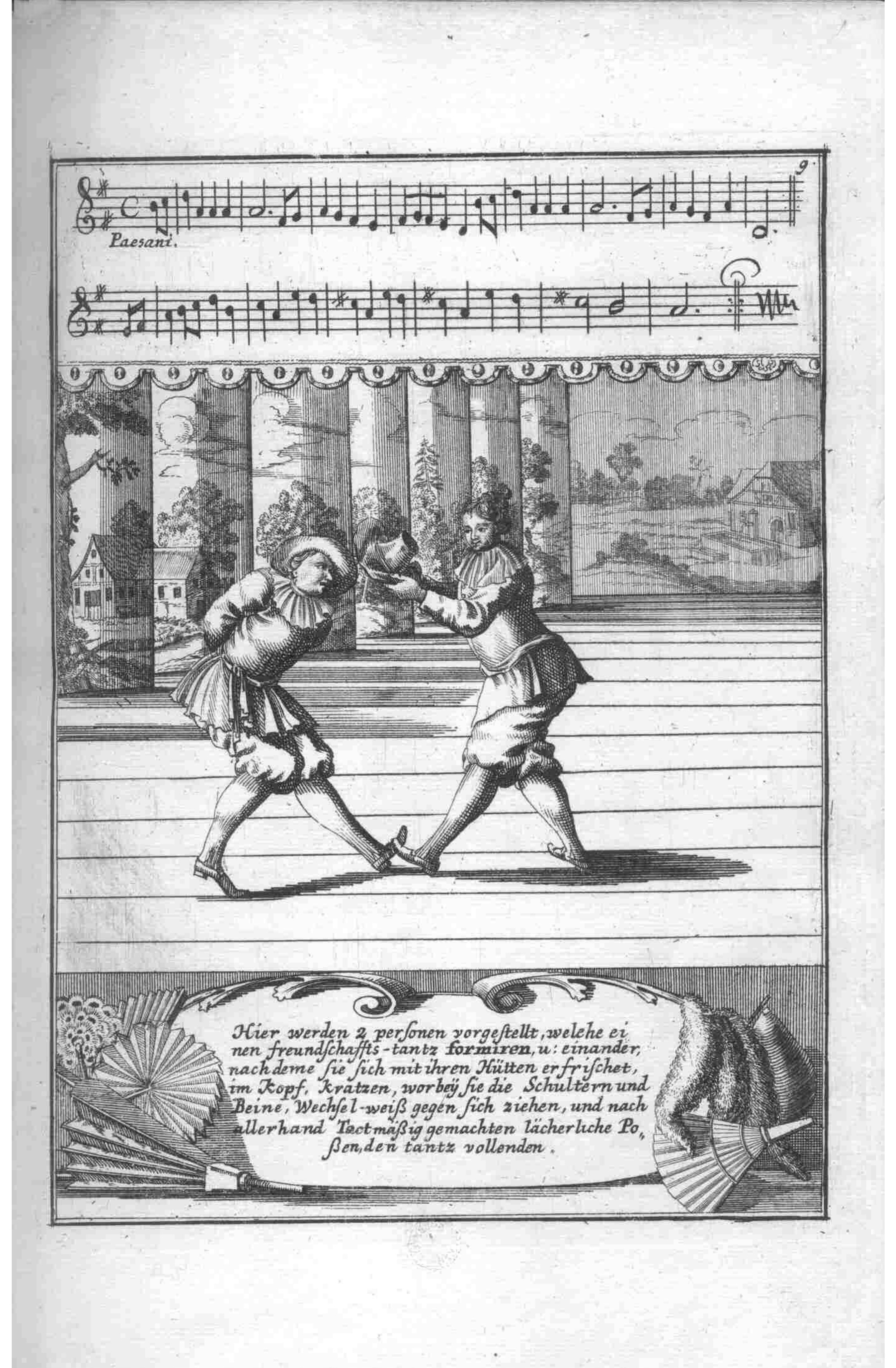
Combat/Duel — Plate 8
Gregorio Lambranzi
- Medium:
- Copper-plate engraving
- Dance:
- Notation/Choreography
- Era:
- 1700s (Enlightenment/Minuet Era)
- Collection:
- Nuova e curiosa scuola de' balli theatrali (1716)
- Source:
- Library of Congress
- Rights:
- Public domain — free to use, share and adapt.
- Recorded as:
- Public Domain
Lambranzi's plates are among the only surviving visual records of European theatrical dance practice before the development of Labanotation and ballet notation. This combat dance shows how martial gesture—a physically legible vocabulary drawn from genuine combat—was theatricalized, codified, and taught as a reproducible sequence. For historians and practitioners, the image reveals the actual body positions, the spatial relationships between dancers, and the costume conventions that shaped movement in this period.
What you are looking at
A copper-plate engraving from Lambranzi's 1716 theatrical dance manual depicts two male dancers in a martial confrontation on a raised stage framed by classical columns and a distant landscape backdrop. Both figures wear the fashionable dress of the early 18th century—short breeches, hose, and draped upper garments with billowing sleeves—suggesting a theatrical rather than genuinely military context. The dancer on the left lunges forward with raised arms in an aggressive posture, while the figure on the right mirrors this stance with arms raised defensively or offensively. The wooden stage floor is clearly delineated with horizontal lines. Above the scene, two staves of musical notation labeled "Paesan" provide the choreographic accompaniment. Below, a German verse in an ornamental cartouche flanked by decorative fan motifs explains the dance's execution and character. The composition captures a freeze-frame of combat choreography—a stylized theatrical gesture rather than actual violence.
The dancing
Both dancers adopt mirror-image stances with legs bent in a wide lunge position, weight shifted forward onto bent knees in a posture of aggressive readiness. Their arms are raised to approximately shoulder or head height in gestures of threat or parry. The dancer on the left has his left leg extended forward, while the right dancer mirrors this configuration. The raised arms and forward-leaning torso convey tension and martial readiness; the bent-knee stance suggests spring and mobility rather than the upright carriage of courtly dances. The spacing between them—close but not in contact—frames the central confrontation as the composition's dramatic focus. The symmetry of their postures suggests choreographed mirroring rather than spontaneous combat.
The dance depicted
This is a theatrical sword dance or combat pantomime, a staged martial display designed for court or public theatrical presentation. The notation labeled "Paesan" (possibly a regional or character designation) and the German verse indicate this was a named, repeatable choreographic sequence rather than improvised action. The costumes, raised stage, and classical setting confirm this as theatrical entertainment rather than genuinely martial practice. Such dances were part of the repertory of travelling dance masters and court performers in early 18th-century German-speaking territories. The work shows how martial movement—the lunges, arm positions, and threatening gestures—was stylized and codified into formal dance grammar suitable for entertainment. The symmetrical mirroring suggests these were set sequences learned and repeated by trained performers.
How it was made
This is a copper-plate engraving, a technique requiring incised lines into a metal surface to hold ink and transfer the image to paper through a printing press. Engraving allowed fine detail, precise linework, and repeatability—multiple impressions could be pulled from a single plate. The technique was ideal for instructional and illustrated books: the clarity of line could show costume detail, body position, and architectural setting, while the reproducibility meant a single engraving could reach hundreds of readers across Europe. The Lambranzi manual exists in multiple copies, confirming this work's circulation as an instructional text rather than a unique artistic object. The careful rendering of musculature, drapery, and spatial recession shows the engraver's skilled handling of the medium to create instructional clarity.
About this work
This plate exemplifies the theatrical dance culture of the Holy Roman Empire in the early 18th century, when elaborate theatrical dances incorporating martial, comic, and courtly elements were performed at courts and in public theatres. Lambranzi's *Nuova e curiosa scuola de' balli theatrali* (New and Curious School of Theatrical Dances, published in Nuremberg, 1716) was one of Europe's most influential dance manuals, circulating throughout the German-speaking world and reaching into the 19th century. Each plate pairs a named dance with its musical notation and a costume illustration, creating a complete record of performance practice. This combat dance sits within a larger repertory that included character dances, comic pieces, and courtly sequences—the full range of what educated performers needed to know. The work preserves a form of theatrical dance that left almost no other traces: no video, no surviving choreographic notation in modern systems, and few written descriptions. The engraving is therefore a primary historical document of early 18th-century movement practice, showing not just what was danced but how bodies moved, how performers dressed, and what the theatrical apparatus looked like.
How to look at it
Notice the precise moment of confrontation the engraver chose: neither fighter is in motion, but rather frozen in a moment of maximum tension—both bent, both armed, both ready. This is the choreographer's art: not continuous movement but the held positions from which movement flows. The symmetry of the two figures is not accidental; mirroring is a fundamental principle of Baroque choreography and design. Observe how the costume detail—the specific cut of the sleeves, the hose, the shoes—tells us this is theatrical fantasy, not functional martial dress. The raised stage, the columns, the distant landscape all situate this confrontation in the artifice of theatre rather than on a battlefield. The notation above anchors the image to music and suggests how a reader-performer would reconstruct the movement from the static image.
The artist
Gregorio Lambranzi was an Italian dancing master active in the early 18th century, documented as performing and teaching in Nuremberg. The *Nuova e curiosa scuola de' balli theatrali* is his sole surviving major publication, though similar dance manuals suggest he was part of a wider culture of travelling performers and instructors who taught theatrical dances across European court and public venues. The manual's success (multiple editions and translations) indicates he worked with a skilled engraver and publisher to create a commercially viable instructional text. Nothing is known of his earlier training or later career. The work stands as evidence of the sophisticated theatrical dance culture of the German-speaking territories in this period, a world that left few written records and thus depends heavily on visual documents like these engravings.
The period
The early 18th century saw a flourishing of theatrical dance in German-speaking court and public spaces, distinct from the ballet development underway in France and Italy. Lambranzi's dances incorporate elements of older traditions (branles, galliards, courtly pavanes) alongside newer theatrical character dances and comic pieces. The period was one of visual codification: as dance became more professionalized and systematized, dance masters sought to record and standardize their teaching through published engravings and notation. Lambranzi's work belongs to this moment of attempted systematization—an effort to make dance teachable across distance and time through visual and musical record. The early 18th century also saw the rise of the public theatre and the expansion of court spectacle in German territories, creating demand for trained performers who could command a large repertory of dances. Simultaneously, the Baroque visual arts were at their height in German-speaking regions, and the quality of Lambranzi's engravings reflects this cultural moment.
Where it lives
This plate is from *Nuova e curiosa scuola de' balli theatrali*, published in Nuremberg in 1716 with a two-volume German edition following in 1725. The work circulated widely in multiple editions and languages through the 18th and 19th centuries. This particular plate is held by the Library of Congress, accessed through their digital collections.
Dance in this work
Questions about this work
Is this a real sword fight or a dance?
It is a choreographed dance that uses the vocabulary and gestures of combat as its content. The raised stage, the costumes, the musical notation, and the theatrical setting all confirm this is performance, not fighting. Martial dances were a major genre in early 18th-century European theatre; they used the spectacle of combat as entertainment while following strict choreographic rules.
What does the music notation tell us?
The notation "Paesan" at the top provides the musical accompaniment and tempo that governs the dance's timing and phrasing. Together with the image, it constitutes a complete record of how the dance should be performed: what the body does, at what speed, to what music. A trained performer with access to both the notation and the engraving could reconstruct the dance.
Why are the two dancers positioned exactly alike?
Mirror symmetry was a fundamental principle of Baroque choreography and visual design. By positioning the dancers as mirror images, the engraver shows both the movement vocabulary and the aesthetic principle governing it. This symmetry also makes the image more didactic—the reader sees the same position twice and thus learns it more thoroughly.
Who performed these dances?
Professional dancing masters, their students, and court performers trained in theatrical dance repertory. These were not social dances but skilled theatrical performances requiring practice and technique. Lambranzi's manual was designed to teach performers and teachers how to execute and teach these dances.
More Notation/Choreography artwork