35 works in this view — arrow keys or swipe to move between them.
Dance in Art
Comic Character — Plate 12
Gregorio Lambranzi
- Medium:
- Copper-plate engraving
- Dance:
- Notation/Choreography
- Era:
- 1700s (Enlightenment/Minuet Era)
- Collection:
- Nuova e curiosa scuola de' balli theatrali (1716)
- Source:
- Library of Congress
- Rights:
- Public domain — free to use, share and adapt.
- Recorded as:
- Public Domain
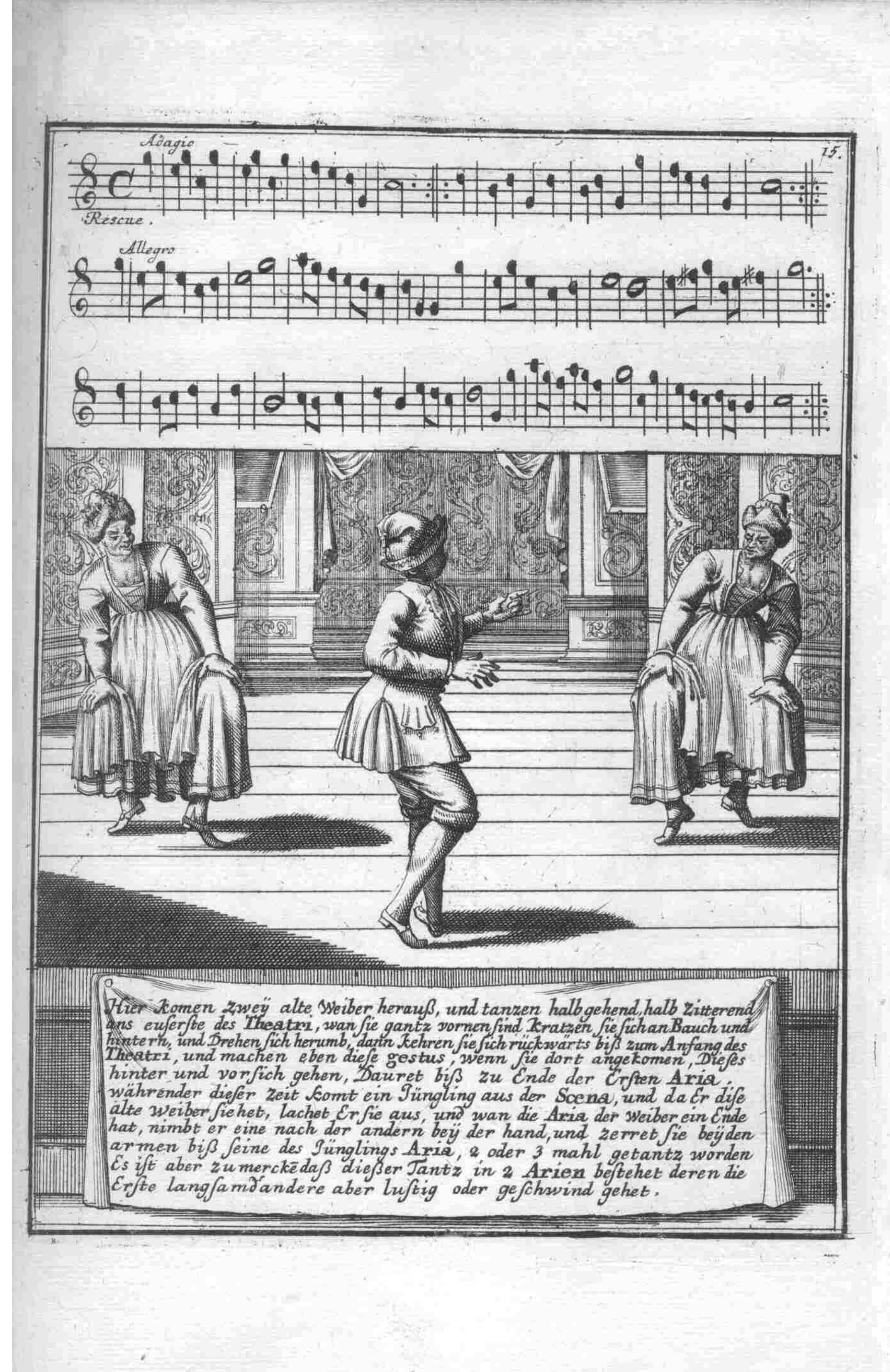
This work is essential evidence for how theatrical dance was actually performed and taught in the early 18th century—not through memory or description, but through systematic notation paired with visual representation. The engraving shows that comic character dance was considered worthy of formal documentation alongside serious ballet, and that the physical vocabulary of theater (exaggeration, asymmetry, mimetic action) was as deliberate and teachable as court dance. For historians of dance, notation, and theater, this manual is one of the few surviving blueprints of Baroque theatrical choreography.
What you are looking at
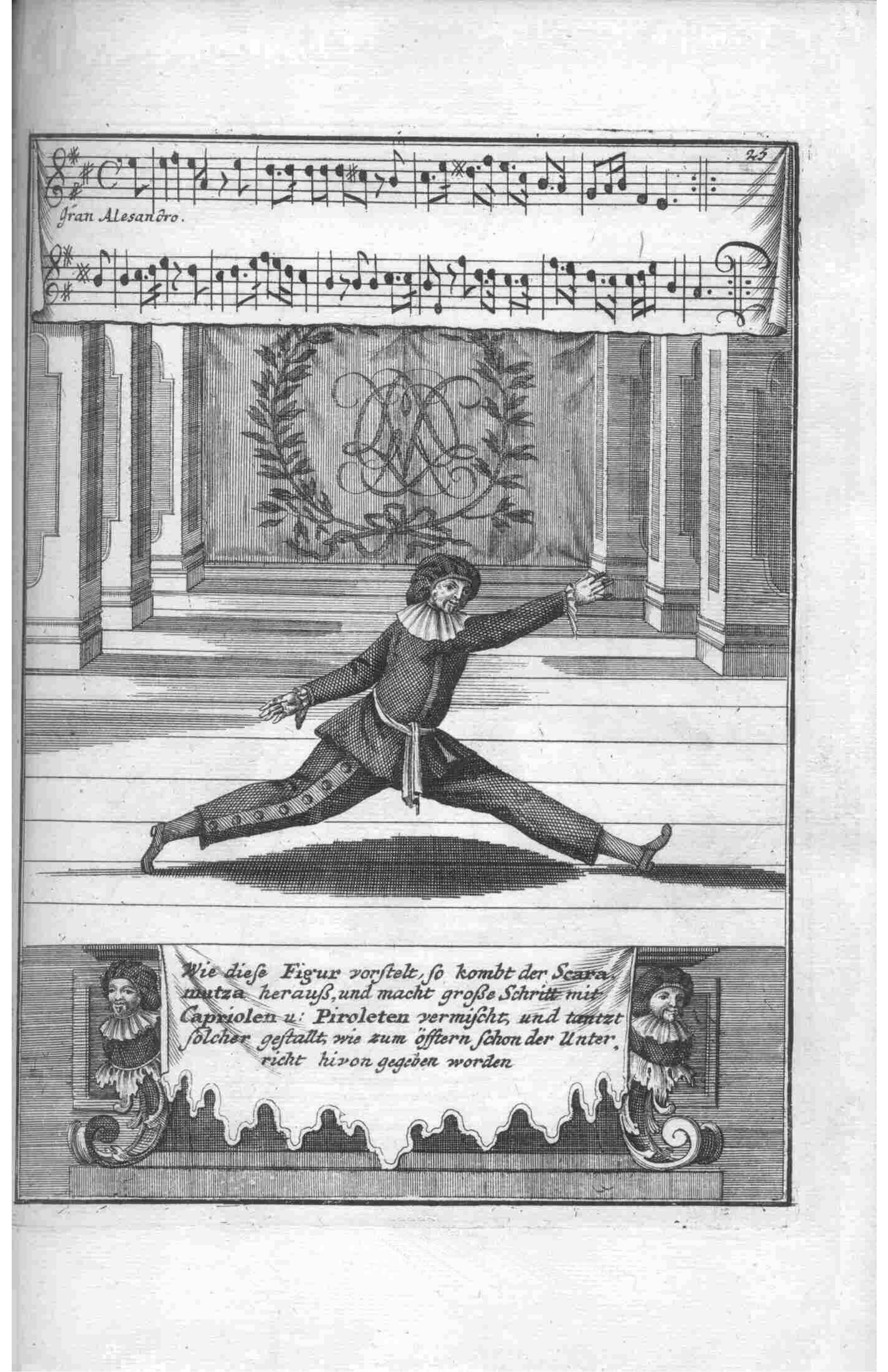
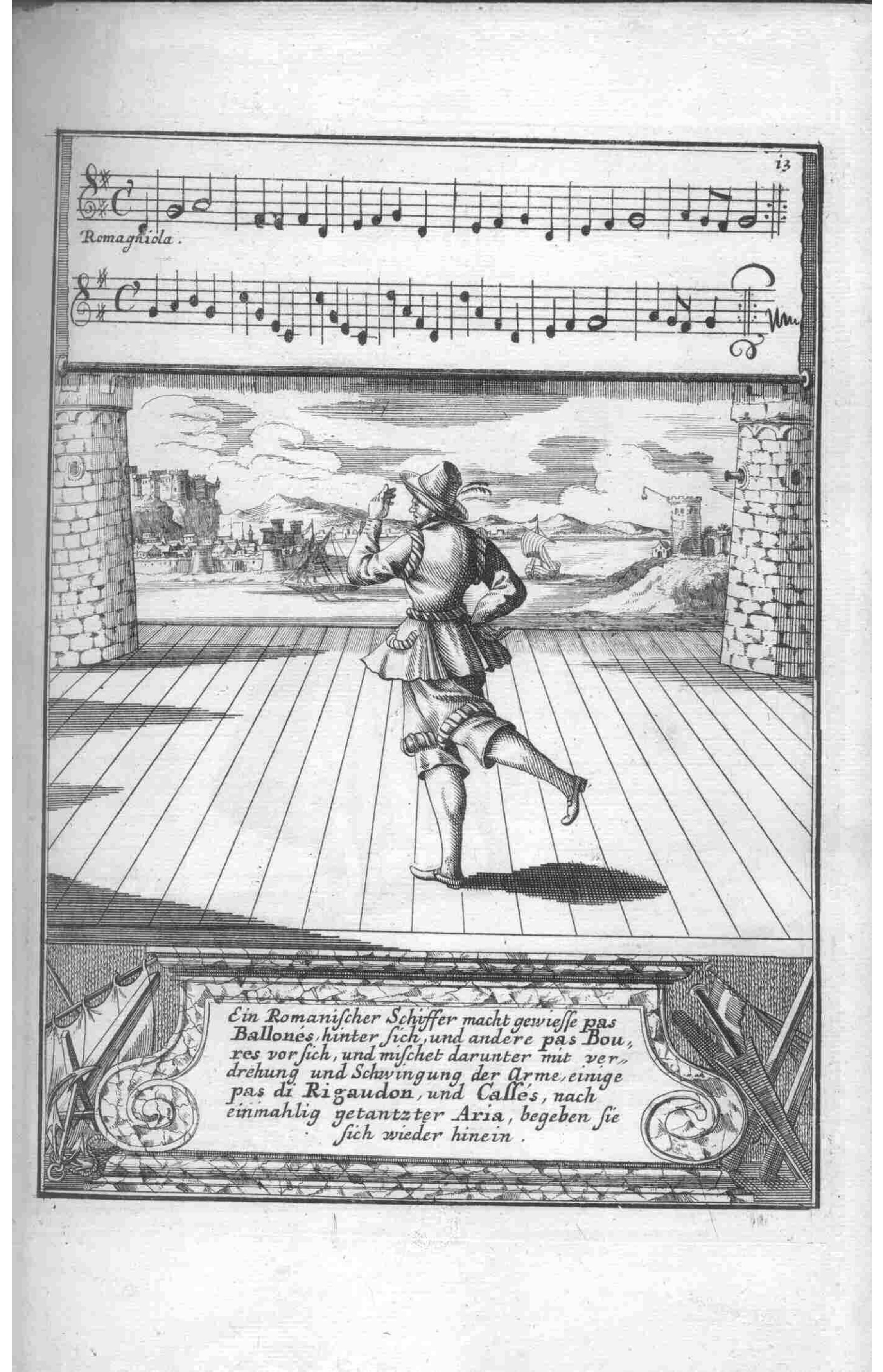
A young man in early 18th-century dress executes a comic theatrical leap on a wooden stage, captured mid-jump with one leg bent and arms animated. He wears a plumed hat, close-fitting coat, breeches, and stockings—the costume of a theatrical character type rather than street dress. The stage is defined by a wooden floor rendered in strict perspective and framed by stone architectural elements (tower-like walls) on either side. Beyond the stage opening, a distant landscape unfolds: a fortified city with towers and flags on the left, water with boats in the center distance, and rolling hills on the right, all rendered in delicate hatching. The sky shows layered clouds. The figure's shadow is carefully marked on the stage floor. The composition is theatrical and architectural, emphasizing the controlled space of the performance and the comic energy of the leap.
The dancing
A single male dancer occupies the stage, captured at the apex of an exuberant jump. His body is slightly twisted, with his left leg drawn up and bent, his right leg extended behind, creating rotational momentum. His torso leans forward and his arms are held with the right arm raised and bent, the left arm lower—a gestural vocabulary of comic exaggeration and theatrical excess rather than balletic control. The pose suggests a moment of violent, uncontrolled movement: this is a capering or prancing step, possibly a comic chase or pursuit sequence given the notation title suggests 'Remagliata' (though the caption below describes a character from Romanist theater).
The dance depicted
This is theatrical dance in the commedia dell'arte tradition, likely depicting one of the stock comic characters (the zanni or servant types) that dominated Italian and European theatrical dance of the early 18th century. The leap and exaggerated arm position are characteristic of comic theatrical choreography: vigorous, asymmetrical, naturalistic in the sense of mimicking ordinary action pushed to absurdity, rather than formalized balletic. The notation at the top—a musical score—indicates this was a notated choreographic work within a formal system, not improvised clowning. The engraving comes from Lambranzi's influential manual of theatrical choreography, which codified these comic and serious dance steps for professional use.
How it was made
This is a copper-plate engraving, a technique that requires cutting or etching lines into a polished copper surface, inking the plate, and printing under pressure. The fine parallel lines (hatching) used to render tone, particularly in the sky, landscape, and shadow, are characteristic of engraving. The combination of bold outlines (the human figure, the stage frame) with delicate linear tone allows both clarity and atmospheric depth. This technique was ideal for disseminating choreographic knowledge: the plate was durable and could print hundreds of impressions, making these dance instructions reproducible and portable. The fineness of the line work indicates a skilled professional engraver, and the plate was designed for a page-sized format in a bound book.
About this work
This engraving is Plate 12 from Gregorio Lambranzi's *Nuova e curiosa scuola de' balli theatrali* (Nuremberg, 1716), one of the first and most important European printed sources for theatrical dance choreography. Each plate pairs a notated musical score with a costumed figure performing a specific step or character movement. The work documents theatrical dance practice during the Baroque and early Enlightenment, capturing both the formal notation system used to record dance and the comic character types that dominated European stages. As a choreographic manual it is comparable to the Beauchamp-Feuillet notation system used for court dances, but extended to theatrical and comic repertory. Lambranzi's manual served professional dancers, choreographers, and theater companies across Europe and influenced dance practice and pedagogy for decades.
How to look at it
Attend to the moment of the jump: the artist has frozen the figure at peak height and maximum extension, when the body is most clearly legible as a silhouette against the stage space. This is not the preparation or the landing, but the moment of greatest theatrical visibility—a convention of action engraving that shows the climax of a movement, not its mechanics. The asymmetrical arm and leg positions are crucial: notice how the right arm and left leg work in opposition, and how the twist of the torso creates a sense of whirling or tumbling rather than controlled elevation. The wooden floor and architectural frame anchor the figure in theatrical space, distinguishing this from abstract figure study. The notated music above tells us this leap was choreographed to a specific musical phrase—look for the correspondence between rhythmic notation and the spatial extravagance of the leap.
The artist
Gregorio Lambranzi was an Italian dance master and choreographer active in the early 18th century. He served at court and in theaters, and compiled his *Nuova e curiosa scuola de' balli theatrali* as a pedagogical and reference work. The manual was published in Nuremberg in 1716 and in an expanded German edition in 1725. Lambranzi's system integrated choreographic notation, figure drawings, and descriptive verse captions to create a comprehensive record of theatrical and ballroom dance steps, characters, and scenarios. His work represents a moment when dance was becoming systematized and documentable in print—part of the broader Enlightenment project of codifying and disseminating knowledge across media.
The period
The early 18th century saw rapid systematization of dance knowledge and notation. The Beauchamp-Feuillet notation system for court dances had been published by Raoul-Auger Feuillet in 1699; Lambranzi's work extended this impulse to theatrical and comic dance, which had previously been transmitted orally or through apprenticeship. This was also the height of commedia dell'arte influence on European theater—Italian theatrical traditions were being adapted and codified in France, Germany, and across Europe. The theatrical dances depicted in Lambranzi's manual reflect a hybrid practice: steps and figures drawn from court ballet, Italian carnival theater, and improvised comedic action, now frozen in notation and image for reproducible instruction. The engraved book as a technology made this knowledge portable and permanent in ways manuscript would not.
Where it lives
This engraving is one of approximately 104 plates in Lambranzi's *Nuova e curiosa scuola de' balli theatrali* (Nuremberg, 1716). The work survives in multiple copies in libraries and collections across Europe and North America. The present record is from the Library of Congress. Each plate was designed to stand alone as a teaching tool while also forming part of a comprehensive manual, so individual plates are often extracted and circulated in reproduction. The work was reprinted and cited throughout the 18th century and remains the primary surviving record of theatrical choreography from this period.
Dance in this work
Questions about this work
What is this dance step called?
The German caption beneath the image identifies this as one of the stock movements from comedic theatrical practice, likely a jump or capering step performed by one of the zanni (comic servant) characters of commedia dell'arte. Lambranzi's caption notes are descriptive rather than giving the step a single name; the notation indicates the musical accompaniment. Modern historians would classify this as comic character dance or theatrical buffoonery of the early Baroque.
How do we know how to read the music and the movement together?
Lambranzi designed each plate as an integrated system: the notated music score at the top corresponds to the movement shown in the figure below. The alignment and duration of the musical notation roughly correspond to the temporal arc of the step, allowing a trained dancer or choreographer to correlate rhythm with spatial action. This was part of the emerging Baroque notation systems—not fully prescriptive like modern movement notation, but precise enough to guide trained dancers through known repertory.
Was this manual actually used, or is it just theory?
Lambranzi's manual was a working tool, not an academic exercise. It was published in Italian and almost immediately in German translation, and it circulated among professional dancers, choreographers, and theater companies. The steps are drawn from performed repertory—commedia dell'arte, court ballets, and theatrical dance practice—and the manual served as both a record and a teaching text. Multiple surviving copies with marginal notes and wear marks suggest active use.
Why engrave a book of dances rather than describe them in words?
Words alone cannot convey the specifics of body position, weight distribution, and spatial relation. Engraving allowed Lambranzi to combine precise visual representation with notated music and descriptive captions, creating a multilayered system that could guide practice. The engraving technique also made the manual reproducible at scale, allowing it to circulate widely among theaters and dance masters across Europe—something a hand-drawn or manuscript text could not do.
More Notation/Choreography artwork