34 works in this view — arrow keys or swipe to move between them.
Dance in Art
Courtly Couple — Plate 13
Gregorio Lambranzi
- Medium:
- Copper-plate engraving
- Dance:
- Notation/Choreography
- Era:
- 1700s (Enlightenment/Minuet Era)
- Collection:
- Nuova e curiosa scuola de' balli theatrali (1716)
- Source:
- Library of Congress
- Rights:
- Public domain — free to use, share and adapt.
- Recorded as:
- Public Domain
Lambranzi's manual is one of very few primary sources that document how theatrical dances were actually constructed and performed in the early 18th century. This plate is valuable because it shows the *method* of teaching: the marriage of notation and image means we can see both what the dance should sound like and what the performers' bodies should do. For dancers and historians, this is a window into a world of stage dance that predates the standardization of ballet technique and exists outside the court tradition—the working theatre of its time.
What you are looking at
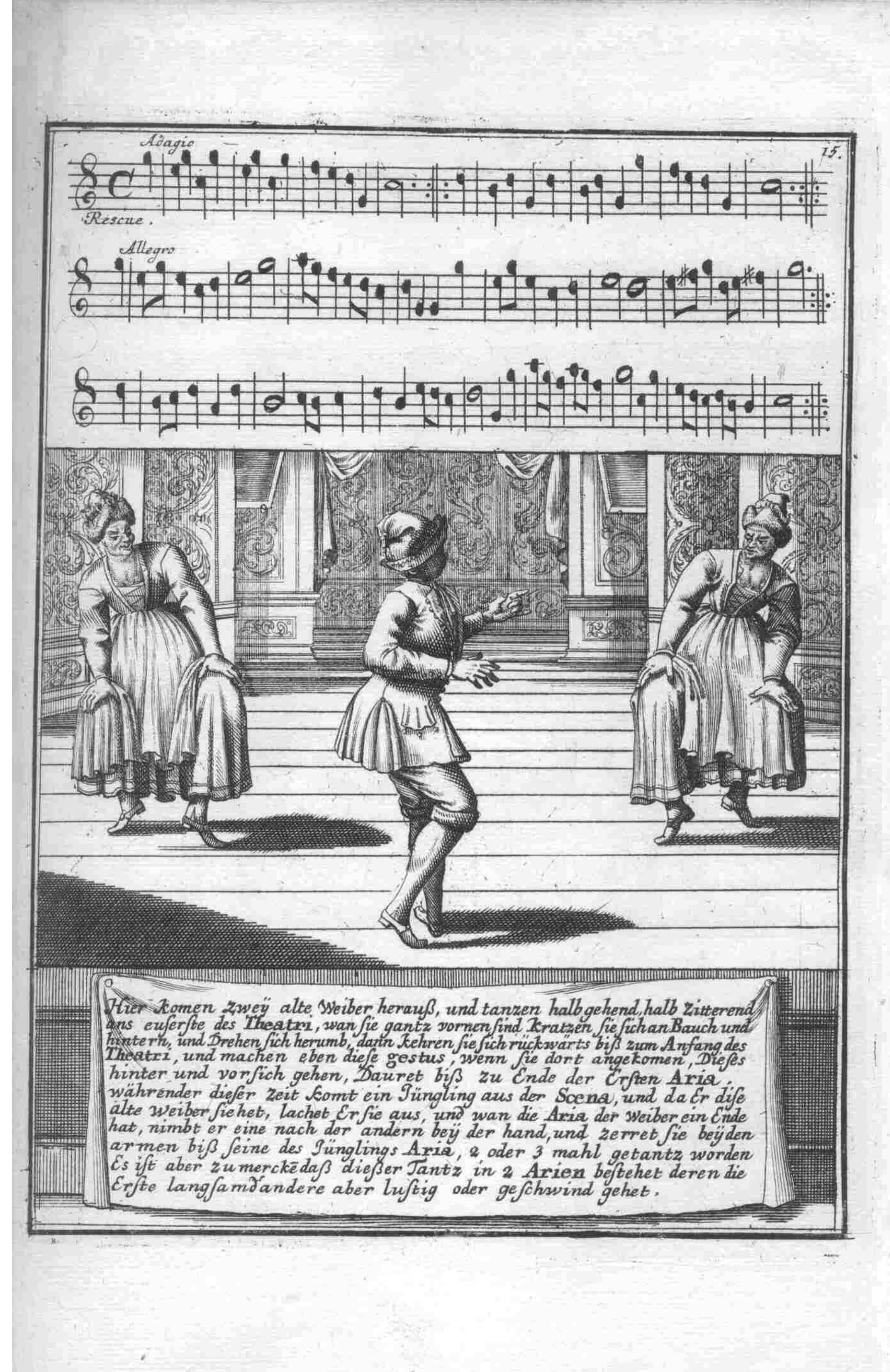
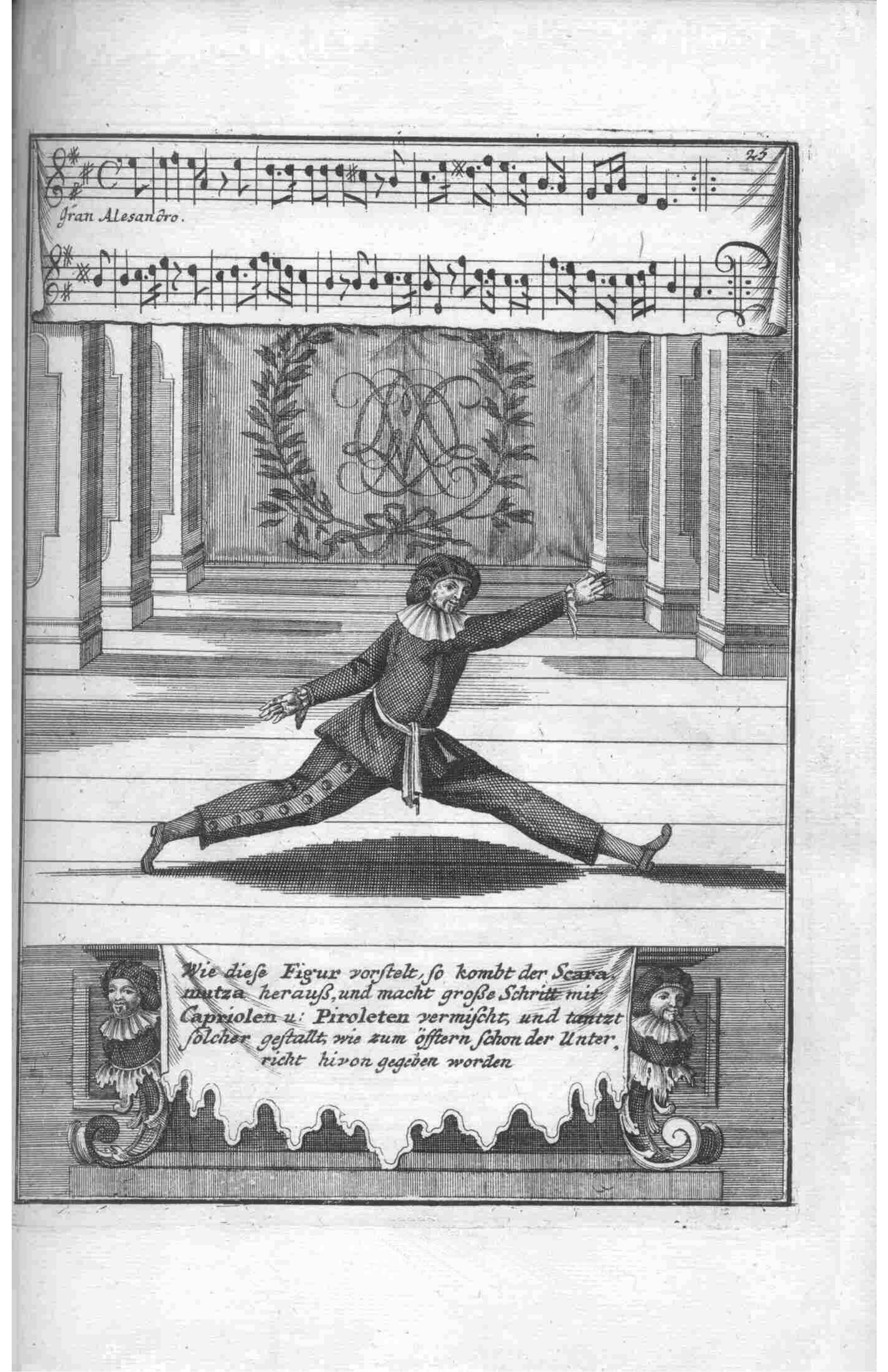
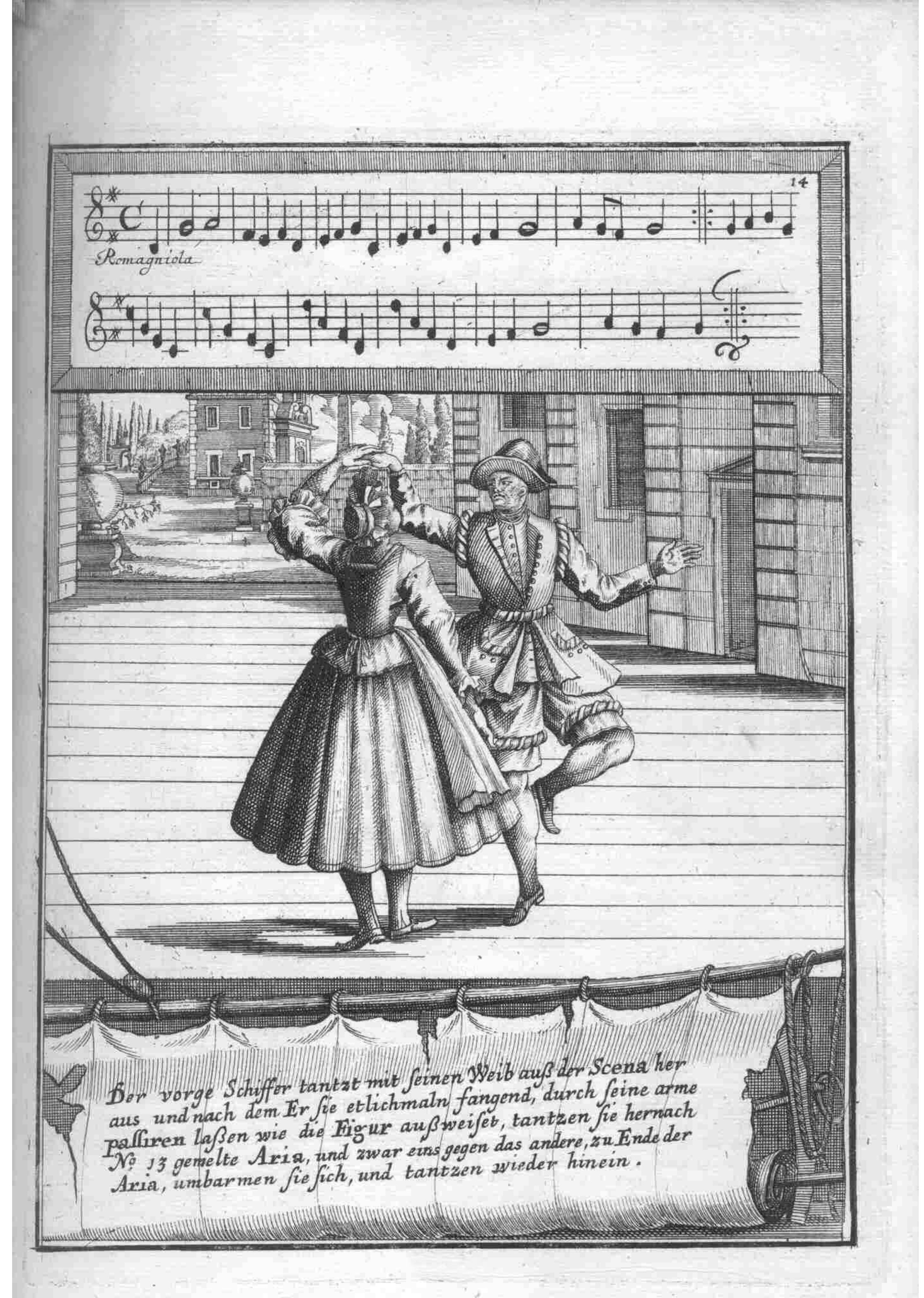
A man and woman in pastoral or country dress occupy a wooden stage framed by a draped curtain. The woman, positioned slightly forward and to the left, wears a full skirt with deep pleats and a fitted bodice; the man, in breeches, stockings, and a plumed hat, stands to her right with one leg extended in a lunging position. Both figures are captured mid-movement in what appears to be a sprightly traveling step or chassé. The stage is rendered in strict perspective with wooden floorboards receding toward the back, where a landscape with a building and cypress trees suggests a rural setting. The engraving is spare but precise: the figures cast no shadows, and all detail is achieved through line work alone. Above the scene, two staves of musical notation—labeled "Romagniola"—show the melody that accompanies this dance. Below, a German-language verse in a cartouche describes the dance and the dancers' performance. The overall effect is didactic: this is a teaching page, not a narrative image.
The dancing
Both dancers stand upright with engaged posture. The man's weight appears to be shifting onto his extended leg; his arm gestures suggest forward momentum or balance recovery. The woman's body is turned to face him; her skirt's volume and the rendering of its folds suggest active movement rather than a static pose. Neither dancer touches the other, though they face and relate to each other across a small distance—characteristic of partner dances where contact is not constant. The spacing and opposing leg positions suggest a traveling step executed together but in parallel or alternating rhythm rather than in closed hold.
The dance depicted
This is a theatrical dance from the early 18th-century Italian tradition of theatrical dance pedagogy, most likely a country or pastoral galliard variant—a form that remained popular on stage well into the 18th century even as court dance had moved toward the minuet. The notation, the rural costuming, and the paired male-female figures are consistent with dances designed for stage performance in the commedia dell'arte or spoken theatre tradition. The notation shows melody without rhythmic or kinetic detail; the image itself is the primary choreographic record. The dance appears to be constructed from traveling steps (chassés or bourrées) executed with sprightliness and a sense of playful courtship, common themes in pastoral theatrical pieces of this era.
How it was made
This is a copper-plate engraving, a process that allows fine linear detail and was the standard medium for printed dance instruction in the 18th century. Engraving enabled mass reproduction and wide circulation—each plate could produce hundreds or thousands of prints. The technique required the artist to work in reverse on the copper surface, planning the composition carefully beforehand. This particular engraving demonstrates skilled use of parallel lines (hatching) to create tone and volume, especially visible in the rendering of the dancers' clothing and the stage floor. The precision required by engraving meant that every detail—the set of the shoulders, the angle of the leg, the folds of the skirt—was a deliberate choice.
About this work
This is Plate 13 from Gregorio Lambranzi's *Nuova e curiosa scuola de' balli theatrali* (Nuremberg, 1716), one of the most significant dance instruction manuals of the early 18th century. It pairs a notated melody with an engraved stage scene showing two performers in the act of dancing. The work belongs to a tradition of pedagogical printmaking that treated dance as both a visual and a musical art, requiring the reader to interpret the image and the notation together. Lambranzi's manual was influential throughout Europe and is one of the few sources that document the stage dances performed in Italian and German theatre during this period—dances that would otherwise have left no trace. The print captures not a famous dancer or a famous court, but the practical work of transmitting technique and choreography through the medium of the engraved page.
How to look at it
The viewer should attend to the *relationship* between notation and image. The melody above is in two brief phrases; the dancers' positions suggest a simple, repetitive movement structure—likely the kind of choreography that could be picked up by a performer in a few rehearsals and executed reliably on stage. Notice the suspended moment chosen: the man's extended leg and the woman's turned body suggest forward momentum, but neither dancer is caught in an extreme or balletic position. This is working theatre, not display. The pastoral costumes and the rural setting suggest that this dance was meant to signal 'country' or 'innocence'—a common theatrical signal of the period. The precision of the engraving allows us to see the exact set of the shoulders, the angle of the arms, and the drape of the fabric, implying that these details mattered to the choreographer and the teacher using this book.
The artist
Gregorio Lambranzi (also known as Gregor Lambranzi) was an Italian dance master and choreographer active in the early 18th century. His *Nuova e curiosa scuola de' balli theatrali* (1716) is his primary surviving work; it is the only major source to document theatrical dance technique and choreography from this era. The manual contains 52 engraved plates, each pairing a musical notation with a stage scene. Lambranzi likely worked with a skilled engraver to realize his designs; the precision of the engraving suggests close collaboration or direct involvement by someone who understood both dance and the technical demands of the medium. His work suggests he was employed in theatrical circles in Nuremberg or southern Germany, where the manual was published.
The period
The early 18th century was a moment of transition in European dance. The court dances of the Baroque—the minuet, the bourrée, the gavotte—were still being refined and were spreading from France across Europe as markers of gentility. At the same time, theatrical dance was developing its own vocabulary, distinct from court practice. Lambranzi's manual documents this theatrical tradition at a point before the eventual dominance of ballet as we know it. The notation system shown here is not the Beauchamp-Feuillet system used for court dances, but a simpler melodic notation—suggesting that theatrical dance was transmitted more by watching and imitation than by written scores. Socially, this was the era of the traveling theatre, the commedia dell'arte, and mixed professional entertainment in German and Italian cities. Dance in this context was populist and pragmatic, designed for effect on stage rather than for display of rank.
Where it lives
This plate is from *Nuova e curiosa scuola de' balli theatrali*, published in Nuremberg in 1716. The work survives in multiple copies in libraries and collections across Europe and North America. The source cited here is the Library of Congress, indicating this impression is held in a major research collection.
Dance in this work
Questions about this work
Is this a minuet?
Unlikely. The costume, notation, and the theatrical setting suggest a country or pastoral dance—a genre distinct from the court minuet, which was more formal and more static. The energy and spacing here suggest a dance designed for comic or romantic effect on stage, not for display of courtly manners.
Why is there music at the top?
Because dance and music were inseparable. The notation allows a musician to accompany the dance; it also tells the performer the speed and character of the movement. Without the music, the image alone is incomplete—the reader needs both the visual and the sonic information to understand and perform the dance.
How do we know how to actually do this dance?
We don't, completely. The image shows position and gesture, but not the full sequence or the exact timing of steps. Lambranzi's manual assumes the reader already knows the basic vocabulary of steps (bourrées, chassés, etc.) and can fill in the details from the image. Modern reconstructions require informed guesswork based on other sources and an understanding of the dance vocabulary of the period.
Who was this made for?
Likely for theatre people—dancers, musicians, choreographers, and perhaps stage directors in German-speaking cities. It may also have been used by dancing masters to teach theatrical style. The manual circulated but was probably too specialized for a purely social dancing audience.
More Notation/Choreography artwork