32 works in this view — arrow keys or swipe to move between them.
Dance in Art
Combat/Duel — Plate 15
Gregorio Lambranzi
- Medium:
- Copper-plate engraving
- Dance:
- Notation/Choreography
- Era:
- 1700s (Enlightenment/Minuet Era)
- Collection:
- Nuova e curiosa scuola de' balli theatrali (1716)
- Source:
- Library of Congress
- Rights:
- Public domain — free to use, share and adapt.
- Recorded as:
- Public Domain
This is primary-source evidence of how combat and rivalry were choreographed and performed on the Baroque theatrical stage—not as naturalistic fighting but as formal, symmetrical, music-coordinated gesture. For historians and dancers, Lambranzi's work is among the few detailed records of early 18th-century theatrical practice before the codification of classical ballet technique, making it invaluable for understanding how dance and drama were integrated in court and commercial theater.
What you are looking at
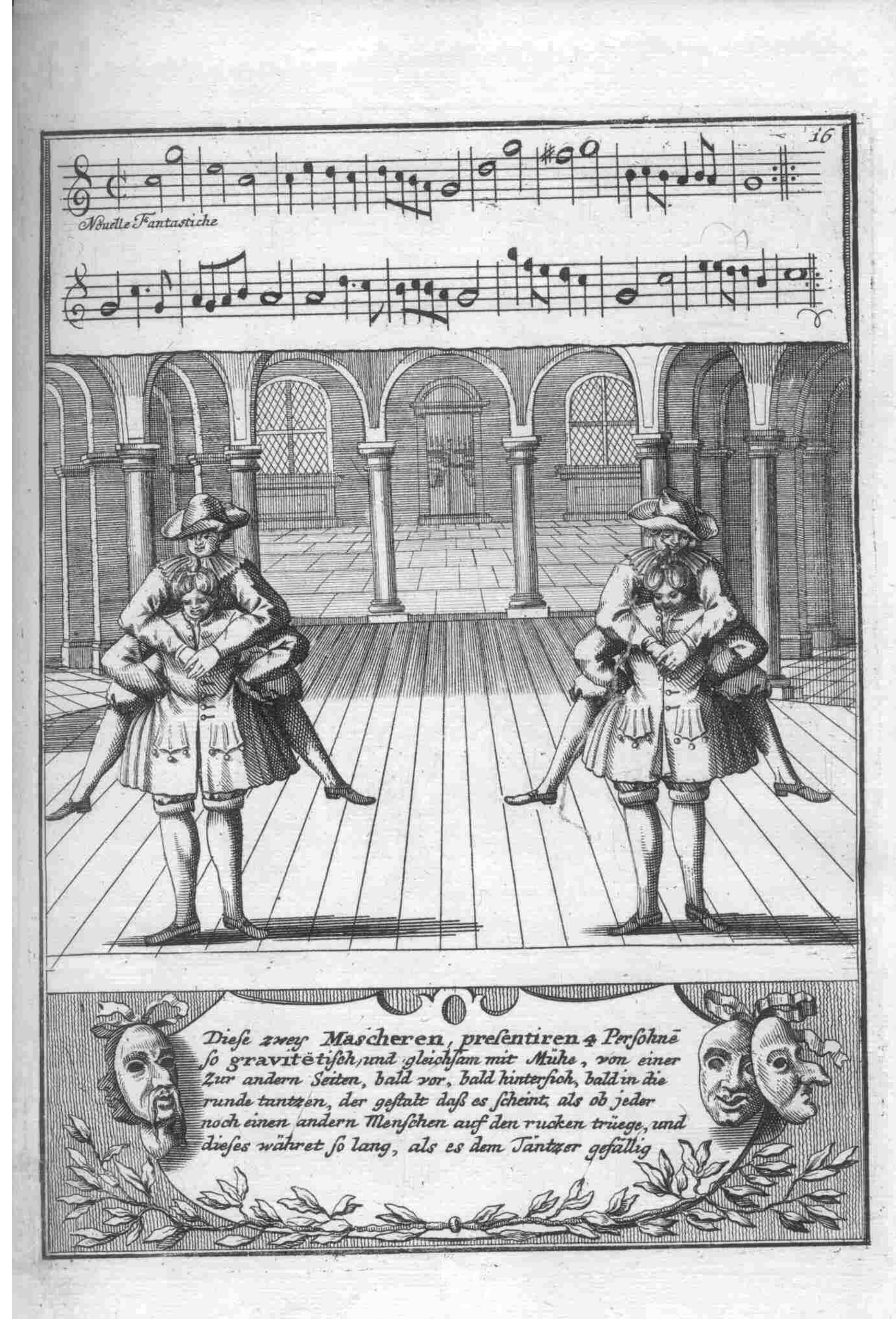
Two men in identical plumed hats and early 18th-century theatrical dress face each other across a vast barrel-vaulted hall supported by columns with arched windows. Each wears breeches, a tunic, and the characteristic silhouette of Baroque stage costume. The space is rendered in careful perspective, its polished floor stretching back to suggest distance and grandeur. The men's postures are mirrored and confrontational: each leans forward slightly, arms raised and bent at the elbow in what appears to be a mock-combat or sparring attitude. Their positioning suggests choreographed opposition—not violence, but formal theatrical play. The engraving's fine parallel hatching creates volume and shadow, emphasizing the theatrical setting and the deliberate staginess of the moment captured.
The dancing
Both dancers stand in a closed, front-facing stance with arms raised to approximately shoulder height, elbows bent, hands open. Their weight appears balanced on both feet in a neutral position—neither lunging nor in extreme extension. The symmetry is exact: the figures are mirror images of each other. Their upper bodies are slightly inclined forward from the hips, and their gaze is directed toward one another. The posture suggests the moment before engagement in a choreographed duel or combat mimicry rather than an actual fight. This is controlled, formal gesture, not explosive movement.
The dance depicted
This depicts a theatrical *combat dance* or *duel*, a staple of 17th and early 18th-century European stage practice, particularly in court ballet and early opera. Such dances were part of the dramatic vocabulary of theatrical performance, used to convey conflict or rivalry between characters while maintaining the decorum and formality of court entertainment. The music notation at the top—labeled 'Menuet Fantaisque' (Fantastic Minuet)—suggests the combat was choreographed to a minuet rhythm, making it a dramatic pantomime-dance hybrid. These were performed by professional dancers and actors on stages like the one depicted, combining spoken dramatic action with stylized movement. The gesture and spacing indicate sparring or pretend combat rather than earnest fighting, maintaining the theatrical convention of the period.
How it was made
This is a copper-plate engraving, a technique requiring the artist to incise lines into a polished copper plate with a burin, then ink and press the plate to paper. Engraving allows fine detail and precise parallel hatching for tonal gradation, visible here in the architectural rendering and the fabric folds of the dancers' costumes. The technique was laborious and expensive but produced clear, reproducible images suitable for instructional purposes. This plate is from Lambranzi's *Nuova e curiosa scuola de' balli theatrali* (New and Curious School of Theatrical Dances), Nuremberg, 1716—a treatise designed to record and transmit choreography and stage practice to a learned European audience. Engravings like this circulated in bound collections, reaching dance masters, theater practitioners, and courtiers across Europe.
About this work
This is one of Gregorio Lambranzi's engraved plates documenting theatrical dances performed on the European stage in the early 18th century. It shows a choreographed combat or duel—two identically dressed men in a symmetrical, confrontational stance within a grand classical interior, suggesting the setting of a court or court-adjacent theater. The accompanying music notation and German verse indicate this was a specific, named piece in the dance repertory: a *Menuet Fantaisque* that combined pantomime and formalized movement. Lambranzi's treatise was one of the era's most influential records of how dances were actually performed and staged, and this plate exemplifies his method of pairing notation and illustration to preserve choreographic knowledge. The work belongs to the history of theatrical dance and court performance in the age of Louis XIV's influence and the early development of European opera and ballet.
How to look at it
Attend to the absolute symmetry of the two figures: this is not naturalistic but consciously patterned, emphasizing order and control even in a moment of conflict. Notice the raised arms and bent elbows—not extended in aggression but contained, almost heraldic in their formality. The architectural setting is rendered with the same care as the figures, asserting that this dance belongs to a space of grandeur and authority. The moment chosen is poised and preparatory, not climactic; the viewer is shown the moment before engagement, suggesting the dance is a ritual or game rather than genuine combat. This reflects the Baroque aesthetic principle that all theatrical action should display *decorum*—appropriateness, restraint, and formal beauty—even when depicting rivalry or conflict.
The artist
Gregorio Lambranzi (c. 1655–c. 1725) was an Italian dance master and choreographer active in the late 17th and early 18th centuries. He worked at the court of Nuremberg and gained renown for his choreographic innovations and his systematization of dance instruction. His *Nuova e curiosa scuola de' balli theatrali* (1716), published in Nuremberg with engravings by Christoph Weigel, is his major surviving work and one of the most detailed choreographic treatises of the period. Lambranzi's approach combined musical notation with figural illustration, allowing readers to understand both the rhythm and the physical execution of dances—a pedagogical innovation that influenced dance notation and instruction for generations. The treatise covers court dances, theatrical spectacle dances, and character dances, offering an encyclopedic view of dance practice in the decades around 1700.
The period
In the early 18th century, theatrical dance was undergoing formalization and systematization. The influence of Louis XIV's court ballet and the rise of professional opera and ballet d'action across Europe had created demand for standardized choreographic knowledge and training methods. Dance masters like Lambranzi responded by publishing treatises with notation and illustrations, establishing dance as a subject worthy of written documentation and analysis—a shift that would eventually lead to the development of Beauchamp-Feuillet notation and later systems. Simultaneously, the *minuet*—the dance Lambranzi pairs with this combat—was becoming the dominant social and theatrical dance form of the aristocracy, and even dramatic action was choreographed to minuet rhythm. This reflects the period's conviction that all movement, including combat and emotion, could be refined and formalized through music and method.
Where it lives
This plate is from Gregorio Lambranzi's *Nuova e curiosa scuola de' balli theatrali* (New and Curious School of Theatrical Dances), published in Nuremberg in 1716. The work is held by the Library of Congress and is catalogued as Plate 15 from this seminal dance treatise. The entire publication consists of engravings by Christoph Weigel after Lambranzi's choreographic designs, making it one of the most comprehensive surviving records of early 18th-century European theatrical dance.
Dance in this work
Questions about this work
What is a 'combat dance' and why would it be performed?
Combat dances were choreographed sequences portraying conflict, rivalry, or sparring between characters on stage. They were integral to court ballet, opera, and theatrical spectacle, allowing drama to unfold through formalized movement coordinated to music. Rather than realistic fighting, they used symmetrical, controlled gesture to convey emotion and narrative while maintaining the decorum expected of court performance.
How do we know what the music sounded like or how to perform this dance?
The notation at the top of the plate—labeled 'Menuet Fantaisque'—indicates it was choreographed to a minuet, establishing the rhythm and meter. Lambranzi's treatise includes written descriptions of steps and positions alongside the engravings, though the notation system of the period is not as detailed as later systems like Beauchamp-Feuillet. A dance historian could reconstruct the approximate sequence and style using period sources and knowledge of minuet technique.
Who would have performed this dance and where?
Professional dancers and actors in court theaters, opera houses, and court spectacles would have performed such choreographed pieces. The grand architectural setting depicted suggests this took place in a princely court or major theater. Lambranzi's treatise was designed to teach dance masters and accomplished dancers, not the general public, indicating this was the domain of trained performers and the educated elite.
Why did Lambranzi publish a book of dances and what makes it important?
Lambranzi published to systematize and transmit the choreographic knowledge of his generation, recognizing that dance was as worthy of documentation and analysis as music or rhetoric. His treatise is now invaluable because it records how theatrical dances were actually performed in the decades around 1700—before the codification of classical ballet—making it one of the few detailed windows into early 18th-century stage practice.
More Notation/Choreography artwork