30 works in this view — arrow keys or swipe to move between them.
Dance in Art
Solo Dancer — Plate 17
Gregorio Lambranzi
- Medium:
- Copper-plate engraving
- Dance:
- Notation/Choreography
- Era:
- 1700s (Enlightenment/Minuet Era)
- Collection:
- Nuova e curiosa scuola de' balli theatrali (1716)
- Source:
- Library of Congress
- Rights:
- Public domain — free to use, share and adapt.
- Recorded as:
- Public Domain
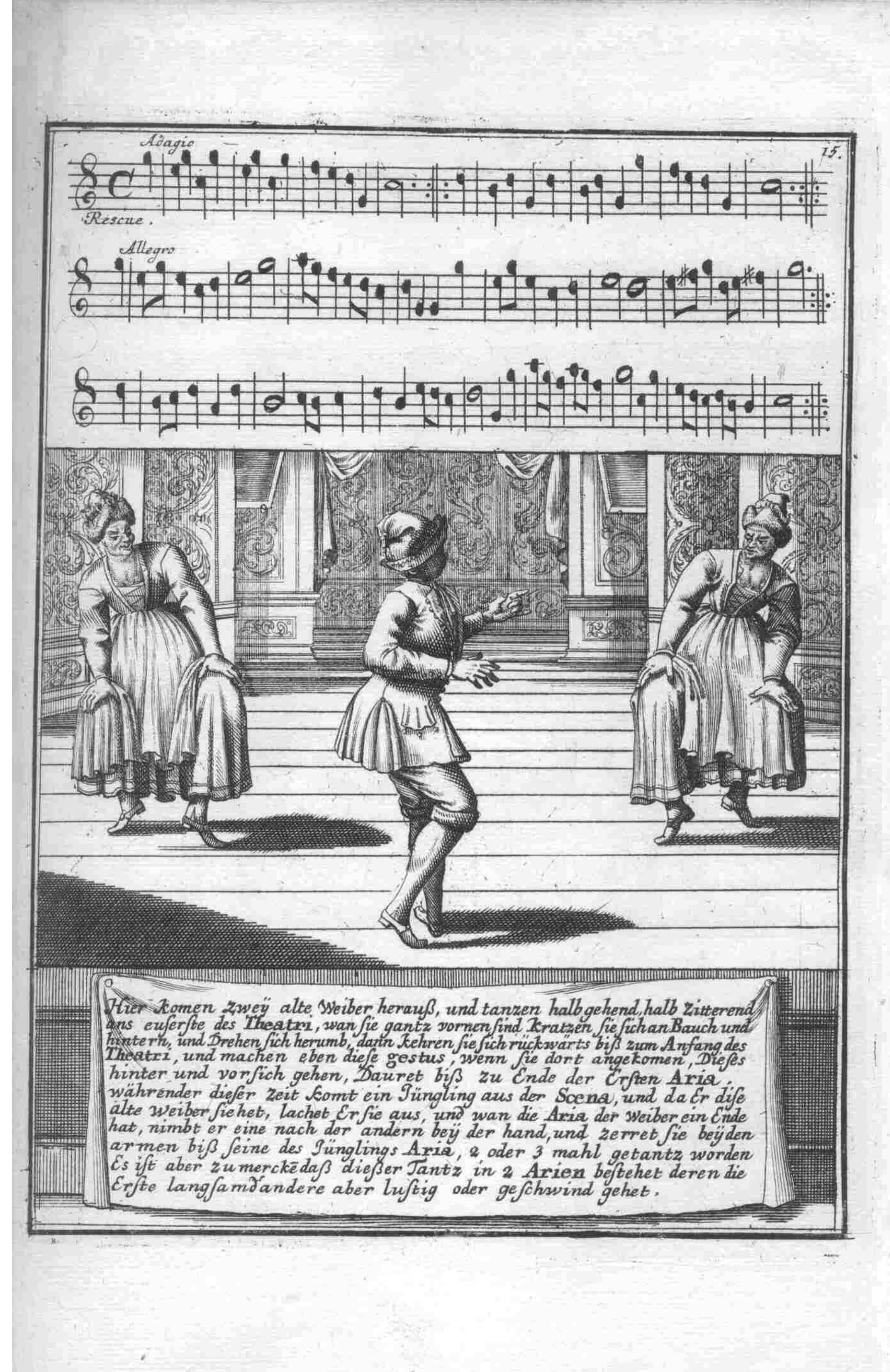
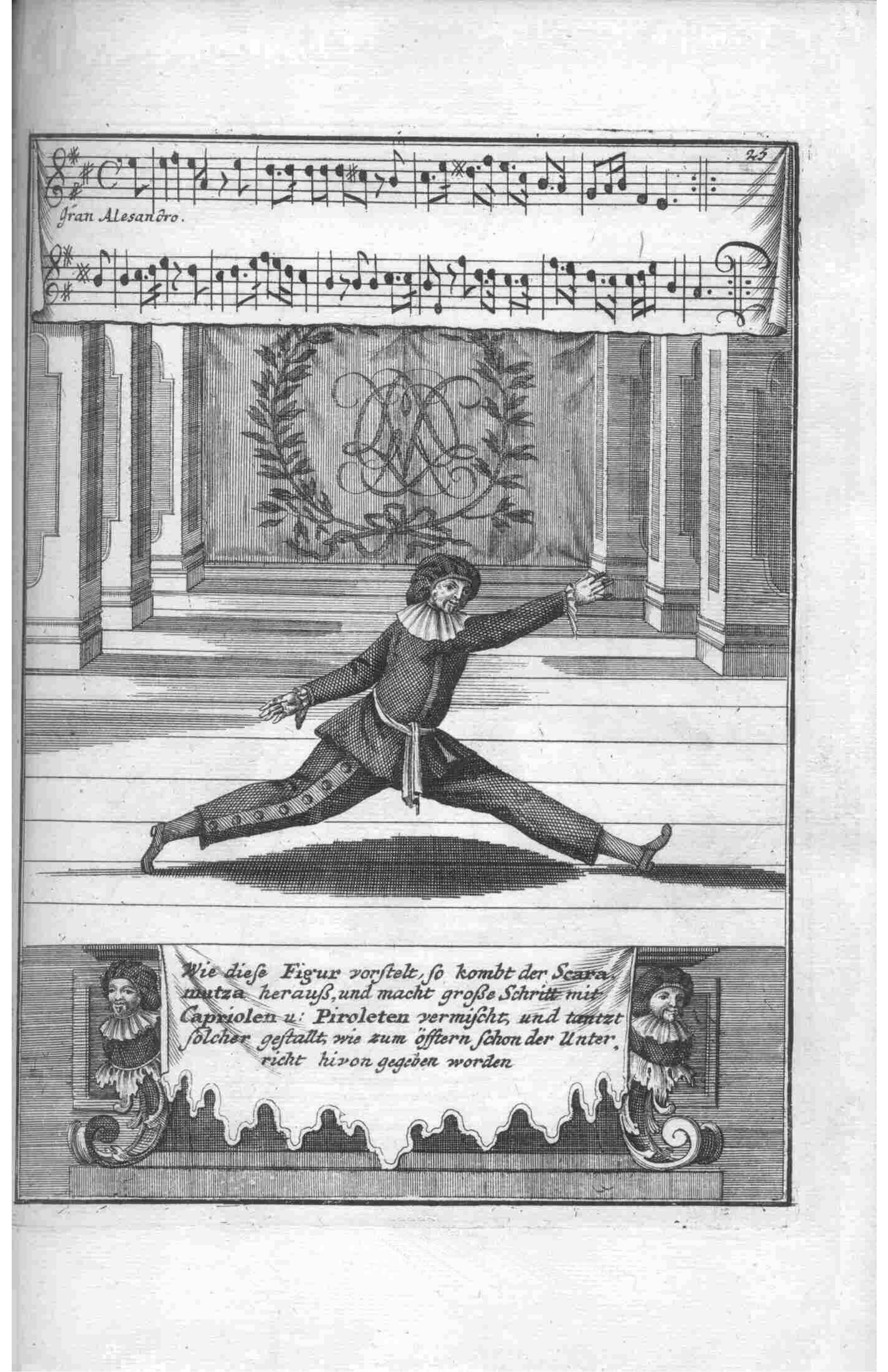
Lambranzi's manual is one of the few surviving visual and notational records of early 18th-century theatrical dance practice, and it remains a crucial source for reconstructing how professional dancers actually performed and what their repertory included. This image is one of dozens in the book that collectively show the range of steps, positions, and theatrical presentations expected of skilled dancers of the era—invaluable evidence for historians and dance reconstructors. The pairing of notation with image was itself innovative and represents an early attempt to solve the problem of how to preserve choreography before film existed.
What you are looking at
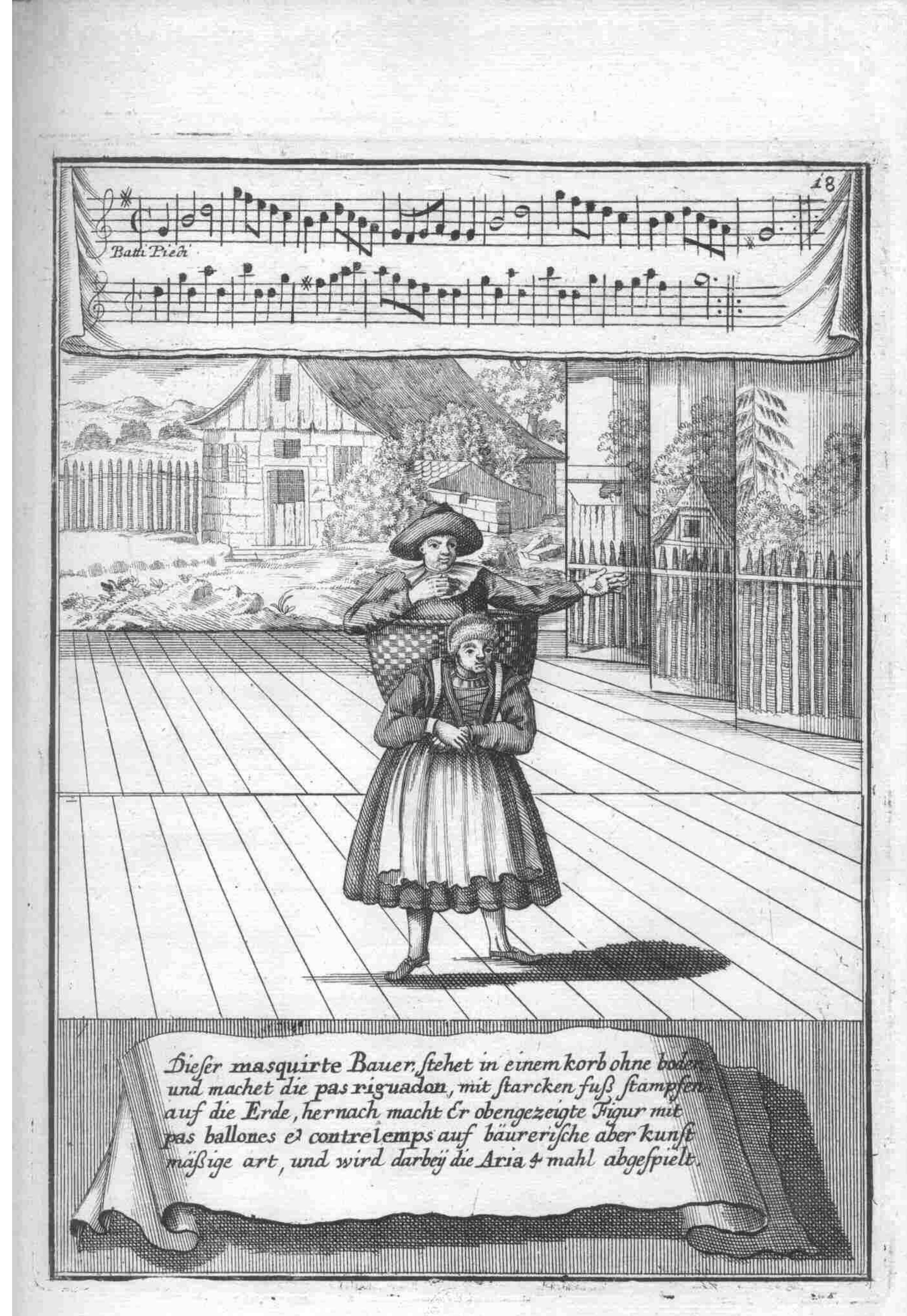
A young female dancer stands alone on a wooden stage floor, positioned center and slightly forward of the picture plane. Behind her, a painted backdrop depicts a rural Baroque garden: a thatched cottage with a steep roof sits in middle distance, flanked by formal gardens with wooden pales and topiary. The sky is cloudless. The dancer wears a dark, richly patterned bodice over a full skirt that falls to mid-calf, with the skirt's hem visibly gathered or scalloped. Her hair is controlled under a dark cap or headdress with a white underlay. Her left arm extends outward and slightly upward in a graceful gesture; her right arm bends across her body. Her weight appears centered, her posture upright and composed. A man's head and shoulders appear behind her—he wears a broad-brimmed hat and appears to be observing or instructing. The composition is framed as a theatrical vignette, with the performers isolated against the stage setting.
The dancing
The primary dancer exhibits an open, presentation-oriented posture with arms disposed in a moderate, courtly frame—neither closed nor embracing, but arranged for display. Her stance is vertical and collected, with no clear weight shift visible; the footwork cannot be determined from this angle and distance. The figure behind her suggests a teaching or partnering relationship, though the spatial separation and his position (observer rather than physical contact) indicates demonstration rather than partner dancing. The dancer's bearing is formal and self-aware, consistent with theatrical or court presentation.
The dance depicted
This is a theatrical dance of the Baroque period, most likely a theatrical minuet, galliard, or courante as performed on the professional stage in early 18th-century Germany. The costume, the formal posture, the stage setting, and the presence of a notation system at the top of the page all confirm this is documentation of a choreographed theatrical work rather than social or folk dancing. The standing pose and arm placement are consistent with the early Baroque theatrical vocabulary. The accompanying male figure may represent a dancing master or partner in the choreography, positioned to show instruction or a duet structure. The notation above suggests this is one movement or phrase extracted from a longer composition.
How it was made
This is a copper-plate engraving, a technique that allowed for precise linear detail and fine tonal gradation through hatching. Engraving required a master craftsman to incise the image in reverse into a polished copper plate; the result could be printed repeatedly and distributed widely. The technique's capacity for sharp definition and delicate line-work made it ideal for documenting choreography and costume, and the durability of the plate meant that manuals like Lambranzi's could be reprinted and circulated across Europe. The marriage of notation (music and choreography) with image was a relatively new publishing practice in the early 18th century and depended on the precision that engraving offered.
About this work
This engraved plate comes from Gregorio Lambranzi's *Nuova e curiosa scuola de' balli theatrali* (*New and Curious School of Theatrical Dances*), published in Nuremberg in 1716—one of the most influential choreographic manuals of the early 18th century. The work systematically documented theatrical dance steps and combinations through the pairing of musical notation with numbered or annotated figures performing on a stage. This particular plate shows a solo female dancer in contemporary court dress, her body arranged in the formal, presentational mode of early Baroque theatrical dance. The image is a primary historical source for understanding how professional dancers moved, how they were costumed, and how choreography was transmitted in the age before film or detailed verbal description.
How to look at it
Note the dancer's preparedness and formality: she is not caught mid-leap or in a moment of dynamic action, but rather held in a composed position that would have been recognized as one of the established attitudes or positions of the Baroque dance vocabulary. The engraver has chosen to show her upright and front-facing, making her costume and deportment legible. The notation at the top is the reason for the image—these are not independently beautiful drawings but documentation tools, and the viewer should understand the image as a key to reading the music and choreographic symbols above it. The presence of the male figure in the background suggests that this is one moment in a sequence or relationship that the full notation would clarify.
The artist
Gregorio Lambranzi (fl. 1703–1720) was a Nuremberg-based dancing master and choreographer whose manual, published in two volumes (German and Italian editions), compiled his system of dance instruction. Little is known of his own performance career, but his position in Nuremberg—a major print center—gave him access to skilled engravers and allowed him to produce a lavishly illustrated treatise. Lambranzi's work represents a synthesis of Italian and German theatrical dance practices and served as a reference for dancing masters across Northern Europe for decades.
The period
The early 18th century was a period of transition in European dance. The court dances of the 17th century (minuet, courante, sarabande) were being adapted for the professional theatrical stage, where they were combined into longer suites and performed with greater virtuosity and elaboration. The rise of professional dance notation—including the Feuillet system (from the 1690s onward)—created a market for manuals and printed choreographies. Simultaneously, Nuremberg's rise as a publishing center made possible the production of illustrated dance books that combined notation, image, and German vernacular instruction. Lambranzi's work arrived at a moment when theatrical dance was becoming increasingly codified and when manuals were becoming a primary means of transmitting technique and choreography across geographical distance.
Where it lives
This plate is part of the *Nuova e curiosa scuola de' balli theatrali*, published in Nuremberg in 1716. The Library of Congress holds a copy of this edition, from which this image derives. The book is a foundational text in dance history and exists in multiple copies in research libraries across Europe and North America.
Dance in this work
Questions about this work
Can we tell from this image what the dancer is doing?
Only in part. The position shown is clearly one of the recognized Baroque dance postures—likely a preparation for or conclusion of a step or phrase. The notation system at the top of the page would specify the exact steps, music, and timing; without decoding that notation, we can see that she is composed and formal, but not which direction she moves next or what the sequence was. This is why Lambranzi provided both image and notation together.
Who was this dancer?
We do not know. Lambranzi's plates are not identified by performer name; they are demonstrations of the choreography and costume associated with particular pieces. The figure is a type (a female theatrical dancer in contemporary dress) rather than a portrait of an individual.
What does the clothing tell us?
The dancer wears the fashionable dress of a prosperous urban woman of the 1710s, adapted for the stage: a boned bodice, full skirt, and controlled headdress. This was the expected costume for female theatrical dancers of the era and indicates that she is a professional performer of relatively high status, not a street dancer or folk performer. The costume also allowed for the kind of upright, collected posture that the dance required.
Why does the man appear in the image?
He may be part of the choreography (a dancing master demonstrating or a partner in the piece), or he may represent the instructor/author's role in transmission. Lambranzi's manual was pedagogical—it showed how steps were done and how to teach them—so the presence of an observing or guiding figure would reinforce that instructional purpose.
More Notation/Choreography artwork