29 works in this view — arrow keys or swipe to move between them.
Dance in Art
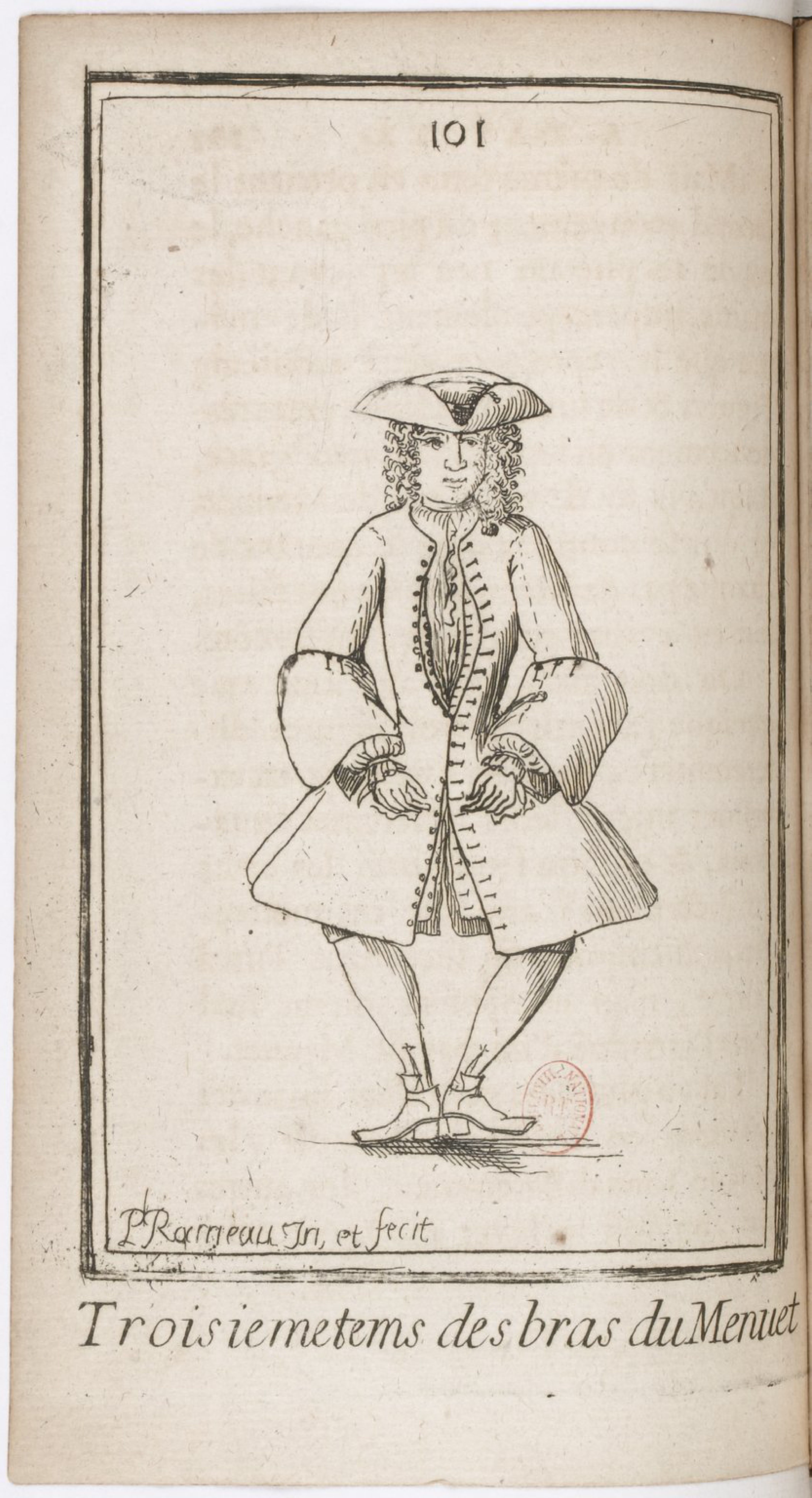
Third Beat of the Minuet's Arms
Pierre Rameau
- Medium:
- Engraving
- Dance:
- Notation/Choreography
- Era:
- 1700s (Enlightenment/Minuet Era)
- Collection:
- Le Maître à danser (1725)
- Source:
- Library of Congress
- Rights:
- Public domain — free to use, share and adapt.
- Recorded as:
- Public Domain
This image is among the earliest visual records of how a specific courtly dance was executed, and the engraved manual was influential enough to shape dance practice across Europe. For historians and dancers, it offers concrete evidence of arm carriage, posture, and costume in aristocratic dance—information that would otherwise be lost to time.
What you are looking at
A single male dancer stands in formal court dress against a plain background, shown at three-quarter length. He wears a tricorn hat, a richly decorated coat with ornamental buttons and embroidered trim down the center front, voluminous breeches gathered at the knee, and heeled shoes with ribbons or bows. His curled hair falls to his shoulders in the fashion of the early eighteenth century. His arms are held in a specific position: one arm extended outward at roughly shoulder height with the hand turned, the other bent with the hand near the body. His posture is upright and composed, his weight distributed evenly on both legs. The engraving is finely detailed with cross-hatching to suggest volume and fabric texture, rendered in black ink on cream paper.
The dancing
The dancer's frame is symmetrical and controlled, with no dramatic weight shift or partnering. The arm position—one extended, one flexed—is precise and ornamental rather than functional. His torso remains vertical and his stance appears stable, suggesting a moment held within a formal sequence rather than a dynamic traveling step. The heeled shoes and the turn-out of the legs indicate training in the courtly dance idiom.
The dance depicted
This is the third beat (or *tems*) of the minuet arm cycle, as the title and inscription state. The minuet was the dominant social dance of the European aristocracy in the early eighteenth century, performed at court and in fashionable assemblies. It was choreographed, not improvised, and the arm work was as codified as the footwork. This image shows the closing position of a three-part sequence, after which the pattern repeats. The restraint and symmetry of the pose are the visual signature of the minuet—ceremony expressed through precise, limited movement.
How it was made
This is an engraving, a technique that allowed fine linear detail and wide circulation through the printing press. Engravings could be bound into instructional books and distributed across Europe, making them essential tools for dance instruction before photography. The precision of the line work here—the careful rendering of buttons, embroidery, and fabric folds—enabled readers to study the posture and costume with accuracy. As one plate in a manual (*Le Maître à danser*), it functions as a teaching image rather than a work of fine art.
About this work
Pierre Rameau's *Le Maître à danser* (Paris, 1725) was one of the first and most influential printed dance instruction books, using engraved figures in sequence to teach the steps and arm patterns of courtly dances. This plate isolates a single moment in the minuet's arm work—the third and final beat of a repeating cycle—and presents it as a stable, readable pose. The work belongs in a history of dance documentation because it is both: a record of how the minuet was actually performed in the early eighteenth century, and an artifact of how dance knowledge was transmitted and standardized before mechanical recording. Rameau's systematic notation in the book anticipated modern dance pedagogy by decades.
How to look at it
Look first at the arm position: notice how formal and controlled it is, how far from natural movement. The extended arm maintains its curve; there is no tension or reach. This is ornament, not function—the point is to display the arm and hand gracefully within a constrained vocabulary. The engraver has chosen to show the figure at rest in this position, not in transition, which is how a teacher would hold it for study. The costume is as important as the body: the coat, breeches, heeled shoes, and tricorn hat are the court dress of the 1720s, and any dancer would have performed in exactly this attire. The three-quarter-length framing allows you to see both the arm position and the stance without distraction.
The artist
Pierre Rameau (c. 1674–1748) was a French dancing master and choreographer active in Paris during the height of French court culture under Louis XIV and Louis XV. He is known almost entirely through *Le Maître à danser*, published when he was in his fifties, which became one of the foundational texts of Baroque dance pedagogy. The book combined written notation with engravings to create a teachable, reproducible system—a significant innovation in an era when most dance knowledge was transmitted orally and by demonstration. Rameau's approach influenced generations of dance masters and helped establish Paris as the center of European dance authority.
The period
The minuet emerged in France in the seventeenth century and became the dominant dance of European aristocratic society in the eighteenth. By 1725, when Rameau published his manual, the minuet was not merely a dance but a marker of gentility and courtly refinement—something every person of quality was expected to perform correctly. The early eighteenth century was also a moment of increasing interest in recording and systematizing dance knowledge; this was the era of Feuillet notation, a graphic system for writing down choreography that appeared in print for the first time in 1700. Rameau's work sits within this broader impulse to codify and preserve dance as an art form worthy of study.
Where it lives
This engraving is from *Le Maître à danser*, published in Paris in 1725. The Library of Congress holds a copy. The book is a bound or stitched collection of engraved plates with accompanying text, making it a printed manual rather than a unique artwork.
Dance in this work
Questions about this work
What does 'troisièmes des bras' mean?
It means 'third beat of the arms.' The minuet arm sequence was divided into three beats, each with a distinct position. This image shows the final position before the pattern repeats. The word *tems* (tact or beat) comes from the musical meter underlying the dance.
Who would have used this book?
Dancing masters and their wealthy pupils—primarily aristocrats and the urban bourgeoisie who aspired to courtly refinement. Rameau's manual was expensive and prestigious, aimed at people who could afford private instruction or wanted to study dance systematically at home.
Why is the pose so stiff?
This is not stiffness but formal restraint, which was the aesthetic ideal of Baroque courtly dance. The minuet required control, symmetry, and grace of gesture. The body was meant to appear composed and elegant, not relaxed or natural. This was how refinement was performed.
Could you actually dance to this image?
Not entirely—you would need the footwork and the full sequence. But if you already knew the minuet, this image would help you correct your arm carriage and understand the precise position of the hand and elbow at this moment in the dance.
More Notation/Choreography artwork