28 works in this view — arrow keys or swipe to move between them.
Dance in Art
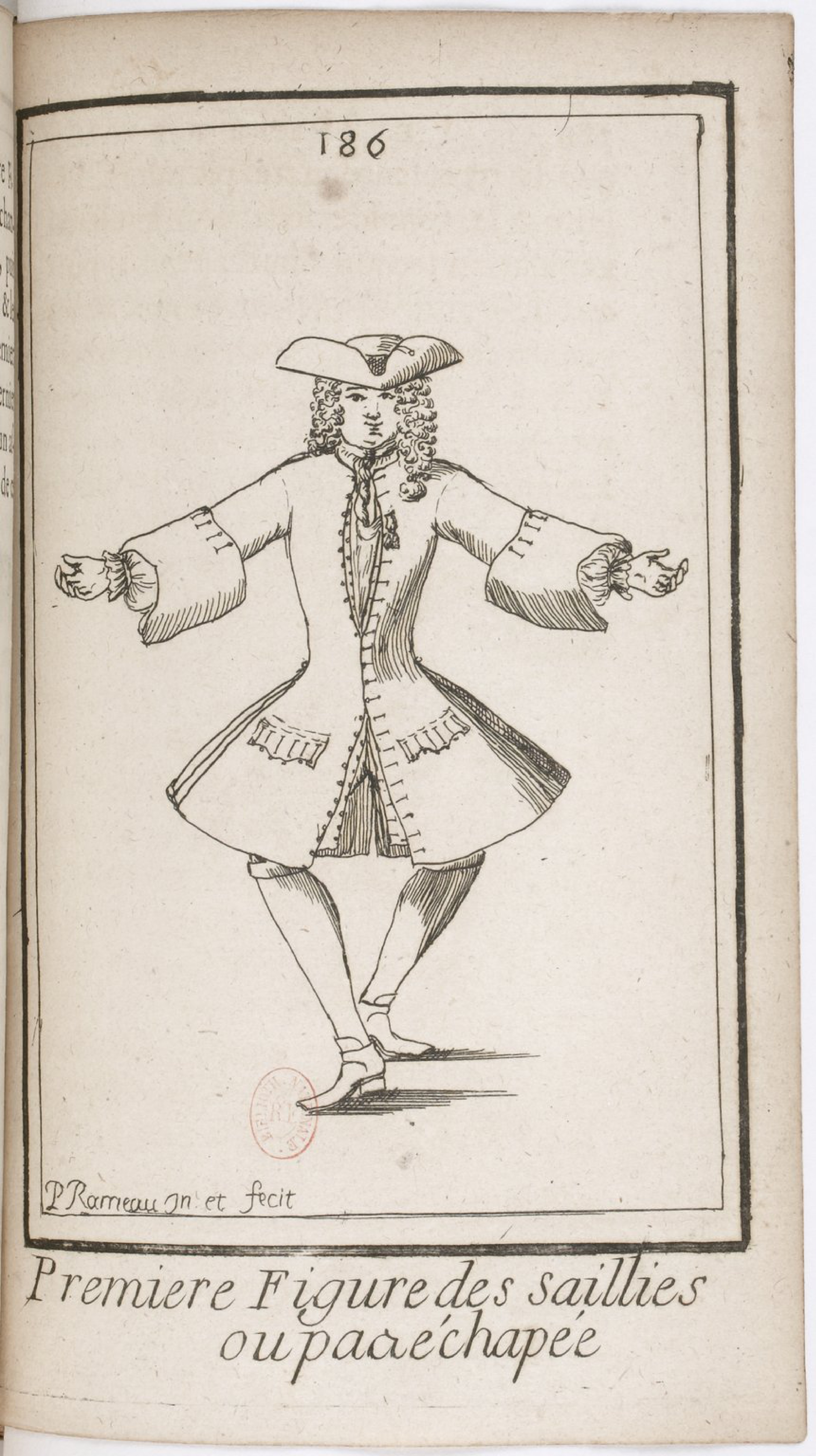
First Figure of the Saillies (Pas Échappé)
Pierre Rameau
- Medium:
- Engraving
- Dance:
- Notation/Choreography
- Era:
- 1700s (Enlightenment/Minuet Era)
- Collection:
- Le Maître à danser (1725)
- Source:
- Library of Congress
- Rights:
- Public domain — free to use, share and adapt.
- Recorded as:
- Public Domain
Rameau's manual is one of the two or three most important surviving sources for baroque dance technique before the late 18th-century Beaumont notation. This image is among the clearest visual records of how a trained courtier held the body and prepared a fundamental step. For historians and reconstructive dancers, it anchors centuries-old written descriptions with concrete visual evidence.
What you are looking at
A single male dancer in aristocratic dress stands in the center of the frame against a plain background, captured mid-movement in what appears to be a teaching or demonstration pose. He wears a three-quarter-length coat with buttons and decorative trim at the hem, a waistcoat with vertical ribbing, breeches, and stockings—the formal dress of the French nobility in the early eighteenth century. His long, curled hair falls past his shoulders in the fashion of the period. His arms are extended outward at shoulder height with palms open and fingers slightly curved, displaying the upper body carriage of formal dance. His legs are in an open position with weight distributed between them, feet turned outward in the five positions fundamental to ballet technique. The engraving is clean and precise, with careful cross-hatching used to model the fabric folds and the contours of the body.
The dancing
One male dancer alone in the frame, standing in what dancers would recognize as a preparation or arrival position. The arms are held in an open, presentational frame at approximately second position, neither fully extended nor relaxed—a deliberate demonstration posture. The legs display clear turnout from the hips, with both feet rotated outward and the body upright and elongated. The weight appears evenly distributed or slightly forward, the carriage erect and dignified. This is a teaching pose rather than a dynamic moment of virtuosity.
The dance depicted
This is the opening or arrival position for the pas échappé (also called saillie in this period), a fundamental vertical jump from a closed position into an open one. Rameau, the era's most respected dance teacher, structured his teaching manual with multiple engravings of the same step to break it into digestible moments, and this appears to be the first in that sequence—the stance the dancer assumes before beginning the jump. The pas échappé was a core element of French baroque dance vocabulary, performed in social dancing, opera-ballet, and the formal choreography of the court.
How it was made
This is an engraving—a line-based intaglio process in which the image is incised into a metal plate and printed. The technique allowed for precise, repeatable reproduction and made it the standard medium for instructional dance manuals of this period. The clean lines and careful detail show the engraver's hand worked from a drawing, probably by or under the supervision of Rameau himself. As part of a printed book, this image had wide circulation among dance teachers and ambitious amateurs across Europe, making it a teaching tool rather than a unique or precious object.
About this work
This is the first of three or more linked engravings showing the pas échappé, a jump fundamental to French baroque dance. Pierre Rameau's *Le Maître à danser* (The Master of Dancing), published in Paris in 1725, broke down complex steps into sequential stillpoints so that readers could understand and practice the technique from the page. The figure shown here—poised, upright, arms open—is the moment before the jump, when the dancer gathers intention and prepares the body. It is a document of how the dance was taught and a record of what early eighteenth-century aristocratic dance actually looked like, captured not as performance but as instruction.
How to look at it
Look first at the body carriage: the upright spine, the open and elongated line from fingertips through the crown of the head, the complete turnout of the legs from the hip. This is the cultivated posture of French baroque dance, radically different from modern ballet's line. The arms are shown in a position of display and control, not raised high or dropped low—a middle ground appropriate to a moment of preparation. The clothing tells you this is elite, courtly dance: the coat, the degree of grooming, the assumption that the dancer was also a nobleman. The engraving technique itself—the clean lines, the even cross-hatching—reflects the rational, reproducible knowledge of the early Enlightenment: movement can be captured and taught.
The artist
Pierre Rameau (fl. 1700s) was the pre-eminent dance master of early-18th-century Paris and the author of *Le Maître à danser* (1725), the first major European dance manual organized as a pedagogical sequence rather than a catalog of figures. He was known for clarity in teaching and for his influence on French provincial and aristocratic dance practice. The manual—illustrated with numerous engravings—became foundational to dance instruction across Europe and was republished and imitated throughout the century.
The period
In 1725, French baroque dance was at the height of its formal elaboration. The dances of the court and public theater—including the opera-ballet that was flourishing at the Académie Royale de Musique—depended on a shared vocabulary of steps and carriage. However, this vocabulary was transmitted orally and through live example; no reliable visual record existed. Rameau's manual was one of the first to attempt a systematic, sequential breakdown of technique using engraved images. It reflects both the growing demand for standardized instruction and the period's faith that complex human movement could be analyzed, frozen, and taught from the page.
Where it lives
This engraving comes from *Le Maître à danser*, a printed dance manual published in Paris in 1725. It is held in the Library of Congress collection. As part of an instructional book, it was created for circulation among dance teachers and serious students rather than as a standalone work of art.
Dance in this work
Questions about this work
What is a pas échappé?
A pas échappé (or saillie) is a vertical jump from a closed position (feet together or nearly together) that lands in an open position (feet apart). It is one of the fundamental petit allégro steps in ballet technique. Rameau's manual breaks it into moments so a dancer can learn the proper preparation, trajectory, and landing.
Why is Rameau's manual important?
It is one of the earliest European dance manuals to use sequential engravings to teach technique. Before notation systems were reliable, dance was learned by watching and imitating a live teacher. Rameau's book attempted to freeze and analyze movement on the page, making dance instruction more systematic and reproducible. Dancers and historians still use it to understand how baroque steps were actually performed.
What does the clothing tell us?
The coat, breeches, stockings, and curled hair are the formal dress of French aristocracy in the 1720s. This tells us that ballet and courtly dance were practiced by nobles and that the dance master's role was to refine and formalize their movement. The clothing also made turnout and upright carriage visible—much more so than modern dance tights.
Is this a single moment or a composite?
It is a single moment: the preparation or arrival stance before the jump begins. Rameau would have drawn or described the jump in several sequential images—takeoff, flight, landing—so a reader could understand the step as a continuous action viewed in parts.
More Notation/Choreography artwork