27 works in this view — arrow keys or swipe to move between them.
Dance in Art
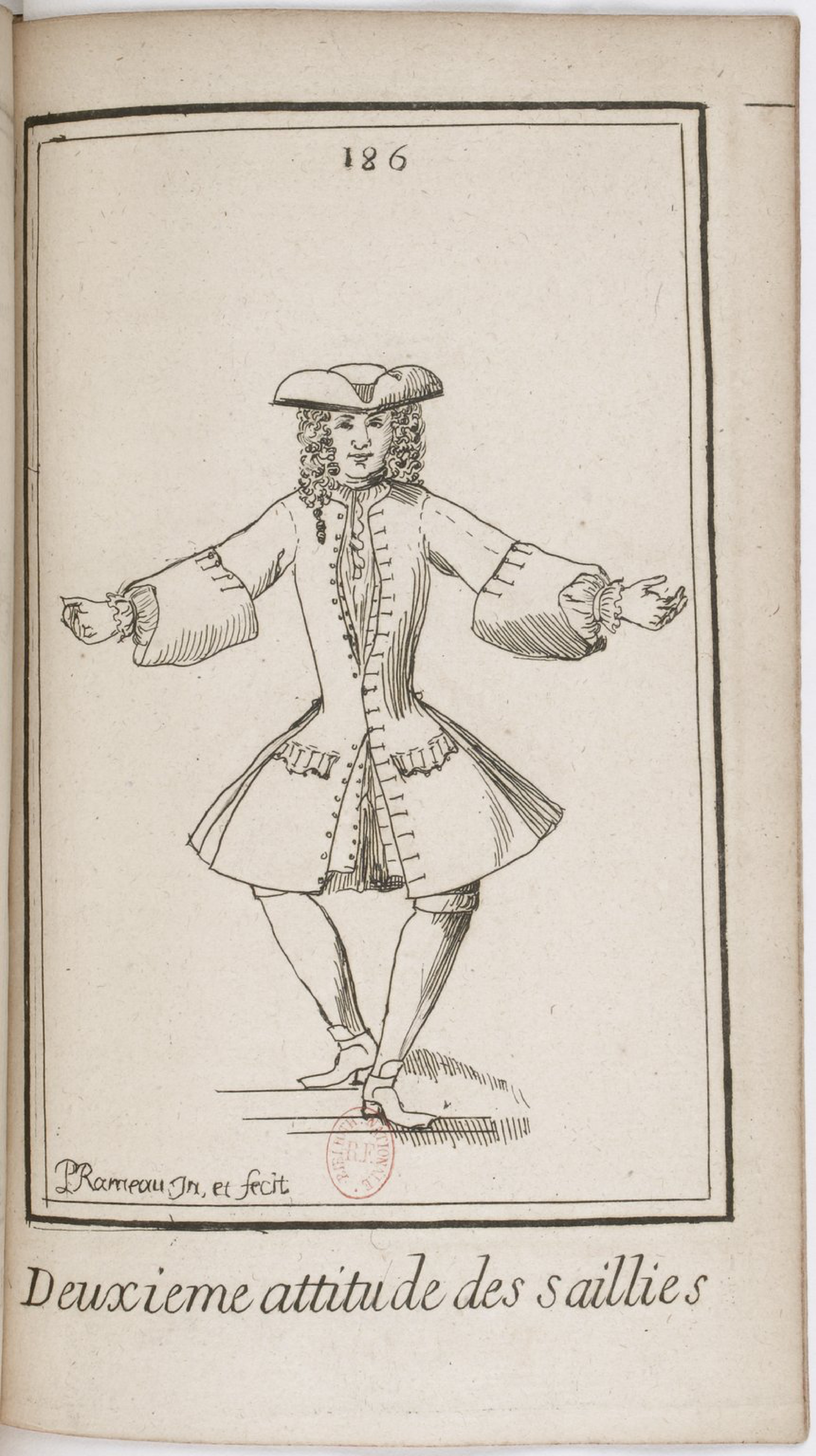
Second Attitude of the Saillies
Pierre Rameau
- Medium:
- Engraving
- Dance:
- Notation/Choreography
- Era:
- 1700s (Enlightenment/Minuet Era)
- Collection:
- Le Maître à danser (1725)
- Source:
- Library of Congress
- Rights:
- Public domain — free to use, share and adapt.
- Recorded as:
- Public Domain
This plate is evidence of how Baroque dance technique was codified and taught in the early eighteenth century. For dancers and historians, it offers a rare window into the actual mechanics of a step—not how it was described in words, but how a master believed it should look. The series of plates of which this forms part represents one of the clearest early modern attempts to translate human movement into visual and graphic form.
What you are looking at
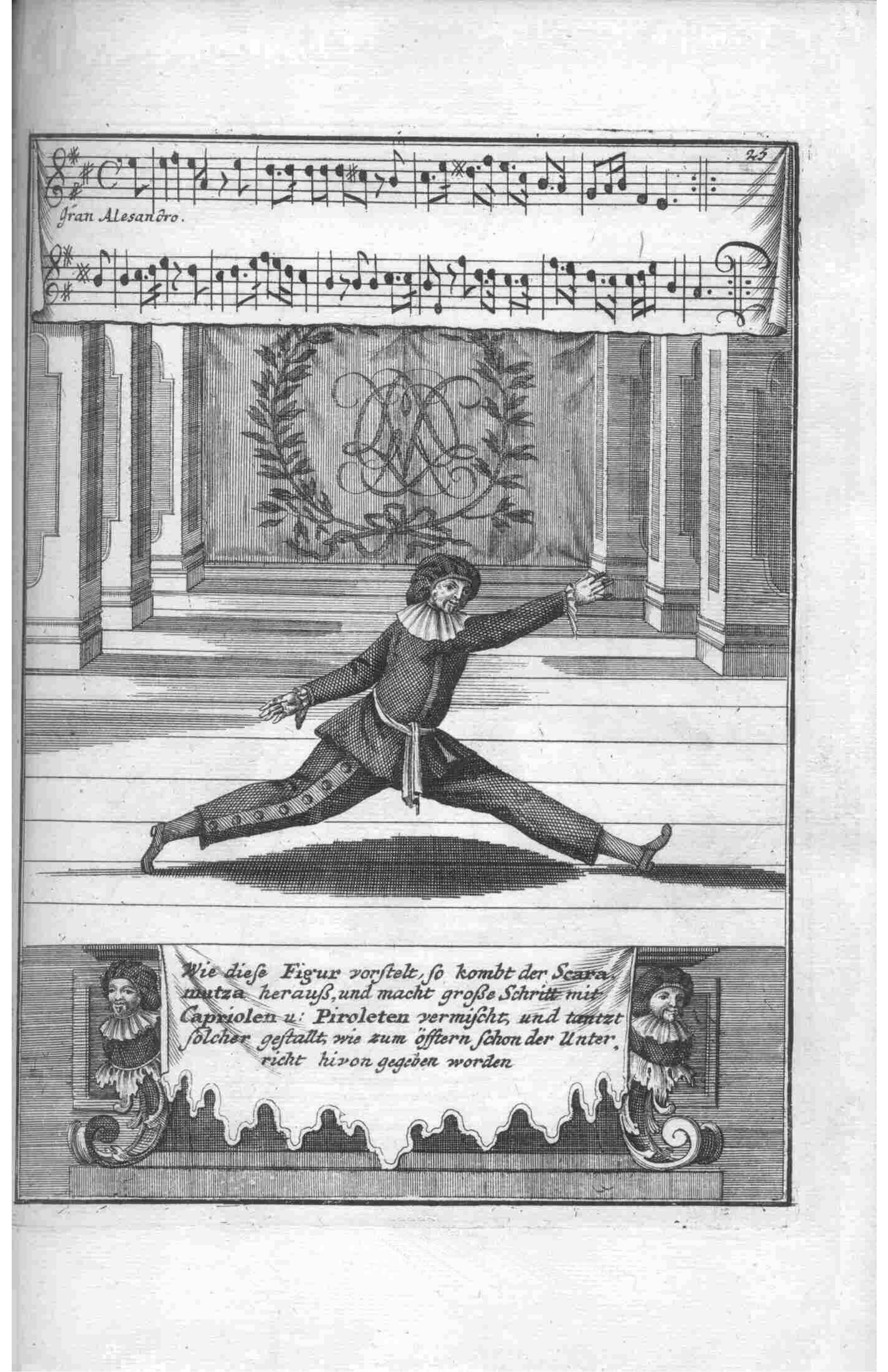
A single male dancer in court dress stands in a frontal pose against a plain background, captured mid-movement in what appears to be a technical demonstration. He wears a tricorn hat, a buttoned coat with decorative buttons running down the front, and a knee-length skirt with pleated sides and decorative ruching at the hem. His legs are encased in stockings, and his feet are positioned in a wide, open stance. His arms are extended outward at shoulder height, palms open in a gesture of balance and display. The engraving is finely detailed with cross-hatching to create volume and shadow, particularly in the folds of the coat and the articulation of the legs. The figure's posture and positioning suggest a moment captured mid-technique rather than mid-narrative: this is a pedagogical image meant to isolate and demonstrate a specific movement quality or step.
The dancing
A single male dancer in three-quarter view, weight distributed between both feet in a wide, turned-out stance. The arms are held at shoulder height with elbows bent and palms facing outward—a pose of presentation and balance rather than embrace or narrative gesture. The body is upright and composed, with no visible strain; the positioning suggests control and technical precision. The wide stance—feet apart, legs straight and turned out—is the salient feature of the moment being demonstrated. This is fundamentally a soloist's position, not a partnered frame.
The dance depicted
This is a technical demonstration from Rameau's instructional manual, showing a specific moment within the *saillie* (also spelled *sauté*), a jumping or bounding step fundamental to Baroque social dance. The catalogue record identifies this as the 'second attitude' or middle phase of the step, where the dancer has landed and opened from a closed position into the wide stance visible here. The *saillie* appears as a step in minuets and other court dances of the 1720s. Rameau's three-plate sequence (noted in the existing description) was a systematic breakdown of a single step into its component positions—a method of dance analysis that became characteristic of written dance instruction in this period.
How it was made
This is an engraving, as stated in the record: a printed image made by incising lines into a metal plate and inking and pressing it onto paper. Engraving allowed fine detail and fine line-work, visible here in the cross-hatching used to model the fabric and the body. As part of a bound instructional book (*Le Maître à danser*, 1725), this image was circulated among a literate, educated audience—dancing masters, ambitious amateurs, nobility—who could afford or access the printed manual. The technique and format made dance instruction portable and repeatable in a way that manuscript or oral teaching could not be.
About this work
This is a technical demonstration plate from Pierre Rameau's *Le Maître à danser* (The Dancing Master), a foundational printed instructional manual for French Baroque social dance published in Paris in 1725. The image isolates a single moment in the execution of a *saillie*, one of the standard steps of the minuet and other court dances. Rameau's method—breaking a step into its component positions and illustrating each one—was innovative for its time and set a template for how dance technique would be documented, taught, and transmitted in the printed era. The work belongs to a crucial moment in European dance history when the techniques of the ballroom began to be systematized, written down, and made available beyond the immediate pupil-master relationship.
How to look at it
Look at the width and turning-out of the legs: this is the defining feature of the moment captured. The artist has frozen the dancer at the point of maximum opening, after the step has been executed and the body has settled into its displayed position. The wide stance and open arms are presented as the correct attitude—a moment of achieved balance and control, not a transitory instant in a flowing movement. The frontality of the pose and its formal symmetry reflect the pedagogical purpose: this is a position to be studied, understood, and replicated, not a narrative scene of courtship or social interaction. The engraving's clarity and precision—the absence of background or context—underscores that we are looking at a technical diagram presented in the form of a figure.
The artist
Pierre Rameau was a French dancing master active in the early eighteenth century and the author of *Le Maître à danser* (1725), one of the most influential dance instruction manuals of the Baroque period. The book was republished and translated, establishing Rameau as a significant figure in the codification of French court dance technique. His systematic approach to breaking down steps into component positions—each illustrated with an engraved plate—was pedagogically innovative and influential on later dance notation and instruction methods.
The period
The early eighteenth century saw an increasing formalization and documentation of Baroque social dance in printed form. Before this period, dance instruction was primarily oral and demonstrated by masters in aristocratic households. The growth of a middle class with access to printed materials, combined with the cultural prestige of court dance, created a market for dance manuals. Rameau's work emerged in this context alongside other instructional texts and contributed to the broader Enlightenment impulse to systematize and codify knowledge. The minuet, the primary court dance of this era, was becoming increasingly regulated and technical, and printed guides like Rameau's served both to disseminate proper technique and to standardize it across Europe.
Where it lives
This engraving is held as part of the Library of Congress collection and comes from the 1725 first edition of *Le Maître à danser*, published in Paris. The work is an illustration within a bound instructional manual, not a standalone print, and should be understood as one plate within a comprehensive sequence of technical demonstrations.
Dance in this work
Questions about this work
What is a saillie?
The *saillie* is a Baroque court dance step involving a jump, hop, or bounding motion from a closed position into an open stance. The term comes from the French verb *saillir*, meaning to jump or spring. It appears in minuets and other dances of the seventeenth and eighteenth centuries. Rameau's detailed breakdown of the step into three distinct positions shows the dancer how to execute it correctly.
Who was Pierre Rameau?
Rameau was a French dancing master and author of one of the most important instructional texts on Baroque court dance. His *Le Maître à danser* (1725) was translated into multiple languages and became a standard reference for dancers across Europe. He is known for his systematic, analytical approach to dance technique and for his use of detailed engravings to illustrate positions and steps.
Why are there three plates of the same step?
Rameau's method involved breaking a single step into its component parts or positions—the beginning, middle, and end of the movement. By illustrating each phase separately, he made it possible for a reader to understand the full arc of the step and to study and practice each position independently. This sequential approach became foundational to later systems of dance notation and instruction.
What can we learn from this image about how Baroque dances were actually performed?
The width of the stance, the turned-out legs, the upright carriage, and the controlled arm position all demonstrate the values of Baroque court dance: formality, control, turned-out legs, and symmetry. The fact that Rameau chose to isolate and emphasize this wide, open position suggests it was considered a mark of good technique and a position to be held and displayed rather than passed through quickly.
More Notation/Choreography artwork