26 works in this view — arrow keys or swipe to move between them.
Dance in Art
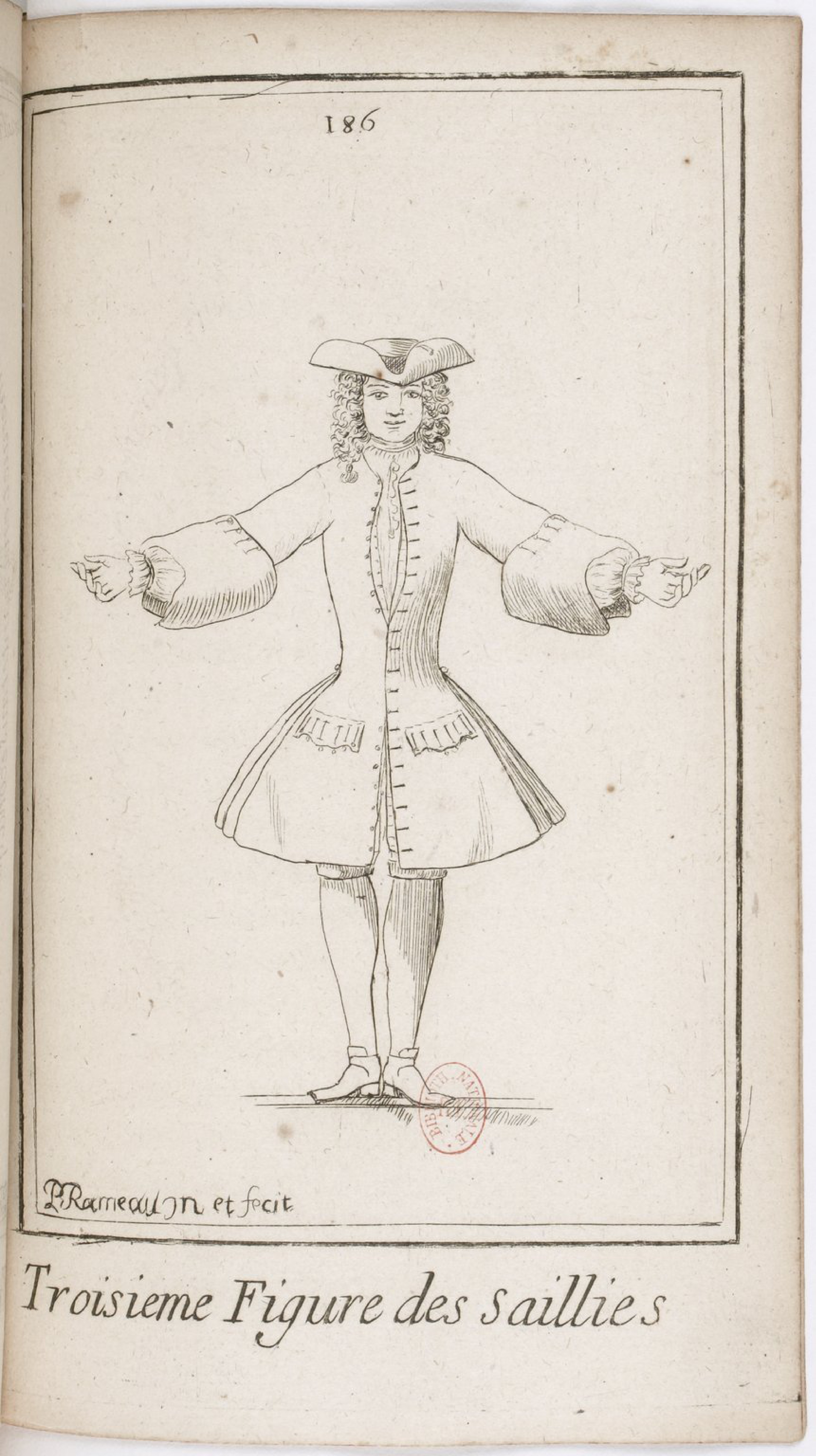
Third Figure of the Saillies
Pierre Rameau
- Medium:
- Engraving
- Dance:
- Notation/Choreography
- Era:
- 1700s (Enlightenment/Minuet Era)
- Collection:
- Le Maître à danser (1725)
- Source:
- Library of Congress
- Rights:
- Public domain — free to use, share and adapt.
- Recorded as:
- Public Domain
This image preserves both the physical vocabulary and the ethical principle of baroque court dance — that nobility of bearing extends even to the recovery from athletic exertion. For historians and dancers, it documents the exact posture and arm position used to conclude a specific jump, and it shows Rameau's pedagogical insight that dance is measured not just by the height of a jump but by the quality of the stillness that follows.
What you are looking at
A single male dancer in elegant court dress stands centered against a plain background, captured in the recovery phase of a *saillie* — the third and final figure of this athletic jumping step. He wears a formal coat with oversized, gathered sleeves ending in deep ruffles at the wrist, a buttoned waistcoat extending to mid-thigh, and a pleated skirt that flares from the waist. His curled hair is crowned with a tricorn hat. His posture is upright and composed, arms extended to either side with palms turned outward in a display gesture, legs straight and together in the supporting stance that concludes the movement sequence. The engraving is rendered in fine black line on cream paper, with close parallel hatching used sparingly to suggest dimension in the sleeves and coat.
The dancing
A single figure photographed from a formal frontal view, standing in what appears to be the closed, collected position of a court dance. The weight appears centered and balanced. Both arms are extended horizontally from the shoulders, elbows softly bent, hands open with palms presented outward in a gesture of completion or salutation. The feet appear together in a closed fifth or neutral position. The body shows no asymmetry or twist — this is the moment of stillness and composure after exertion.
The dance depicted
This is the final figure of the *saillie*, a baroque court jump that appears in Rameau's *Le Maître à danser* as a sequence of three plates showing the approach, the jump itself, and this recovery. The *saillie* was part of the aristocratic ballroom vocabulary of 1720s France, performed by trained courtiers and dancing masters. What Rameau documents here is not a decorative port de bras but the deliberate restoration of elegant repose after an athletic, open-legged jump — the principle that even vigorous steps must resolve into composed stillness. This image is the third in a three-part visual argument about decorum in motion.
How it was made
This is an engraving, a relief print made by incising lines into a metal plate and inking the raised surface. The uniform line weight and precise parallel hatching are characteristic of line engraving in the early eighteenth century. As a page from *Le Maître à danser*, a printed manual, this image was intended for circulation among dancing masters and educated courtiers across Europe — engraving allowed multiple copies to be pulled from a single plate, making technical instruction available well beyond Paris. The technique's capacity for fine, controlled line made it ideal for documenting the exact geometry of a posed figure.
About this work
This is the third figure of the *saillie*, a baroque court jump, from Pierre Rameau's *Le Maître à danser* (1725), a foundational manual for aristocratic dancing masters. It shows a male dancer at the moment he has completed his jump and returned to composed stillness — arms extended, posture upright, feet together. Rameau's three-plate sequence for the *saillie* illustrates a central principle of baroque court dance: that even explosive, athletic steps must be framed and concluded by elegant repose. The engraving format allowed this instructional sequence to be printed and distributed across Europe, shaping how dancing was taught and understood in the Enlightenment.
How to look at it
Attend to the moment: this is not the jump but the instant after, when the dancer has landed and has deliberately composed himself. Notice the arm position — extended but not stretched, palms open as if presenting the body to view or to a partner. The feet are not pointed or placed in an ornamental position, but simply together, grounded. This pose embodies the philosophy that runs through Rameau's teaching: a jump is only complete when it resolves into stillness. Compare this with the previous figure in the sequence (the jump itself) to see how Rameau uses the three engravings to make a temporal argument.
The artist
Pierre Rameau (c. 1674–1748) was a French dancing master and theorist whose *Le Maître à danser* became the most widely read technical manual of the eighteenth century. He designed the work to codify and standardize the technique of noble style (*danse noble*) — the formal, upright carriage and precise footwork that separated aristocratic ballroom dance from entertainment or theatrical forms. Rameau used engraved figures to make abstract principles visible: the alignment of the body, the placement of the feet, the recovery from jumps. He was not an artist but a practitioner, and his collaboration with engravers made his teaching portable.
The period
The 1720s were a moment of formalization and documentation in European court dance. The earlier, more improvisational minuet was being codified into standardized steps and patterns. Rameau's manual coincided with a broader Enlightenment effort to rationalize and systematize knowledge — to write down, measure, and engrave practices that had previously been transmitted orally and physically from master to pupil. The *saillie* itself was a relatively new jump in the baroque vocabulary, prized for its visibility and difficulty, and Rameau's decision to devote three plates to its three phases shows its prestige. The manual was reprinted and translated repeatedly, circulating widely among dancing masters in France, England, and Italy.
Where it lives
This engraving is a plate from *Le Maître à danser*, first published in Paris in 1725 by Michel Bruslé. The work is held by the Library of Congress. This was a widely distributed instructional manual intended for dancing masters and serious students of courtly dance.
Dance in this work
Questions about this work
What is a saillie and why does Rameau show it three times?
The *saillie* is an open jump performed with turned-out legs, a basic but showy element of baroque court dance. Rameau devotes three consecutive engravings to it — approach, jump, and recovery — to enforce his teaching principle: that a jump is incomplete without a composed landing and recovery. The sequence moves from preparation through exertion to stillness, showing that nobility of style lies in the whole movement, not just the moment of lift.
Who would have used this manual?
Dancing masters, aristocratic students, and anyone aspiring to courtly elegance. Rameau's *Maître à danser* was the standard text across Europe in the eighteenth century. Unlike earlier dance treatises, it was written to be portable and reproducible — engraved, printed, and distributed — so it reached beyond the royal court into provincial cities and other countries.
Is this a real person dancing or a generic figure?
It is a generic idealized figure, not a portrait. Rameau worked with engravers to create a standardized male dancer in formal court dress, shown from the front in clear light. The figure serves as a model for imitation — like a diagram — rather than a record of any particular dancer's performance. The precision of the engraving reinforces this teaching purpose.
What does the pose tell us about baroque dance technique?
The upright spine, closed feet, extended arms, and outward-facing palms show that baroque court dance prized vertical alignment, turnout, and an open, presented quality of the body. There is no slack or collapse; even in recovery from a jump, the dancer appears alert and composed. The arm position — horizontal, not overhead or dropped — suggests a controlled, consciously graceful presentation rather than a natural, relaxed stance.
More Notation/Choreography artwork