25 works in this view — arrow keys or swipe to move between them.
Dance in Art
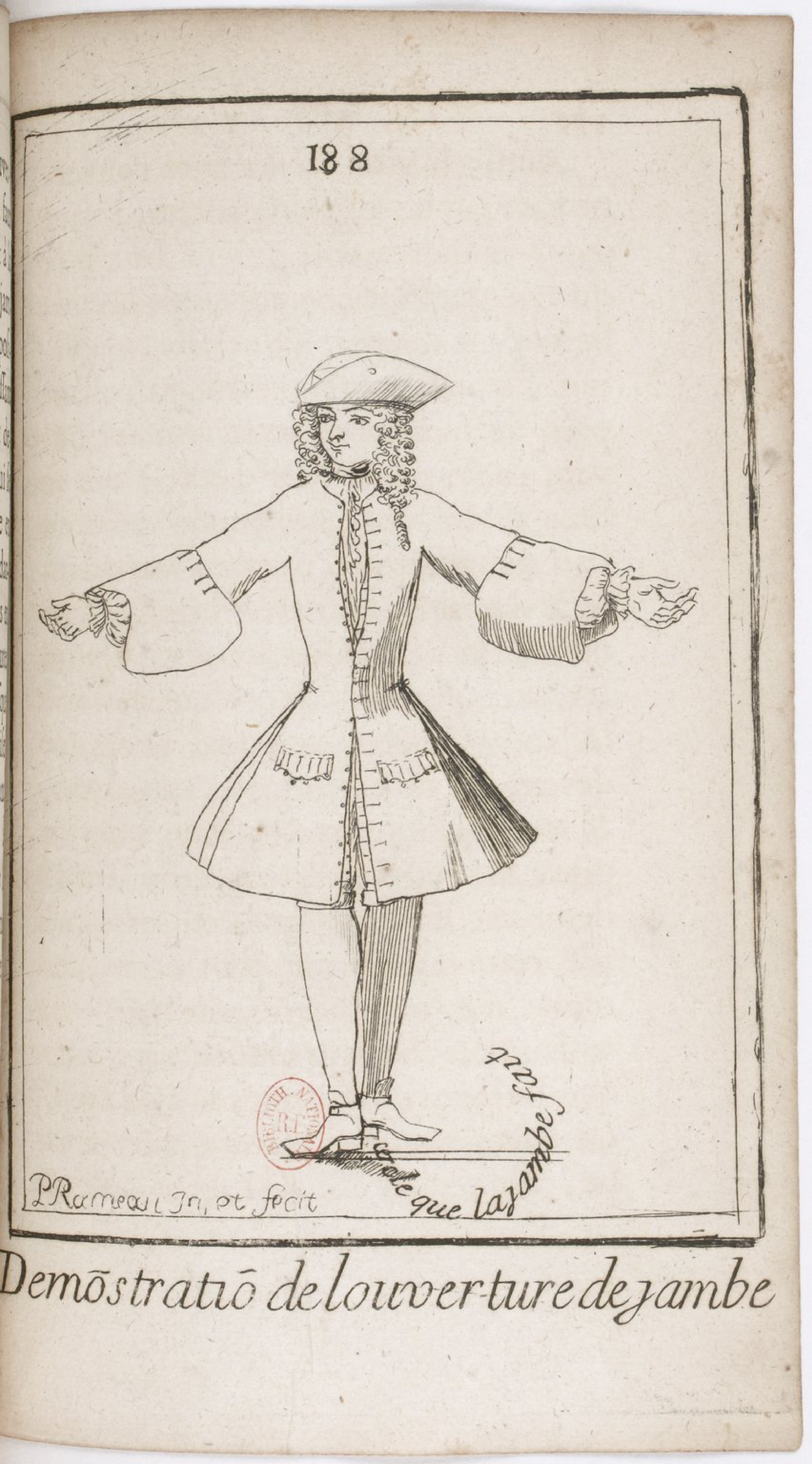
First Figure of the Opening of the Leg
Pierre Rameau
- Medium:
- Engraving
- Dance:
- Notation/Choreography
- Era:
- 1700s (Enlightenment/Minuet Era)
- Collection:
- Le Maître à danser (1725)
- Source:
- Library of Congress
- Rights:
- Public domain — free to use, share and adapt.
- Recorded as:
- Public Domain
Rameau's manual is one of the rare surviving documents that tells us how European court dancers actually moved in the 1720s, and this image of the leg opening captures one of the core technical principles he emphasizes: the difference between trained and untrained movement lies in precision, turnout, and the controlled extension of the limbs from a stable center. For anyone reconstructing or studying Baroque dance, this engraving is a primary source showing not just a step, but the posture and anatomy required to execute it.
What you are looking at
A single male dancer stands in profile against a plain background, dressed in early 18th-century court costume. He wears a coat with wide skirts, ornate buttons or frogging down the front, and decorative cuffs at the wrists; his legs are encased in tight breeches and stockings. His long, curled hair is topped with a tricorn hat. His posture is upright and composed, weight forward, with both arms extended outward at shoulder height, palms open and fingers delicately articulated. His left leg (the one further from the viewer) is extended to the side in a controlled lift from a closed position—this is the *ouverture de jambe* itself, the central subject of the instruction. The stance demonstrates the five positions' closed foundation and the mechanics of opening the working leg while maintaining upper-body stillness and deportment.
The dancing
The single figure maintains an upright, aristocratic frame with squared shoulders and an engaged core. His arms are held in a classical port de bras, extended laterally with soft elbows and relaxed wrists, the hands open and expressive. The weight appears centered over the supporting leg, with no visible sway or loss of vertical alignment. The extended leg is fully straightened, turned out from the hip, and held at approximately waist height; the foot is pointed. This is controlled, geometric movement—the body does not lunge or lean into the extension, but rather holds it as a demonstration of control and refinement.
The dance depicted
This is a technical diagram from Pierre Rameau's instructional manual *Le Maître à danser*, illustrating one of the foundational mechanics of Baroque court dance. The *ouverture de la jambe* (opening of the leg) is a movement in which a dancer extends the working leg from a closed position, typically from first or fifth position, and is essential to the vocabulary of French dance of the period. This specific image shows the first figure or position of that opening—the initial moment of extension. Rameau's method emphasizes precision and turnout as distinguishing marks of trained dancers from the untrained, and this image serves as both technical instruction and aesthetic demonstration. The pose would have been recognized by dancers and nobles trained in courtly movement as fundamental to minuets, gavottes, and other social and theatrical dances of the 1720s.
How it was made
This is an engraving, a relief-printed medium well suited to the precise, linear representation of anatomical detail and geometric clarity. The fine lines allow Rameau to define musculature, the fall of fabric, and the articulation of the limbs without ambiguity. Engravings circulated widely in printed books and could be reproduced accurately, making them the ideal medium for a dance manual intended for distribution among the nobility and professional dancers across Europe. The clarity and repeatability of the technique aligned perfectly with Rameau's pedagogical intent: to codify and standardize the movements of French dance so that they could be transmitted and replicated by students far from a master's direct instruction.
About this work
This engraving is one of a sequence of illustrated positions and movements from Pierre Rameau's *Le Maître à danser*, the most influential French dance manual of the early 18th century. It isolates and examines a single foundational gesture—the outward extension of the leg from a closed stance—that underlies the technical vocabulary of Baroque social and theatrical dance. The image is both anatomical study and aesthetic ideal: it shows what the movement looks like when performed correctly by a trained dancer, and how the body should be organized to execute it. For anyone learning Baroque dance from a printed page rather than a living teacher, this single frozen moment carried the weight of precise instruction.
Rameau's manual occupied a unique position in dance history. Published just as French dance was becoming standardized and codified, and before the five positions had been fully notated in Beauchamp-Feuillet notation, it offered a verbal and visual alternative to notation: clear, teachable prose and careful engravings that could be consulted repeatedly. This image of the *ouverture de jambe* remains one of the clearest historical documents we have of how Baroque dancers were expected to move and carry their bodies.
How to look at it
Pay attention to the precise angle of the extended leg—it is not lifted high or swung dramatically, but held at a controlled height that demonstrates command without strain. Notice the stillness of the upper body; despite the leg's extension, the torso remains centered and upright, the shoulders level, the arms held without tension. The artist has chosen to freeze the moment of sustained extension rather than the moment of opening or closing, emphasizing the ability to hold the position steadily. The open hand and extended arm are equally important to the image; they show that the arms and legs move together as part of a unified, graceful line. The tricorn hat and court coat are not mere fashion detail but necessary context—this is a gentleman dancer demonstrating the movement as a man of breeding would perform it, not a theatrical performer or professional entertainer.
The artist
Pierre Rameau (c. 1674–1748) was a French dancing master and theorist who taught in Paris and worked with the Opéra. *Le Maître à danser* (The Dancing Master), published in 1725, was his major contribution to dance literature and became the standard instructional text of the era. The manual was translated into other languages and reprinted multiple times, establishing Rameau as one of the primary authorities on French dance technique and etiquette. His approach was systematic and deductive: he began with the foundation—the five positions and basic steps—and built toward complex sequences. The engravings throughout the manual were executed with exceptional clarity and anatomical accuracy, reflecting Rameau's conviction that dance could and should be taught through careful visual and verbal instruction.
The period
In the 1720s, dance was at a moment of codification and standardization. The five positions, formalized earlier by Beauchamp, were becoming the universal foundation of court dance teaching. Rameau's manual appeared at the height of the minuet's popularity and social prestige—the minuet was the primary dance of the European aristocracy and a mark of gentility and education. The earlier invention of Beauchamp-Feuillet notation (c. 1700) had made it possible to record dances in written form, but notation was difficult to read and required specialized training; Rameau's manual offered an alternative pedagogical pathway. The period saw increased systematization of dance technique across Europe, and Rameau was part of a broader movement to establish dance as a discipline with teachable, transmissible rules. Visually, the engraved manual allowed dance instruction to be distributed in print form just as the Enlightenment was making systematic knowledge and rational instruction central to pedagogy.
Where it lives
This engraving is one of many illustrative plates from Pierre Rameau's *Le Maître à danser*, first published in Paris in 1725. The work is held at the Library of Congress, where it is catalogued as part of the early printed dance literature collection. The entire manual survives in multiple copies and has been digitized; this image comes from that digitized collection.
Dance in this work
Questions about this work
What is the *ouverture de la jambe*?
It is the extension of the working leg from a closed position, a fundamental movement in Baroque dance. The leg opens (usually to the side) while the dancer maintains an upright posture and turnout. Rameau identified this simple opening as one of the key technical differences between trained dancers and the untrained—a trained dancer can extend the leg smoothly and hold it steady without losing balance or shifting the upper body.
Why did Rameau use engravings to teach dance?
Engravings allowed Rameau to distribute precise visual instruction in printed form, reaching students who had no access to a master teacher. The medium was clear, repeatable, and could be studied repeatedly. Notation (Beauchamp-Feuillet) was another system in use, but it was abstract and required specialized training; Rameau's engravings offered a more accessible alternative.
Is this a real person or an ideal type?
It is likely an idealized figure—a representation of how the movement should look when performed correctly—rather than a portrait of a specific dancer. The purpose was pedagogical: to show the student what correct execution resembles, not to document an individual performance. The anonymous gentleman in court dress serves as a visual standard.
How does this relate to modern ballet?
The five positions and basic techniques shown in Rameau's manual form the foundation of ballet vocabulary today. The *ouverture de jambe* is essentially what modern dancers call *battement* or leg extension. While ballet technique has evolved significantly, the basic anatomical principles—turnout, centered weight, control of the extended limb—remain continuous from the Baroque period through classical ballet to the present.
More Notation/Choreography artwork