40 works in this view — arrow keys or swipe to move between them.
Dance in Art
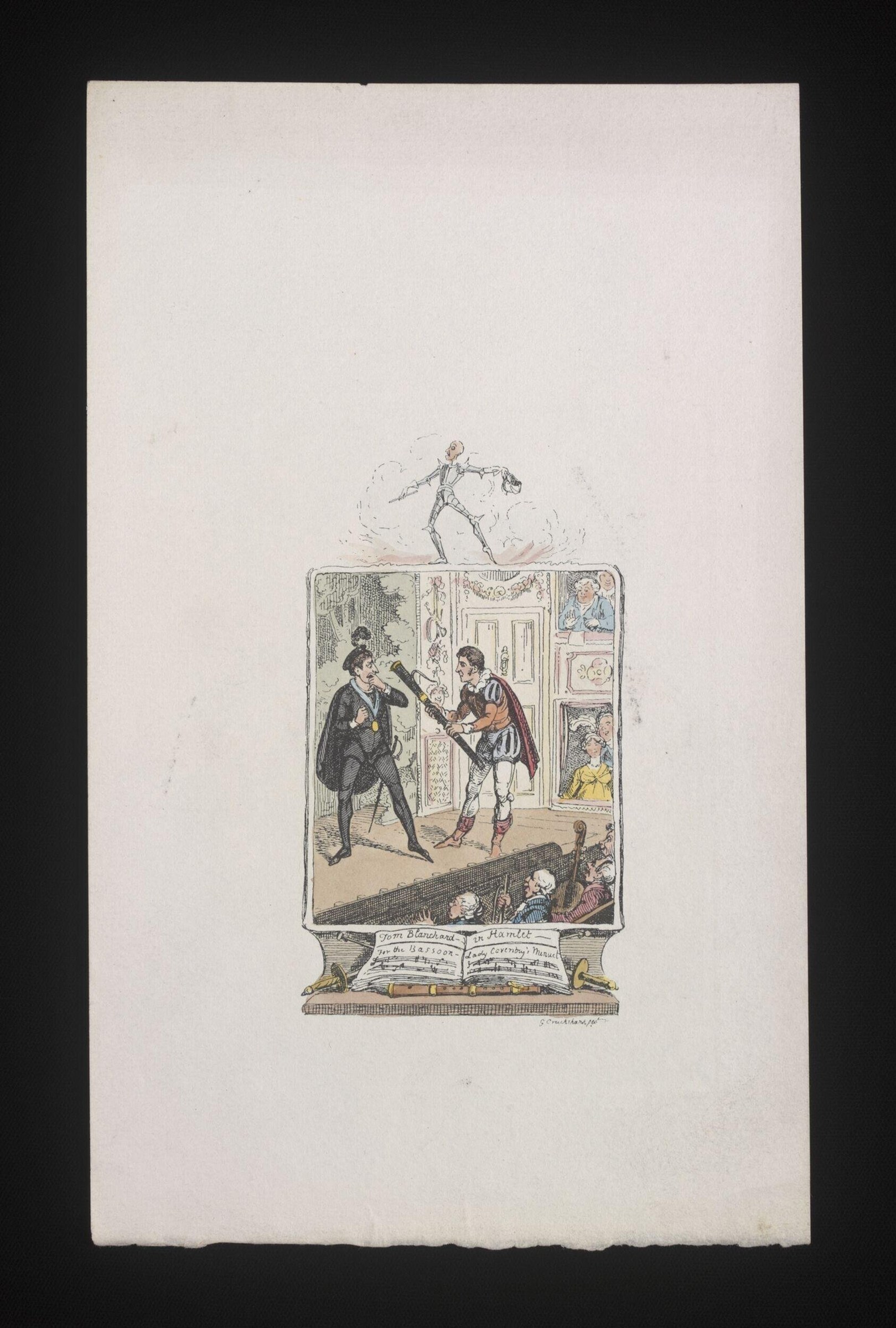
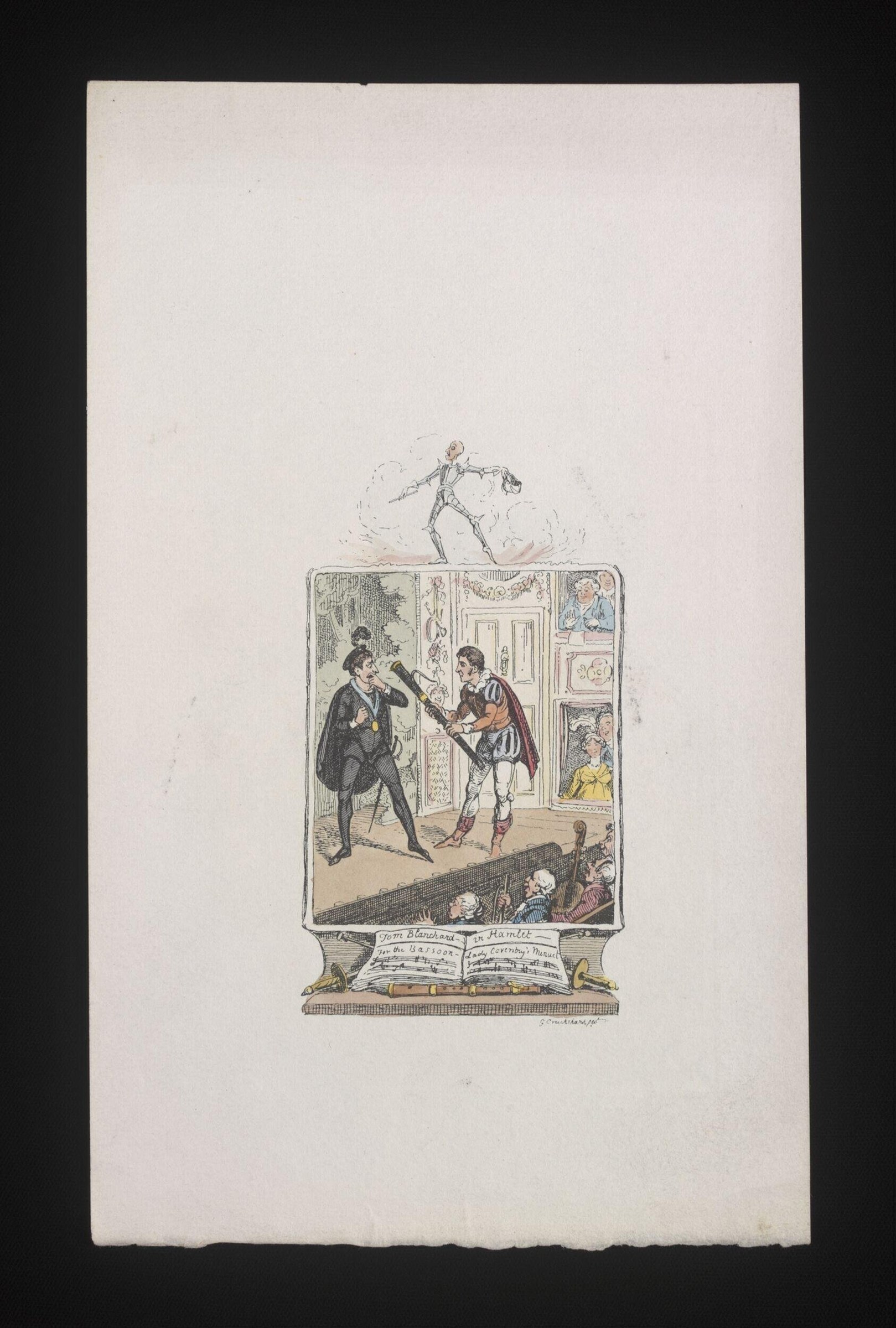
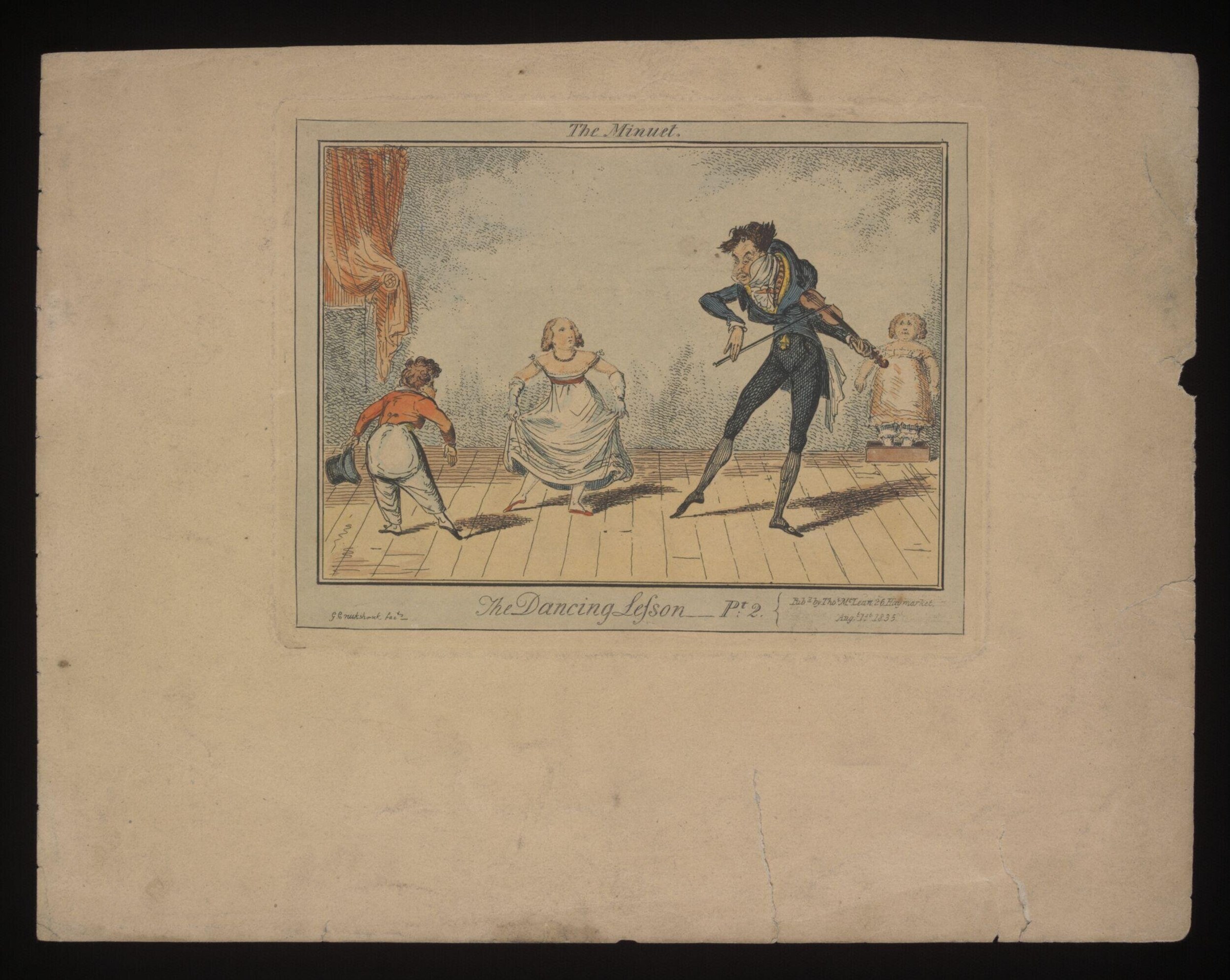
The Dancing Lesson, The Minuet.
Cruikshank, George
- Dance:
- Minuet
- Era:
- Mid 1800s (Polka Era)
- Source:
- Victoria and Albert Museum
- Rights:
- Rights vary by item — check the source record before reusing this image. Source record ↗
- Recorded as:
- Check V&A creditLine
The minuet had been the language of courtship, alliance, and social rank for over a century; its persistence in the schoolroom after its decline in the ballroom shows how deeply it shaped ideas of movement, grace, and bodily discipline. This image preserves not a performance but the mechanism by which aesthetic values were transmitted across generations—the look of instruction itself, which is often invisible in art about dance.
What you are looking at
A well-dressed man in a dark coat with gold trim gestures down toward two young children on a wooden parquet floor, in the presence of a woman in pale dress. The setting is an interior with a draped window in the upper left showing orange fabric. The scene has the character of instruction or demonstration: the man's posture and extended arm direct attention, while the smaller figures of the children suggest pupillage. The light is even and architectural, emphasizing the geometric regularity of the floorboards. This is a moment of teaching, not performance—the composition frames a transfer of knowledge about movement and deportment.
The dancing
Three figures occupy the floor: an adult male in the center-right with his body angled and arm extended in an instructive gesture; a child on the left in an orange-red garment, positioned low and forward as if being corrected; and a younger child on the right in pale dress, standing upright as a model of correct posture. A woman in high-waisted neoclassical dress stands between them, observing. The adult's pose suggests he is demonstrating or correcting the children's positioning. None of the figures is executing a turn or complex step; the stance is formal and frontal, consistent with minuet instruction.
The dance depicted
This is a minuet lesson, as stated in the title. The minuet was the principal social and courtly dance of the 18th century and remained central to childhood education and deportment training well into the 19th century. The image shows a dancing master—identifiable by his coat, bearing, and pedagogical posture—instructing children in the formal, controlled movement and upright carriage essential to the minuet. The minuet required studied grace, small measured steps, and precise arm placement; it was as much about social comportment as motion. The presence of the woman and the domestic setting suggest this is private instruction, typical of genteel families training their children in social accomplishment.
How it was made
This is a hand-coloured engraving or etching, as evidenced by the fine parallel line-work visible in the background shading and the characteristic plate marks and borders of the print medium. The colour—particularly the orange drapery and the flesh tones—has been applied by hand after printing, a common practice for popular prints of the early 19th century. This technique allowed for wide circulation of instructional and satirical imagery at modest cost. The precision of the line and the careful composition suggest professional production for a book or print series on manners and dancing instruction.
About this work
This engraving depicts a dancing master teaching minuet deportment to children in a domestic setting, a scene immediately recognizable to early 19th-century viewers as a moment of genteel education. The minuet had begun to fade from fashionable adult practice by this period—the Waltz Revolution was displacing it—but it remained the foundation of children's movement training and social etiquette. The image is itself pedagogical: it shows what correct instruction looked like and implicitly instructs the viewer in the standards of form and behavior required of educated families. Cruikshank's eye for social detail, here unmarred by the sharp satirical bite of his later political work, captures a quiet but pivotal transaction in the making of a well-bred child.
How to look at it
Notice how the dancing master's body is not demonstrating a step or figure, but rather making a point about positioning—he gestures downward and corrects, rather than performing. The children's stillness is the point: minuet education began with posture and deportment, only later with movement. The geometric precision of the floor echoes the precision demanded of the form itself. The presence of the woman as audience or guardian reminds us that this was a family concern, not a professional entertainment.
The artist
George Cruikshank (1792–1878) was a prolific English engraver, caricaturist, and satirist whose illustrated books and print series reached a large popular audience. In the 1820s–1830s, he produced satirical and moralistic sequences on manners, marriage, and social life, of which this appears to be one. While he is better known for his savage political caricature and his work for Charles Dickens, he also produced more earnest instructional and observational prints documenting contemporary social practice. This work belongs to that more documentary vein.
The period
The minuet was in rapid decline in fashionable ballrooms after 1800, displaced by the waltz, which required a closed couple position and continuous rotation—a radical departure from the minuet's measured, frontal formality. However, minuet instruction remained mandatory for the children of the gentry and professional classes well into the 19th century as a marker of genteel birth and as a foundation for all ballroom movement. At the same moment Cruikshank was drawing this, reform-minded dance masters were debating whether the waltz was morally corrupting; the minuet, by contrast, had become a sign of proper restraint and tradition. This print dates to the heart of that transition.
Where it lives
The work is from the Victoria and Albert Museum collection. It is part of the museum's holdings of 18th and 19th-century satirical and instructional prints. Such prints were widely distributed as bound collections or individual sheets and were intended for middle-class domestic and educational use.
Dance in this work
Questions about this work
Why is this a minuet and not some other dance?
The title states it explicitly. But visually, the children's formal upright posture, the frontal orientation, and the presence of a teaching figure correcting rather than demonstrating all point to minuet instruction. The minuet was taught as a system of deportment first and steps second, which is exactly what this image shows.
When did people stop learning the minuet?
The minuet disappeared from adult ballrooms rapidly after 1800, but children of genteel families continued to learn it as part of their education until well into the Victorian period. It was considered essential to forming the bearing and grace expected of educated people, regardless of whether they would ever dance it socially.
Is this satirical?
Not obviously. While Cruikshank is known for satire, this print appears straightforward and instructional. It may have been part of a series on manners and deportment that was earnest rather than mocking in intent, though early 19th-century audiences would have read some gentle comedy in the formality of the scene.
More Minuet artwork