33 works in this view — arrow keys or swipe to move between them.
Dance in Art
Promenade Quadrille
Coote, Charles Junr.
- Dance:
- Quadrille
- Era:
- Late 1800s (Victorian Ballroom)
- Source:
- Victoria and Albert Museum
- Rights:
- Rights vary by item — check the source record before reusing this image. Source record ↗
- Recorded as:
- Check V&A creditLine
This print provides rare visual evidence of how the quadrille was performed in a theatrical concert setting, distinct from its social ballroom context. It documents the transition of a social dance into a choreographed spectacle during the Gilded Age, showing how Victorian entertainment culture used formal dance as a framework for massed, synchronized visual performance.
What you are looking at
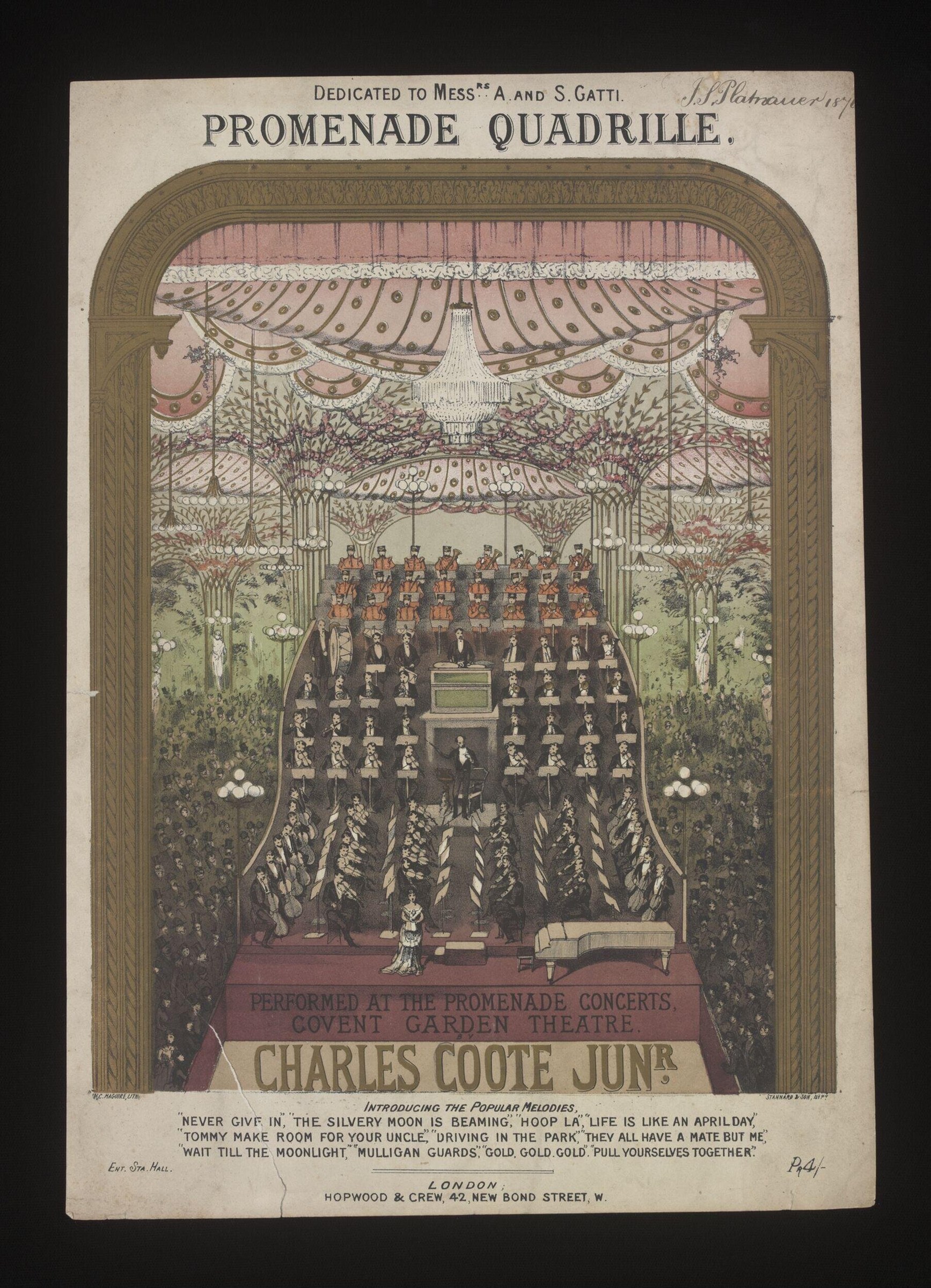
This is a color-printed theatrical playbill or program cover for a quadrille performed at the Promenade Concerts at the Covent Garden Theatre, under the direction of Charles Coote Junr. The image depicts an ornate indoor garden pavilion with elaborate decorative elements: a coffered ceiling with hanging chandeliers, tall columns supporting the structure, and dense foliage—trees and flowering plants—lining both sides of the space. The upper gallery features draped pink fabrics and striped decorative panels. Within this fantastical garden setting, four distinct formations of dancers are arranged in geometric rows and columns, each group composed of male figures in dark formal dress (tailcoats and white shirt fronts). The largest central group occupies the middle ground, flanked by two rectangular formations of dancers. At the very front, a conductor or musical director stands at what appears to be a piano or conductor's podium. The overall composition creates a theatrical spectacle: a grand ballroom-cum-garden hosting an elaborate coordinated dance formation.
The dancing
The dancers are arranged in precisely geometric formations rather than paired couples in social holds. Each figure appears upright and frontal, standing in orderly rows and columns—a stylized representation typical of theatrical prints rather than a naturalistic recording of movement. The formal dress (dark tailcoats, white fronts) indicates a ballroom or formal theatrical context. No individual couples are shown in recognizable ballroom frame or hold; instead, the emphasis is on the collective geometry and spectacle of massed dancers. The positioning suggests a synchronized, choreographed formation dance rather than improvised social dancing.
The dance depicted
The print is titled 'Promenade Quadrille' and depicts the quadrille, a formal group dance that was central to 19th-century ballroom culture. The quadrille was performed by sets of four couples in a square formation, executing a sequence of figures to music. This image shows a highly theatrical version of the quadrille, likely performed as entertainment at the Promenade Concerts—public musical performances that often featured dance demonstrations. The massed geometric arrangement of male dancers here represents an elaborated or adapted version of the standard quadrille, transformed into a spectacular theatrical formation. The presence of a conductor suggests musical accompaniment was carefully controlled for the performance.
How it was made
This is a color lithograph or hand-colored engraving, indicated by the fine line work in the architectural frame, the engraved detail in foliage and figures, and the selective hand-coloring of fabrics, greenery, and flesh tones. The print bears publication marks at the bottom: 'LONDON / HOPWOOD & CREW 42, NEW BOND STREET W.' The technique allowed for mass circulation to audiences and for theatrical promotion—playbills and program covers like this served both as souvenirs and as advertisements for performances. The decorative ornamental frame and the attention to theatrical spectacle suggest this was designed for a fashionable, affluent audience.
About this work
This theatrical print documents a performance of the quadrille at London's Covent Garden Theatre during the late Victorian era, when the quadrille remained a centerpiece of formal ballroom and concert entertainment. The image transforms the intimate social dance into a massive staged spectacle, with dozens of formally dressed male dancers arranged in geometric precision. The print is both a record of an actual performance and a product of theatrical commercial culture—a program cover designed to advertise and memorialize an entertainment event. It reveals how 19th-century quadrille was adopted and adapted for theatrical display, becoming a vehicle for visual spectacle and synchronized group choreography rather than the improvisational social interaction of the ballroom.
How to look at it
Notice the extreme stylization of the dancers' bodies: they are rendered as nearly identical, upright figures in precise geometric formation rather than as individuals captured mid-movement. The ornate architectural frame and lush garden setting dominate the composition, making the dancers themselves secondary to the spectacle of the venue. The print captures not a single moment of dancing but rather the entire formation and setting—the moment has been frozen into a timeless, almost heraldic image of order and theatrical display. This mode of representation is characteristic of theatrical prints, which functioned more like maps of a production than like photographs of actual movement.
The artist
Charles Coote Junr. is identified on the print as the director or choreographer of the performance. Beyond this print, little is documented about his practice; he appears to have been an active figure in late-Victorian theatrical dance and music direction, particularly in London concert venues. The dedication to 'Mess. A. and S. Gatti' (likely proprietors or sponsors associated with the Covent Garden venue or concert series) suggests he worked within established theatrical and commercial structures of the period.
The period
The quadrille had dominated ballroom culture since the early 19th century and remained a mainstay of formal entertainment through the Victorian era, though by the late 1800s it was increasingly being supplemented (and eventually displaced) by waltzes and other couple dances. Public concert series like the Promenade Concerts at Covent Garden represented a commercialization of music and dance performance—audiences paid to watch entertainment rather than participate in it. This print dates to a moment when the quadrille was being codified, documented, and transformed into theatrical spectacle; the transformation of a participatory social dance into a massed theatrical formation reflects broader Victorian trends toward elaborate staged entertainment and the professionalization of dance.
Where it lives
The print is held in the Victoria and Albert Museum collection. It is a published theatrical playbill or program cover, one of a class of commercial prints that were circulated to audiences, performers, and archives throughout the late 19th century. The publication information (Hopwood & Crew, New Bond Street, London) identifies it as a commercial London print product.
Dance in this work
Questions about this work
Was the quadrille still danced socially in the 1890s?
Yes, the quadrille remained a fixture of formal ballroom culture and was still taught and performed well into the 20th century. However, by the late Victorian period it was increasingly codified and formalized, and competed with newer dances like the waltz and the two-step. This theatrical version suggests that the quadrille had also become a subject of public entertainment and spectacle, not just social participation.
Why are there so many men in formal dress and no women?
This print likely represents a theatrical or demonstration performance rather than a social ball, where the conventions were different. The massed formation of identically dressed dancers served theatrical effect and spectacle. In actual ballroom quadrilles, dancers would be mixed-gender couples, but theatrical performances sometimes adapted the form for visual impact.
What were the Promenade Concerts?
The Promenade Concerts at Covent Garden Theatre were public musical (and sometimes dance) entertainment events, likely featuring orchestral music and staged dance performances. They represented the Victorian commercialization of culture—paying audiences could watch professional performers in a formal venue rather than participating in social dancing themselves.
More Quadrille artwork