35 works in this view — arrow keys or swipe to move between them.
Dance in Art
Erminie Quadrille
Joseph Williams
- Dance:
- Quadrille
- Era:
- Late 1800s (Victorian Ballroom)
- Source:
- Victoria and Albert Museum
- Rights:
- Rights vary by item — check the source record before reusing this image. Source record ↗
- Recorded as:
- Check V&A creditLine
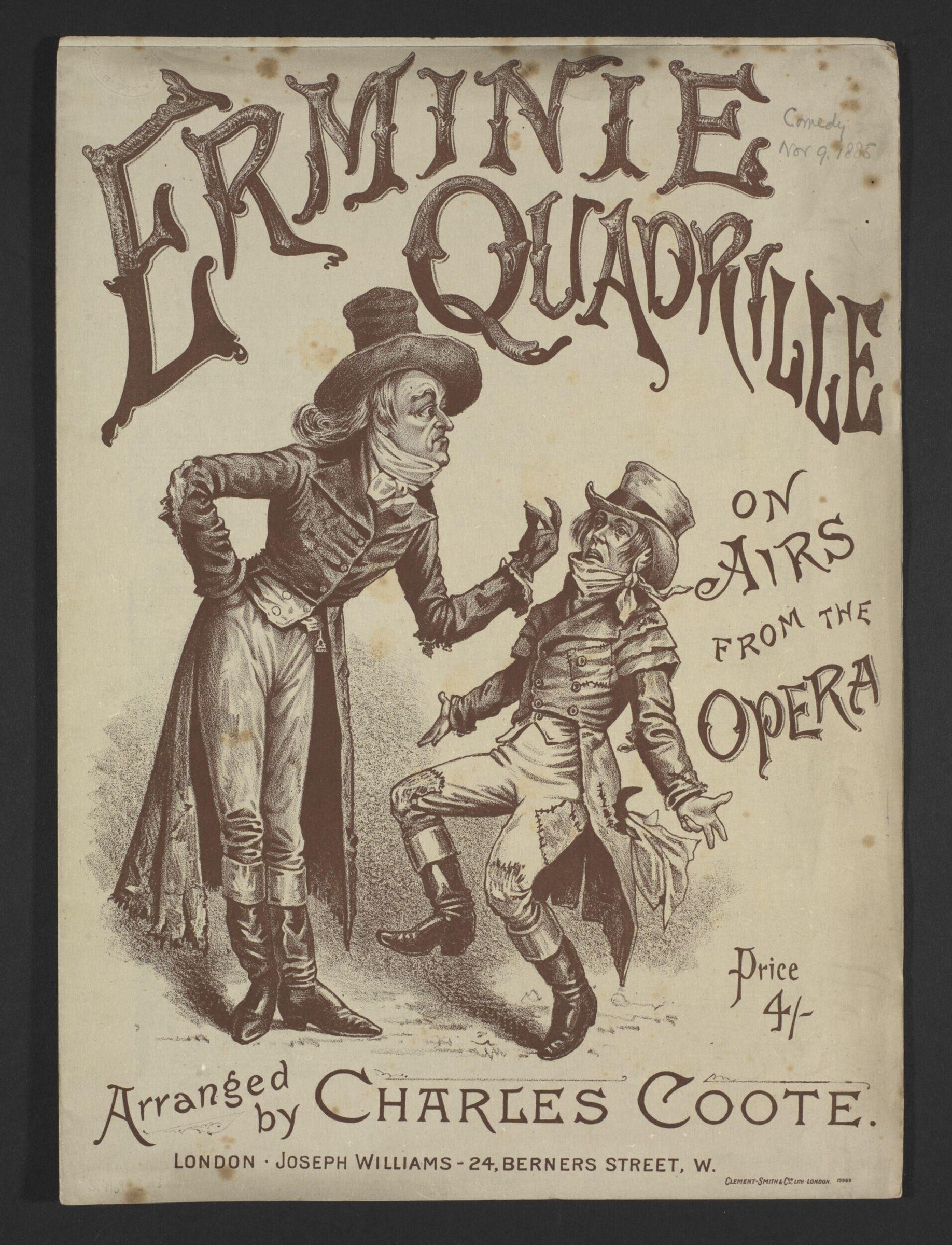
Quadrille publications like this one are primary evidence for how ballroom dance was disseminated, standardized, and made fashionable across the English-speaking world in the 19th century. The cover's theatrical tone—its use of caricature and comic proportion—reveals that ballroom dancing was not always the staid, formal activity later generations imagined, but was presented as entertainment, novelty, and visual spectacle.
What you are looking at
A tall, lean man in early 19th-century dress—dark coat with tails, fitted breeches, and a tall hat—bends forward with exaggerated courtesy toward a much smaller figure: a child or youth in military-style dress with a coat featuring ornate buttons and braiding. The two face each other in the center of the composition against a plain background. The man's posture is elaborately bowed, his right arm extended in a gesture of greeting or invitation, while the smaller figure mirrors this with raised arms. The print is rendered in a rich brown ink with careful cross-hatching for shadow and texture, and the clothing details—the weave of fabric, the fall of the coat tails, the braid trim—are precisely articulated. This is a cover or title page for a musical score or dance instruction book: the large ornamental title "ERMINIE QUADRILLE" sits above the figures, with "ON AIRS FROM THE OPERA" below and "Arranged by CHARLES COOTE" at the base. The publisher's mark reads "LONDON · JOSEPH WILLIAMS · 24, BERNERS STREET, W."
The dancing
The two figures are shown in greeting positions rather than active dancing. The man is in a deep, courtly bow with his torso bent forward at the waist and his right arm extended in a formal salute. The boy stands upright facing him with arms raised, mirroring an answering gesture. Neither figure shows the typical frame or hold of ballroom dance; instead, this is a theatrical presentation moment. The contrast in scale—the exaggerated height difference—suggests comedy or burlesque rather than naturalism, a common device in dance humor of the period.
The dance depicted
This is a quadrille, a formal four-couple or group dance that dominated European ballrooms from the 1830s through the late 19th century. The quadrille consisted of five figures (movements) danced to specific musical phrases, often adapted from popular opera melodies, as this title announces. Charles Coote was a London dance musician and arranger active in the mid-Victorian era who specialized in providing instrumental arrangements for ballroom use. The figures shown here—the elaborate bow and the answering courtesy—depict the opening salute (première révérence) or a formal introduction moment, rather than a figure of the dance itself. This is a title page designed to advertise the music and catch the eye of dance pupils and ballroom musicians.
How it was made
This is a wood engraving or steel engraving, a technique that allowed for fine detail and multiple impressions from a single block or plate. The precision of the line work—the careful parallel hatching for shadow, the articulation of fabric texture, and the crispness of the lettering—suggests engraving rather than lithography. The technique's capacity for sharp contrast between black ink and paper, combined with the ability to print many copies, made engraving the standard for commercial sheet music covers and dance instruction materials throughout the 19th century. The price marked "4/" (four shillings) indicates this was an affordable, mass-market publication for music sellers and dancing masters.
About this work
This is the cover or title page of a published arrangement for quadrille dancing, featuring caricatured figures in a formal greeting. The quadrille was the dominant ballroom form of the 19th century, performed by couples in set formations and figures, often danced to melodies borrowed from popular operas. By publishing arrangements with illustrated covers, London music publishers like Joseph Williams made the current fashionable dances available to provincial ballrooms and private pupils. The exaggerated proportions and theatrical presentation of the figures suggest this was aimed at a broad, entertainment-conscious audience rather than elite dancing masters; the comedy of the oversized courtier bowing to the tiny military figure would have appealed to Victorian humor. This object is a complete artifact of the commercial dance culture of the era: music, image, and instruction bundled for sale.
How to look at it
The viewer should attend to the exaggerated courtesy and formal gestures: the deep bow and answering arm raise represent the etiquette of ballroom introduction and respect, frozen in caricatured form. The artist has chosen not to show active dancing steps, but rather the social ritual that preceded or framed them—a choice that tells us that the quadrille was understood as much as a display of manners and theater as of choreographed movement. The grossly oversized figures and the theatrical title lettering signal that this is not a technical instruction manual, but a commercially packaged entertainment product aimed at a wide, pleasure-seeking audience.
The artist
Charles Coote (fl. 1850s–1880s) was a London-based composer and arranger specializing in ballroom and quadrille music. He published dozens of arrangements through Joseph Williams and other London music sellers, each with illustrated covers by commercial engravers of the period. Coote's role was similar to that of other Victorian dance musicians: to make the latest ballroom fashions—often taken from opera, popular songs, or continental sources—playable and teachable for British dancing masters and their pupils. He was neither a famous composer nor a trained choreographer, but an entrepreneurial music publisher catering to the mass market for recreational dance.
The period
The quadrille dominated European and American ballrooms from the 1830s through the 1880s, eclipsing the cotillion and country dances of earlier decades. It was danced by couples arranged in a square formation of four or eight, executing a set sequence of five figures in time to music, typically in 2/4 time. The form was democratic in appeal—less demanding than country dance, more orderly than the waltz, suitable for both formal assemblies and private parties. By the 1850s–60s, when this cover was published, the quadrille was at peak popularity and had become a standard repertoire item in ballroom instruction. Publishers rushed to bring out new arrangements based on whatever operas or songs were currently fashionable, and the illustrated cover was a key marketing tool. The caricatured style of the engraving reflects the broader Victorian appetite for comic and satirical imagery in print culture.
Where it lives
The catalogue record identifies this work as held by the Victoria and Albert Museum and sourced from the "va" collection. It is a printed sheet music cover or dance instruction book cover, a common artifact of Victorian commercial publishing.
Dance in this work
Questions about this work
What is a quadrille?
A quadrille is a ballroom dance for four couples (eight dancers) arranged in a square. It consists of five set figures danced in sequence to a specific musical pattern, typically in 2/4 time. Couples execute a series of advancing, retreating, and turning movements on musical cues. The quadrille dominated European and American ballrooms from the 1830s until the early 20th century and was considered both fashionable and accessible to amateur dancers.
Who was Charles Coote?
Charles Coote was a Victorian composer and music arranger based in London who specialized in quadrille and ballroom music. He arranged popular melodies—often from operas, popular songs, and continental dances—into ballroom-ready scores for publication and sale to dancing masters and private pupils. He was one of many such arrangers who made ballroom dance commercially available and standardized.
Why would a dance book have such an exaggerated comic cover?
Victorian dance culture was not always serious or formal; ballroom dancing was entertainment and spectacle, not merely technical instruction. The caricatured cover was designed to appeal to a broad, pleasure-seeking audience and to catch the eye of potential buyers in a crowded marketplace of publications. The humor made the product memorable and suggests dancing was a fun, social pursuit rather than a solemn discipline.
How much did this cost?
The price marked on the cover is 4/—four shillings in old British currency. This was an affordable, mass-market item: a working person's weekly wage might be 15–20 shillings, so a dance arrangement cost a small but real fraction of earnings. This price point indicates the publication was aimed at dancing masters, music sellers, and reasonably well-off amateurs, not the wealthy elite.
More Quadrille artwork