36 works in this view — arrow keys or swipe to move between them.
Dance in Art
The Gorilla Quadrille
Marriott, Charles Handel Rand
- Dance:
- Quadrille
- Era:
- Mid 1800s (Polka Era)
- Source:
- Victoria and Albert Museum
- Rights:
- Rights vary by item — check the source record before reusing this image. Source record ↗
- Recorded as:
- Check V&A creditLine
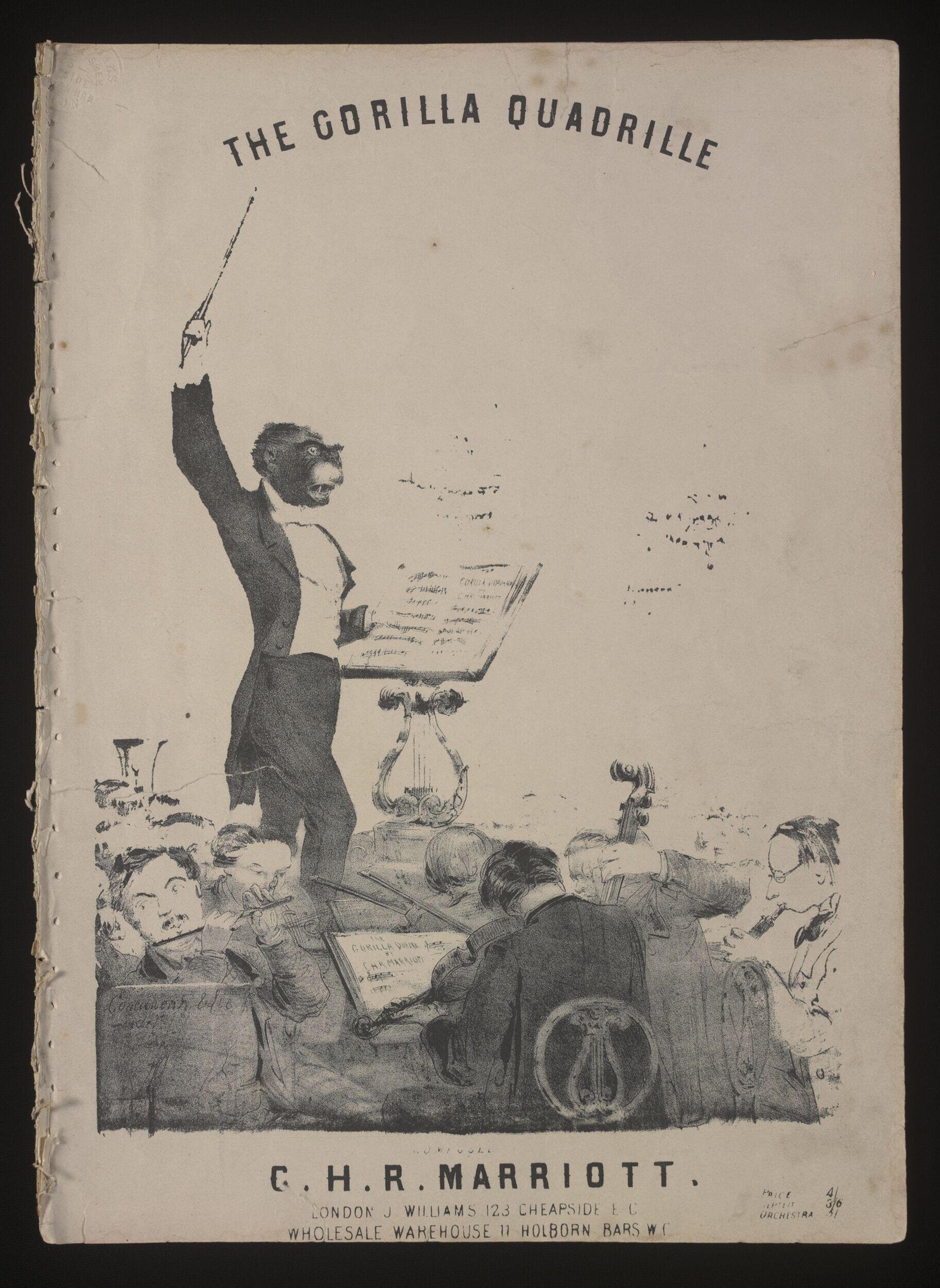
This work is essential for understanding how the quadrille functioned in Victorian visual culture not as a subject for reverent documentation but as a target for social satire. It demonstrates that ballroom dance in the 19th century was inseparable from broader anxieties about class, civility, and human nature—topics Marriott addresses through grotesque inversion. The print is a rare record of how Victorians themselves could view their own dance rituals as objects of ridicule.
What you are looking at
A satirical engraving depicts a gorilla conducting a ballroom dance scene with anthropomorphic animals and fantastical figures. The gorilla stands elevated on a decorative pedestal, one arm raised in a conducting gesture while holding a baton, the other gesturing toward an open score or ledger. Below and around the pedestal crowd dozens of figures in Victorian dress—some human, some animal-headed or grotesque—arranged in loose formation as though assembled for a formal quadrille. The composition is dense and chaotic, filled with marginal sketches and notations. The figures wear period dress of the 1860s: tailcoats, crinoline skirts, bonnets. The setting is ambiguous—interior space implied by the pedestal's theatrical placement—and the tone is unmistakably comic, transforming a staid Victorian social dance into absurdist theatre.
The dancing
The gorilla occupies the visual and compositional center, rendered in clear silhouette with exaggerated posture: one arm flung high in a theatrical conducting or conducting gesture, the body twisted to face both the score and the assembled crowd. The assembled figures below show little clear formation or unified hold; most stand or are positioned loosely, without the rigid frame and closed holds characteristic of ballroom dancing. Skirts and coats suggest formal dress rather than functional dance posture. The crowded, somewhat chaotic arrangement suggests the artist was more interested in satirical composition than in recording actual dance technique.
The dance depicted
The work is titled *The Gorilla Quadrille*, and the inscription and pedestal structure confirm this is meant to depict a quadrille—a formal group dance for four couples arranged in a square, popular in Victorian ballrooms. However, the image reads as parody rather than documentation: the gorilla-as-conductor is absurd rather than authoritative, the crowd is uncoordinated, and the overall effect is satirical commentary on Victorian ballroom culture rather than a faithful record of the dance itself. The quadrille was a staple of the Regency and Victorian social season, but this rendering mocks its formality by placing it under simian authority.
How it was made
This is a wood engraving or steel engraving, identifiable by the fine hatching lines that create tone and shadow, the precision of the line work, and the bold black ink on cream stock. The technique allowed for mass reproduction and widespread distribution, making it ideal for satirical commentary aimed at a broad Victorian audience. The marginal sketches and notations visible around the main scene suggest this may be a proof or working proof, or a deliberate compositional choice to reference classical engraving practices of annotation and revision. The medium's accessibility and reproducibility indicate this was a popular satirical print, likely issued as a sheet for distribution or inclusion in a serialized publication.
About this work
This is a satirical engraving by Charles Handel Rand Marriott, dating to 1860, that depicts a ballroom quadrille presided over by an absurdly anthropomorphized gorilla. The work belongs to a Victorian tradition of animal satire and commentary on social rituals, using the formal quadrille as its target. By inverting the hierarchy of a genteel ballroom dance and placing an animal in authority, Marriott creates a critique of both Victorian formality and, possibly, of anxieties about evolution and civilisation circulating in the 1860s following Darwin's *Origin of Species* (1859). The engraving's dense, crowded composition and annotated margins suggest it is a complex satirical print intended for an educated, print-literate audience familiar with both ballroom culture and engraving conventions.
How to look at it
Attend first to the gorilla's raised arm and baton: it is the gesture of a conductor or maestro, claiming authority over the dancers below. This inversion—animal commanding humans—is the engine of the satire. Notice next the crowd below: despite the title's invocation of a quadrille, there is no visible quadrille formation, no clear pairs or lines, no dancers in closed hold. Instead, figures mill about in loose, almost chaotic arrangement. The artist has chosen not to freeze a moment of actual dance movement, but to stage a satirical social scene. The marginal sketches and notations reinforce this: this is engraving as social commentary, not dance documentation.
The artist
Charles Handel Rand Marriott was a 19th-century engraver and satirical artist active in London. The publishing information visible on the print (Williams, Cheapside; Wholesale Warehouse, Holborn Bars) identifies this as a commercial print issued through London print dealers. Marriott specialized in satirical engravings addressing Victorian social conventions and contemporary events, and was part of the broader culture of social and political satire that flourished in mid-Victorian print culture alongside the work of artists like John Leech and George Cruikshank.
The period
The quadrille was at the height of its popularity in Victorian ballrooms during the 1850s and 1860s. As an ordered, precisely choreographed group dance requiring strict adherence to figures and formations, it represented Victorian ideals of propriety, hierarchy, and collective social discipline. Published in 1860, this print appeared just a year after Darwin's *Origin of Species*, at a moment when anxieties about evolution, species boundaries, and the place of humans in nature were reshaping British intellectual culture. The coincidence is likely not accidental: a gorilla presiding over human social ritual becomes a visual expression of these contemporaneous anxieties about civilisation and animal nature.
Where it lives
The print is held in the Victoria and Albert Museum collection. It is a commercial satirical engraving, issued by the print sellers Williams (Cheapside, London) and distributed through the Wholesale Warehouse at Holborn Bars. It is the kind of popular print that would have circulated among London audiences during the 1860s, available for purchase as a standalone sheet.
Dance in this work
Questions about this work
Is this a faithful depiction of how a real quadrille was danced?
No. This is satire, not documentation. The artist has deliberately avoided showing an actual quadrille formation—which would require four couples in a square, moving in unison through prescribed figures. Instead, the figures are loosely scattered, and the focus is on the absurdity of a gorilla conducting the dance. The work is interested in social commentary, not dance instruction.
Why did Marriott choose a gorilla as the conductor?
The gorilla was a potent symbol in 1860s Britain, especially after Darwin's *Origin of Species* (1859) reopened debates about human and animal nature. By placing a gorilla in the role of maestro over a refined Victorian ballroom, Marriott is commenting on the fragility of civilisation and the anxieties circulating about the boundaries between animal and human. It is simultaneously a comment on Victorian pretension and a meditation on human nature itself.
What is a quadrille?
A quadrille is a formal group dance for four couples (eight people) arranged in a square. It consists of several figures or sections, each with prescribed steps and formations, danced to music in 2/4 time. It was enormously popular in Victorian ballrooms and remained a fixture of formal dance well into the 20th century. The quadrille required precision, coordination, and strict adherence to form—making it an ideal target for Victorian satire.
What technique is used to make this engraving?
This is a wood or steel engraving—a relief printing technique in which lines are cut into the surface of a block or plate, inked, and pressed onto paper. The fine parallel lines (hatching) visible throughout create tone and shadow. This technique allowed for mass reproduction, making it ideal for commercial distribution to a wide audience. The marginal sketches suggest this may be a proof or a deliberately annotated working print.
More Quadrille artwork