40 works in this view — arrow keys or swipe to move between them.
Dance in Art
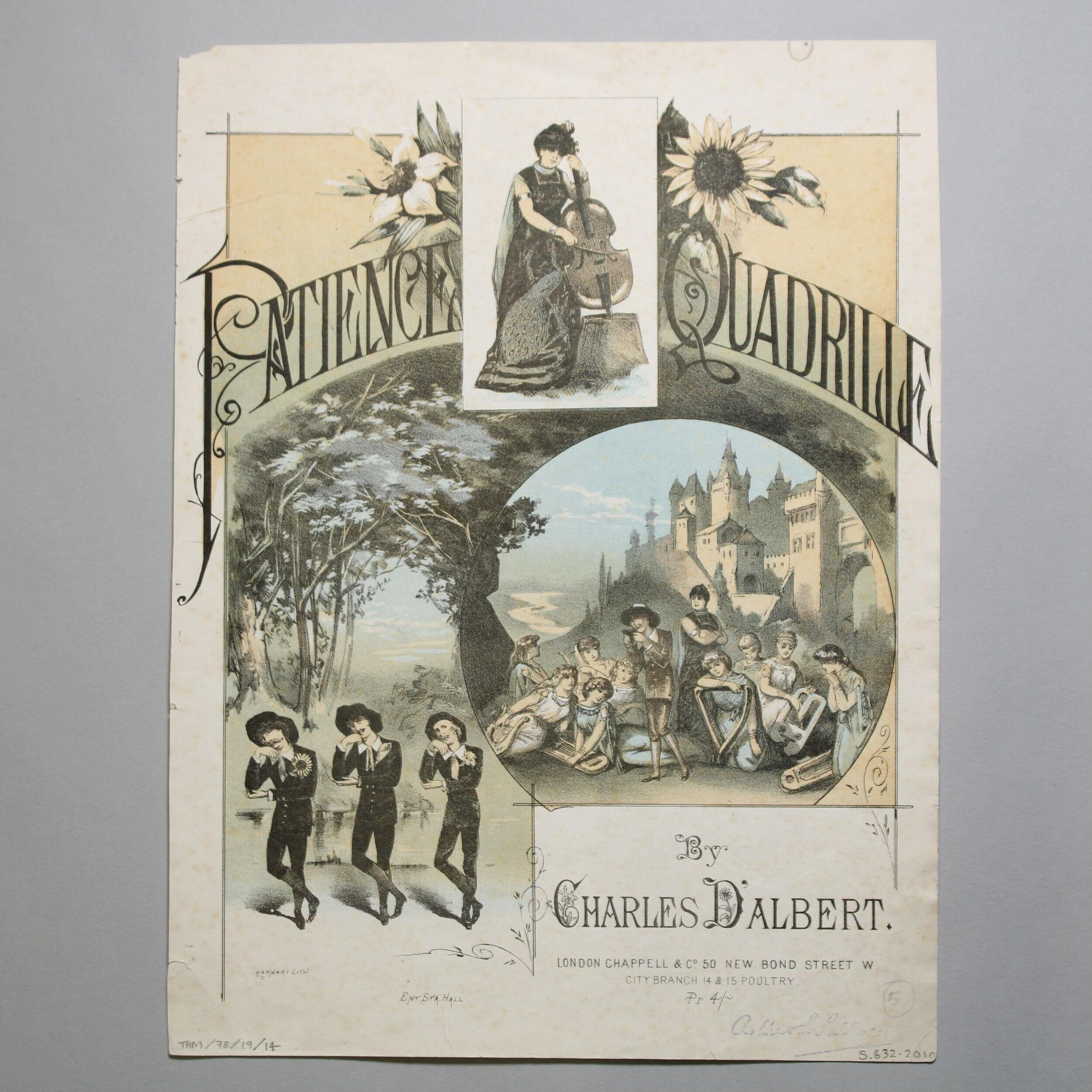
The Patience Quadrille
Hanhart, Michael
- Dance:
- Quadrille
- Era:
- Late 1800s (Victorian Ballroom)
- Source:
- Victoria and Albert Museum
- Rights:
- Rights vary by item — check the source record before reusing this image. Source record ↗
- Recorded as:
- Check V&A creditLine
The quadrille was the dominant social dance form across Europe and America for nearly a century, yet named variants like *The Patience Quadrille* are rarely documented visually or textually. This print is evidence of how specific quadrilles were branded, taught, and circulated as fashionable entertainment; it shows that ballroom dances were not improvised or organically transmitted, but carefully choreographed, named, and promoted through ephemeral printed materials. For historians of Victorian social dance and ballroom culture, this work is a primary document of how the dance was positioned within genteel society.
What you are looking at
A composite theatrical illustration celebrating *The Patience Quadrille*, a social dance of the 1880s. The composition is divided into three sections. At top center, a woman in dark Victorian dress plays cello or viola da gamba, her body bent in concentration. On either side, sunflowers with swaying stems frame decorative panels in pale ochre. The lower half shows a castle courtyard or ballroom interior with a gathered company of dancers and musicians: figures in period dress (men in formal black coats and hats, women in elaborate gowns) are arranged in conversation and dance postures around the space. A castle or fortified building with multiple towers and flags dominates the architectural backdrop. Three male figures in identical formal dress—coats, hats, and what appear to be knee breeches—walk or stride in unison across the lower left margin, their parallel poses suggesting either a procession or a repeated dance figure. The overall tone is genteel and whimsical; the hand-colored engraving technique gives the work the appearance of a theatrical programme cover or dance instruction manual from the period.
The dancing
The main figures are composed in the formal, upright posture characteristic of Victorian ballroom dance. The central musician exhibits the curved spine and absorbed concentration of chamber music performance rather than dance. The courtyard figures show varied stances: some stand in conversation, others appear to be in the preparatory or transitional moments between dance figures rather than mid-movement. The three identically dressed men at lower left walk in step, their bodies straight and their arms at their sides, suggesting the marching or promenade passages common to quadrilles. No closed ballroom holds are visible; instead, the dancers appear to be in the opening or regrouping phases typical of a set dance.
The dance depicted
This is a quadrille, a four-couple square dance that was the dominant social form of the Victorian ballroom from the 1830s onward. Quadrilles were highly structured, consisting of five distinct figures (usually *Pantalon*, *Été*, *Poule*, *Trénis*, and *Finale*), each with prescribed arm positions, turns, and floor patterns. The title *Patience* suggests this may have been a named variant or a figure sequence known by that name in period ballroom practice. The image does not depict the active turning or rotation of a figure in progress; rather, it captures the social and procedural aspects—the assembly of dancers, the musicians providing the rhythm, and the formal presentation that would precede the dancing itself. The presence of the musician at top suggests the music's centrality to the quadrille's execution.
How it was made
This is a hand-colored engraving or chromolithograph, likely a printed ephemerum—a dance card, programme, or instructional broadside distributed to dancers or published in a dance manual of the period. The technique allowed for mass reproduction of the image while the hand-coloring (ochre backgrounds, selective tinting of the figures) gave each copy a semi-artisanal finish. The ornamental typography and composite layout—with the title framed by art nouveau flourishes and the central musician portrait inserted as a vignette—are typical of late Victorian commercial graphic design, suggesting this was both a practical guide and a souvenir or advertisement for a specific quadrille or dance instructor.
About this work
This theatrical print celebrates a specific quadrille variant, *The Patience Quadrille*, documenting both the prescribed dance form and the social ceremony surrounding it. Quadrilles were fundamental to Victorian courtship and entertainment, occupying the same cultural space that waltzes had opened a generation earlier. The image is a rare artifact of how a named dance was marketed and taught: it combines visual instruction (the orderly groupings and marching figures), musical notation cues (the musician at top), and theatrical presentation (the castle setting, the decorative frames) to create a complete picture of Victorian ballroom life. The work belongs in a dance collection because it reveals not just what was danced but how the social machinery of dance—the programme, the musicians, the formality, the gender roles—was organized and celebrated.
How to look at it
Notice the frozen, preparatory character of the main scene: this is not a moment of dynamic rotation or turns, but the formal assembly before the quadrille begins. The three marching figures at left are the visual key to understanding quadrille structure—they show the promenade or marching patterns that frame each figure of the dance. Observe how the artist has used the castle architecture and decorative framing to elevate a social dance into a romantic theatrical event. The sunflowers and musician at top suggest that the quadrille was understood not merely as steps, but as a total sensory and artistic experience involving music, beauty, and ceremony.
The artist
Michael Hanhart was a chromolithographer and printmaker active in London in the mid-to-late 19th century, known for theatrical, decorative, and commercial illustration. The style and printing technique of this work are consistent with the London print industry's output of the 1880s, when chromolithography allowed for cheap, colorful reproduction of images for theatrical programmes, dance cards, and promotional materials. Hanhart's practice exemplifies the role of commercial printmakers in disseminating popular entertainment imagery.
The period
The quadrille reached its peak social importance in the 1870s–1880s, at a moment when waltzes and polkas had already disrupted older contre-danse forms and when newer dances (particularly the Viennese waltz and its variations) were beginning to dominate. By the 1880s, individual quadrilles were often given fanciful names and slight choreographic variations to maintain novelty and competitive advantage among dance instructors. The simultaneous rise of chromolithographic printing made it economically feasible to produce and distribute printed dance cards and instructions to the expanding middle-class ballroom audience. The castle setting in this image invokes a romantic, theatrical aesthetic that was fashionable in Victorian visual culture—the work blends instruction with fantasy.
Where it lives
The work is held by the Victoria and Albert Museum, identified as part of their theatrical and decorative prints collection. It is a commercial print, likely distributed as a dance card, programme, or instructional broadside, and represents the type of ephemeral material that documented and promoted named ballroom dances in the Victorian era.
Dance in this work
Questions about this work
What is a quadrille?
A quadrille is a four-couple square dance consisting of five distinct figures, each with prescribed steps, turns, and floor patterns. It was danced in sets of two couples facing two couples across a square. Quadrilles were the dominant social dance in European and American ballrooms from the 1830s until the 1920s, when the foxtrot and other freestyle dances began to supersede them.
What does 'Patience' mean in the title?
Named variants of quadrilles were common and often had fanciful or symbolic titles. 'Patience' likely refers to either a specific sequence of figures, a mood or character associated with the dance, or a play on the card game of the same name. Without access to period dance manuals, the exact meaning is uncertain, but such names were used to market and distinguish one version of the quadrille from another.
How was this print used?
This print was most likely distributed as a dance card (a small pamphlet or broadside carried by dancers to the ball), as an instruction manual for dance students, or as a theatrical programme announcing a specific quadrille variant. The combination of visual instruction, decorative presentation, and the artist's name indicates it was both a practical guide and a promotional item.
Why is there a musician at the top?
The musician illustrates that quadrilles were always danced to live music, usually played by a small ensemble of strings and sometimes a piano or harmonica. The specific rhythm and tempo of the music dictated the pacing of the dance figures. Including the musician in the print emphasizes that the quadrille was a collaborative art involving dancers, musicians, and choreography.
More Quadrille artwork