48 works in this view — arrow keys or swipe to move between them.
Dance in Art
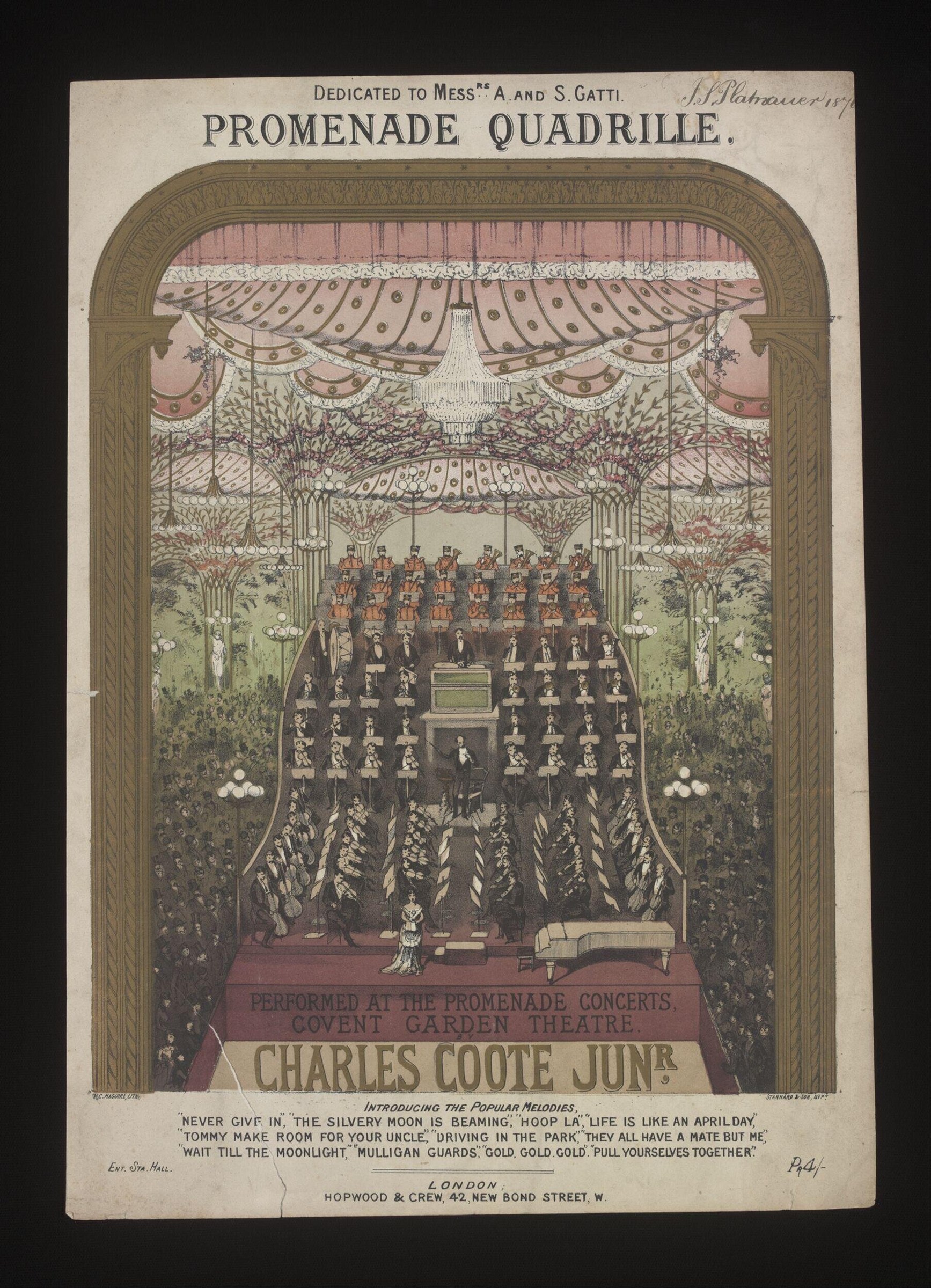
Promenade Quadrille
Coote, Charles Junr.
- Dance:
- Quadrille
- Era:
- Late 1800s (Victorian Ballroom)
- Source:
- Victoria and Albert Museum
- Rights:
- Rights vary by item — check the source record before reusing this image. Source record ↗
- Recorded as:
- Check V&A creditLine
For historians of Victorian ballroom dance, this engraving is significant evidence of how the quadrille functioned as a public spectacle as well as a social form—not confined to private drawing rooms but performed in concert halls before audiences. The precision of the formation and the emphasis on the architectural setting over individual movement reflects the Victorian ideal of dance as order, propriety, and collective refinement. For artists studying 19th-century concert culture and theatrical documentation, it exemplifies the genre of promotional concert prints that shaped public memory of live performances.
What you are looking at
This is a hand-colored engraving of an outdoor promenade concert held under an ornate pavilion or bandstand. The structure features a peaked glass roof supported by decorative columns, with festooned draped fabric and garlands hanging from the interior ceiling. Below, arranged in precise geometric formation, are rows of formally dressed dancers and musicians in dark clothing (suggesting late 19th-century evening wear). The stage is framed by formal garden plantings with topiary bushes on either side and white flowering plants in the foreground. A conductor or leader stands at the center of the formation. The engraving is delicately hand-colored in soft greens, pinks, and browns, and the title and dedication appear at the top: "Dedicated to Mess. A. and S. Gatti." The composition emphasizes the architectural setting and the orderly arrangement of the performers rather than the motion of individual dancers.
The dancing
The dancers are arranged in formal rows facing inward toward a central conductor or leader, suggesting a precisely choreographed formation. Their postures appear upright and controlled, typical of Victorian-era social dancing. No individual couples or close holds are distinctly visible at this scale and distance; instead, the composition prioritizes the geometry of the group over the mechanics of paired movement. The formal dress of all participants—dark jackets and evening wear—indicates this was a prestigious public performance rather than a casual social gathering. The rigid spatial arrangement suggests this may be the opening formation or promenade section of a quadrille or similar group dance.
The dance depicted
This depicts a Promenade Quadrille, a variant of the quadrille that was central to Victorian ballroom culture. The quadrille was a four-couple French dance that by the mid-19th century had become a standard feature of fashionable social dancing in Britain and Europe. The "promenade" section (a processional walk in time with music) was the opening movement of many quadrille variations. The orderly arrangement of performers and the outdoor concert setting suggest this image documents either a public demonstration or a fashionable social event. The title credits Charles Coote Junr. as the artist and notes the performance was given at the Promenade Concerts, Covent Garden Theatre, a major London venue.
How it was made
This is a hand-colored engraving, a technique that allowed multiple copies to be produced and distributed. The fineness of the engraved line—particularly visible in the architectural detailing and the delicate rendering of vegetation and drapery—indicates skilled work. Hand-coloring was applied after printing, which accounts for slight variations in tone and the soft, watercolor-like appearance of the greens and pinks. This production method was typical for mid-to-late 19th-century theatrical and concert imagery, where prints served as both documentation and promotion. The date notation at top right (partially legible) and the publisher's mark (Hopwood & Crew, 42 New Bond Street, London) indicate this was a commercial print with fairly wide circulation among London's concert-going public.
About this work
This engraving documents a specific moment in Victorian ballroom culture: the Promenade Quadrille as performed at one of London's most prestigious concert venues. It is not a naturalistic capture of movement but rather a formal architectural and social portrait of an event—emphasizing the elegant setting, the geometric precision of the formation, and the fashionable status of the participants. The image belongs in a gallery of dance art because it reveals how ballroom dance was understood and valued in the Victorian era: not primarily as a display of individual virtuosity or expressive movement, but as an orderly, publicly presented social practice embedded in architectural grandeur and fashion.
How to look at it
View this image first as an architectural and social document: note the precise geometry of the pavilion, the ordered rows of performers, and the formal gardens. Then look at how the engraver has differentiated the figures—the central conductor, the rows of dancers, the placement of musicians—to convey hierarchy and function. Observe that no single dance step or couple interaction is depicted in detail; instead, the artist prioritized the visual spectacle of the assembled group. This reflects a key difference between Victorian and modern dance documentation: then, the formation and the setting mattered as much as the movement itself. The hand-coloring adds a layer of elegance and prestige, suggesting this was a print for a socially aspirational audience.
The artist
Charles Coote Junr. was a 19th-century engraver and theatrical print artist working in London. His practice included creating hand-colored engravings of ballroom scenes, concert performances, and theatrical subjects for publication and sale. The dedication of this print to "Mess. A. and S. Gatti"—likely the celebrated Gatti brothers, who were prominent music-hall and concert impresarios in Victorian London—suggests Coote worked within the circle of theatrical and musical enterprises. His work exemplifies the commercial engraving trade that documented and promoted London's entertainment culture.
The period
The Promenade Concerts at Covent Garden Theatre were major cultural events in mid-to-late 19th-century London, combining orchestral music, popular entertainment, and fashionable social display. The quadrille, which originated in early 19th-century France, had become the signature ballroom dance of the Victorian era by the 1860s–1880s—a time when public demonstrations of social dancing were increasingly common. This period saw the rise of illustrated papers and theatrical prints as a mass medium for documenting and promoting entertainment. The hand-colored engraving was the dominant technology for this, before photographic reproduction became standard. The image captures a moment when ballroom dance was transitioning from purely private practice to public performance and spectatorship.
Where it lives
The holding collection and accession information are not recorded in the available catalogue data. The print was published by Hopwood & Crew of 42 New Bond Street, London, a commercial print publisher. The source is listed as the Victoria and Albert Museum (V&A).
Dance in this work
Questions about this work
What is a promenade quadrille?
The quadrille was a four-couple ballroom dance performed in a square formation, with a caller or musician directing the five distinct sections (including jig, galop, and finale). The 'promenade' was the opening section: a slow, processional walk in couples, serving as both a display of fashion and an introduction to the full dance. By the Victorian era, the quadrille was the most prestigious ballroom dance in fashionable society.
Where and when would this have been performed?
The Promenade Concerts were held at Covent Garden Theatre in London during the mid-to-late 19th century. These were public musical events that combined orchestral performance with fashionable social dancing, drawing the city's elite and upper-middle classes. The print documents one such event, likely from the 1860s–1880s based on the style.
Why is the dance shown from such a distance?
This engraving prioritizes the architectural setting and the social prestige of the event over the technical details of the dance. The distant perspective emphasizes the elegance of the pavilion, the orderliness of the formation, and the spectacle of the assembled group. This reflects how Victorian society valued ballroom dance: as a display of collective refinement and propriety, not as an individual virtuoso performance.
How were prints like this made and distributed?
This is a hand-colored engraving: the image was first engraved into a metal plate using a burin, then printed by pressing paper against the inked plate. After printing, each copy was colored by hand using watercolors or similar media. These prints were sold commercially to audiences who attended the concerts, serving as both souvenirs and promotional materials for future events.
More Quadrille artwork