44 works in this view — arrow keys or swipe to move between them.
Dance in Art
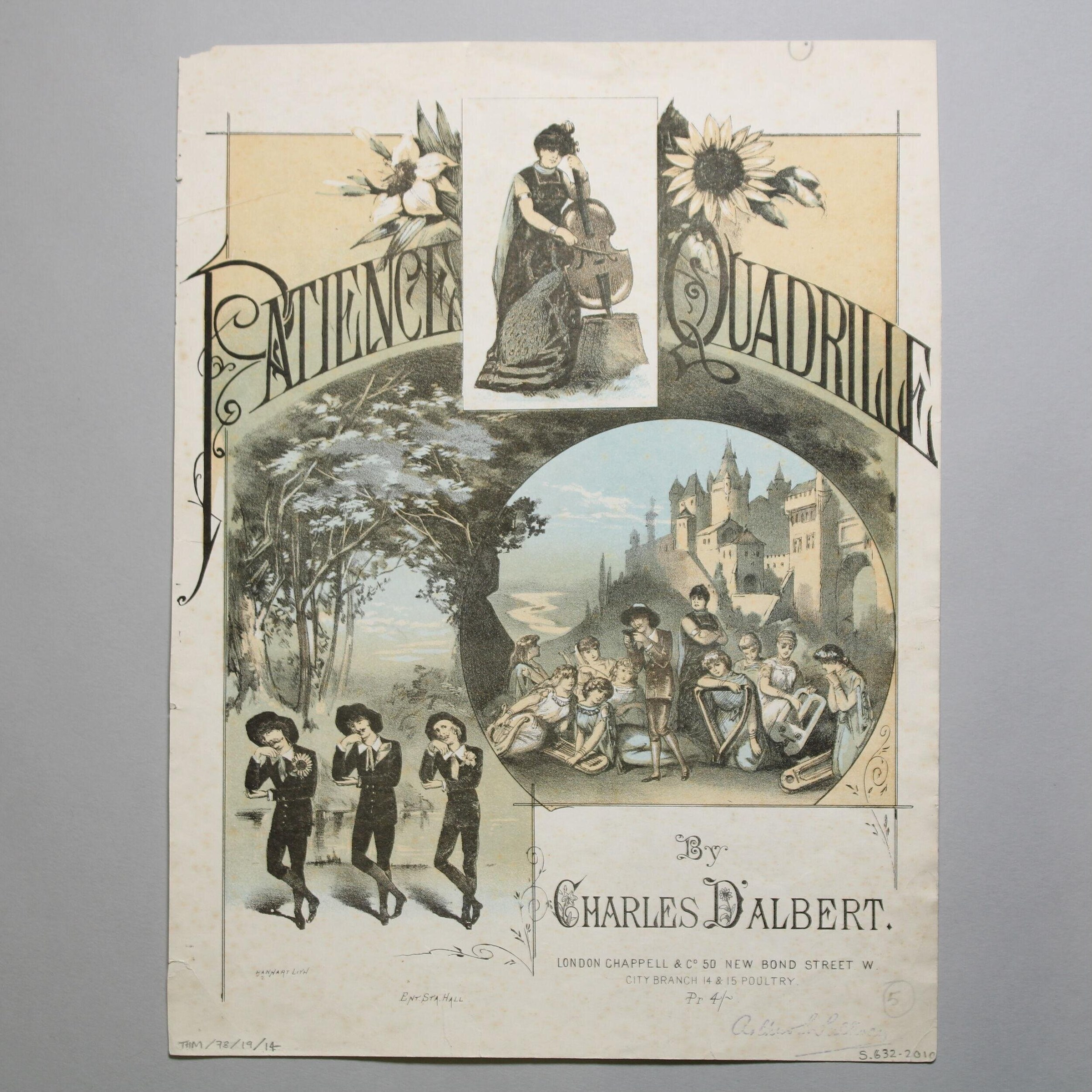
The Patience Quadrille
Hanhart, Michael
- Dance:
- Quadrille
- Era:
- Late 1800s (Victorian Ballroom)
- Source:
- Victoria and Albert Museum
- Rights:
- Rights vary by item — check the source record before reusing this image. Source record ↗
- Recorded as:
- Check V&A creditLine
The quadrille dominated middle and upper-class ballroom culture from roughly 1830 to 1890, and hundreds of published compositions attest to its centrality—yet most histories treat it as a footnote between the waltz and modern social dance. This title page preserves not technique but atmosphere: the cellist's focus, the formal dress, the castle setting, the casual grouping of waiting dancers. For anyone researching how 19th-century people actually socialized, dressed, and understood their bodies in motion, this commercial print is more valuable than any instruction manual.
What you are looking at
This is a chromolithographed title page for a quadrille composition, divided into three distinct vignettes that together narrate the form's social world. The central panel shows a single cellist in dark formal dress, seated and absorbed in performance. To the left, three young men in black tailcoats and top hats stand in a line, possibly awaiting their turn to dance or observe. The largest and most elaborate panel on the right depicts a castle interior or grand ballroom where a group of dancers—both male and female in period dress—gather in conversation and social arrangement. Sunflowers frame the left and right edges, while decorative scrollwork containing the title "Patience Quadrille" curves across the top. The color palette is muted: cream paper, olive and sepia tones in the figures and architectural details, with touches of pale blue in the ballroom scene's distant landscape visible through the castle windows.
The dancing
The cellist sits upright in a formal posture, completely focused on the instrument held between the knees—a figure of concentration rather than movement. In the ballroom scene, the dancers are arranged in loose groups rather than in organized sets; some stand, others appear seated on benches or chairs, with arm positions relaxed and social. The young men at left stand with arms at their sides in a waiting or observational stance. None of the figures display the rigid geometry or lifted deportment typical of formal ballroom technique; instead, the overall impression is one of ease, conversation, and social gathering rather than disciplined performance.
The dance depicted
This is documentary evidence of the quadrille as it was socially performed in the mid-to-late 19th century. The quadrille was a group dance for four couples arranged in a square, danced to a specific musical form that the cellist in the title page appears to be providing. The ballroom scene shows the characteristic mix of male and female dancers in formal evening wear, though no couples are locked in the closed holds that would characterize the dance's actual execution. The presence of the musician and the assembly of figures in a grand interior confirms the quadrille's status as a formal, choreographed social event requiring musical accompaniment and proper venue. The title suggests this is a specific composition—"Patience Quadrille"—one of many published quadrille scores of the period.
How it was made
This is a chromolithograph, a color printing process that allowed for the relatively affordable mass production of illustrated sheets and title pages. The technique—which separates color into multiple stone plates, each printed in sequence—is evident in the careful registration of the pale yellow backgrounds against the sepia line work of figures and architectural detail. Chromolithography made such decorative commercial printing accessible to music publishers and affordable to amateur musicians and dancers, meaning this image would have been part of the consumer world of home music-making and private dancing. The quality of the printing and the inclusion of naturalistic detail in the architecture and costume suggests this was a respectable commercial publication, not a cheap or ephemeral product.
About this work
The Patience Quadrille is a mid-19th-century chromolithographed title page for a dance composition, one of thousands of quadrille scores published as the form dominated European and American ballroom culture. It shows the social infrastructure of the quadrille—musician, dancers in formal dress, the grand interior setting—organized around a single musical performer. The work belongs in a gallery of dance imagery because it documents not the ideal technique of dance instruction, but the lived social reality of how people actually gathered, dressed, listened, and moved together in formal settings. It is a window into a world where dancing was synonymous with courtship, social standing, and the arrangement of mixed company.
How to look at it
Attend first to what the three scenes do not show: no movement, no dance holds, no suggestion of the figures mid-step. Instead, the artist has chosen stillness—a moment of gathering, waiting, and social arrangement. The cellist at the center is the organizing principle; the dancers are spectators and participants in a social pause. Notice the careful attention to costume: the men's tailcoats and top hats are accurate to the period, the women's skirts are full but not exaggerated, and all figures are rendered with documentary precision rather than idealization. The architectural setting and landscape vista through the windows signal that this is a formal, expensive occasion requiring proper venue. The title page as a form is itself instructive: it is meant to be beautiful enough to display on a piano or keep in a portfolio, making the dance and the music inseparable from the visual culture of the domestic interior.
The artist
Michael Hanhart was a London-based commercial engraver and chromolithographer active in the mid-to-late 19th century, known for decorative title pages, illustrations, and ornamental prints. The credit line indicates publication by Chappell & Co., a major London music publisher at 50 New Bond Street, with a city branch at 14 & 15 Poultry. Hanhart's practice was typical of the period: he produced countless illustrations for published sheet music, ballets, and theatrical works, his name appearing on title pages as the craftsman responsible for translating composers' and publishers' concepts into chromolithographed form. His work was competent, decorative, and aimed at the middle-class consumer market.
The period
By 1881, when this was published, the quadrille was entering its twilight as a serious ballroom form, though it remained respectable and widely danced. The waltz had already displaced it as the dominant couple dance in the 1830s–1850s, but the quadrille persisted as a formal, choreographed alternative suited to larger gatherings and mixed social groups. The publication of composition after composition—with titles such as "Patience," suggesting a narrative or character—reflects the period's appetite for novelty within familiar forms. Chromolithography was at its peak as a commercial technology, allowing publishers to produce attractive, colorful sheet music covers that appealed to amateur performers and collectors. In the visual arts, the 1880s saw increasing interest in historical and social subject matter; even a commercial music-publisher's title page might include naturalistic architectural detail and genuine observation of contemporary dress and posture.
Where it lives
This chromolithograph is held in the Victoria and Albert Museum collection. It is catalogued as a commercial music publisher's product, part of the massive archive of 19th-century sheet music and related ephemera that documents the social history of dance and domestic music-making.
Dance in this work
Questions about this work
Is this showing an actual dance, or just a decorative design?
Both. The title page is decorative and commercially designed, but it depicts real people in real circumstances: formal evening dress, a musician providing accompaniment, and the social arrangement of a quadrille gathering. The artist has chosen to show the social moment rather than the choreography itself, but the scene is historically accurate in its details of dress, setting, and social organization.
What was the quadrille and who danced it?
The quadrille was a choreographed group dance for four couples (eight people total) arranged in a square, performed to a specific musical form. It was danced by the upper and middle classes in formal ballrooms from roughly 1830 onward, often as part of a longer evening that also included waltzes and other couple dances. It required a live musician and a properly dressed setting, making it a marker of social respectability and proper behavior.
What is chromolithography and why would a music publisher use it?
Chromolithography is a color printing process using multiple stone plates, each inked with a different color and printed in sequence. It allowed publishers to produce attractive, colorful title pages and sheet music covers affordably and in quantity. By the 1880s, colored sheet music was standard, and attractive covers helped sell compositions to amateur musicians and dancers who kept them in portfolios on their pianos.
Why is the cellist the central figure?
The quadrille required live musical accompaniment, and the cellist was essential to the event. Placing the musician at the center of the composition reflects the period's understanding that music and dance were inseparable. The cellist's concentration and formal posture match the dancers' formality, making the musician a figure of equal importance to the dancers themselves.
More Quadrille artwork