43 works in this view — arrow keys or swipe to move between them.
Dance in Art
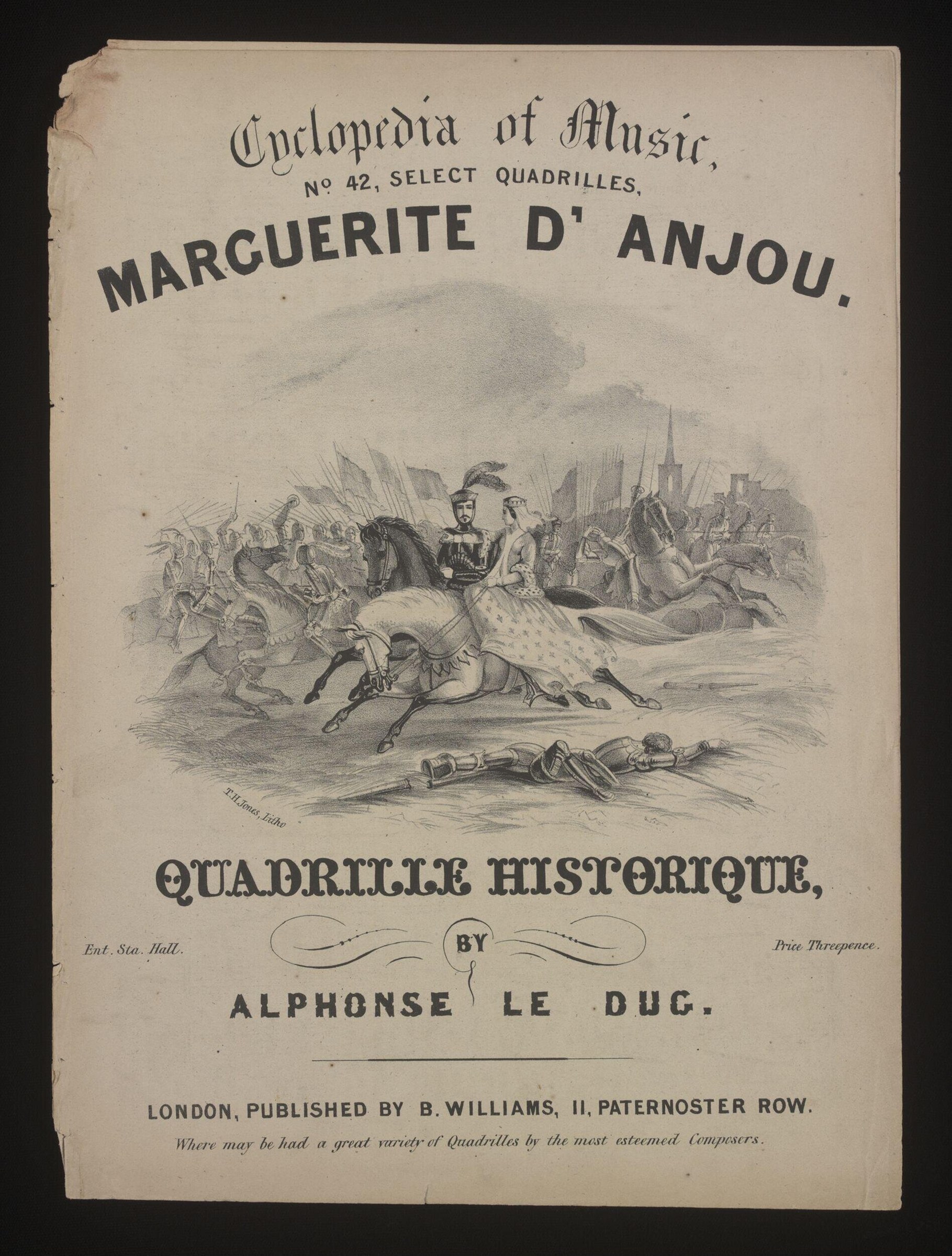
Quadrille Historique
Leduc, Alphonse
- Dance:
- Quadrille
- Era:
- Late 1800s (Victorian Ballroom)
- Source:
- Victoria and Albert Museum
- Rights:
- Rights vary by item — check the source record before reusing this image. Source record ↗
- Recorded as:
- Check V&A creditLine
This object shows how 19th-century ballroom dance was embedded in a visual and narrative culture far beyond the ballroom itself. The quadrille was adaptable to any theme or story a composer chose, making it a vehicle for historical, literary, and political commentary performed in elite and middle-class social space. Understanding what the dancers saw when they purchased this music—the heroic military image, the sense of historical gravitas—is essential to understanding what the dance itself meant to them.
What you are looking at
A military scene of cavalry in full gallop dominates the composition, with a mounted officer in the center wearing a plumed hat and military dress, attended by soldiers and horses in vigorous motion. In the background, a fortified town with spires and walls recedes under a dramatic sky. The foreground shows fallen weapons and military equipment scattered on the ground, emphasizing the aftermath of combat. The entire scene is rendered in fine engraved line work characteristic of mid-19th-century illustration, with careful attention to the anatomy of the horses and the detailed uniforms of the soldiers. The composition is theatrical and narrative, capturing a moment of military action that serves as the visual foundation for the quadrille's historical theme.
The dancing
The mounted figures are depicted in vigorous, dynamic posture, with riders sitting deep in the saddle and horses rearing or striding at full extension. The central officer raises one arm in command or acknowledgment. Multiple figures and mounts are shown in overlapping poses that suggest rapid forward movement and controlled chaos. No ballroom dance hold or closed position is visible—this is military action, not social dance, though the composition may reference the pageantry and spectacle that quadrille choreography sometimes imitated.
The dance depicted
The image does not depict dance itself, but rather illustrates a historical military scene that served as the narrative theme for the 'Quadrille Historique.' The work is a music publication for Select Quadrilles based on the historical incident of the Battle of Anjou (the title refers to the Marquise d'Anjou's involvement or a historical moment involving Anjou). Quadrilles of this era often took narrative or historical themes and embedded them in the choreographic figures and music. This engraving provided the visual context and story that dancers would enact through the formalized, geometric patterns of the quadrille form.
How it was made
This is a steel engraving, identifiable by the fine parallel lines (hatching) that create tone and shadow, the precise linear definition, and the clarity of detail possible only in engraved work. The medium allowed for mass reproduction and distribution as sheet music covers or as standalone prints, making it an economical way to sell both the music and the associated narrative to a broad, literate, middle-class audience. The publisher, B. Williams of Paternoster Row, London, was a major music publisher, suggesting this was a commercial product intended for amateur ballroom dancers and piano students.
About this work
This is the title page engraving for 'Marcherite d'Anjou: Quadrille Historique,' a piece of Select Quadrilles published in London in the late 19th century. The quadrille was the dominant ballroom dance of the mid-19th century across Europe and North America, performed by four couples in square formation and composed of five figures with linked music and choreography. Publishers routinely created quadrilles based on current events, historical moments, operatic scenes, and other themes; this one drew on a military historical episode. The engraving's function was to sell the music by evoking the drama and spectacle of the historical moment, even though the actual dance—performed in evening dress in a ballroom—would transform that narrative into abstract geometric patterns and turns.
The work sits at the intersection of visual culture, music publishing, and social dance practice. It demonstrates how the quadrille was not merely a dance but a multimedia phenomenon: music, narrative, visual imagery, and embodied social performance all combined to create a coherent cultural object. For historians of 19th-century ballroom practice, this engraving is evidence of how dances were marketed, themed, and made meaningful to their performers and audiences.
How to look at it
Begin with the military drama: note the rearing horses, the focused energy of the figures, the spatial recession into the fortified town, and the fallen weapons in the foreground. This is not a still moment but a scene of action and purpose. Then consider the engraving technique: the fineness of the line work, the careful hatching that models form and creates atmosphere, the precision required to render such detail. Finally, reflect on the disconnect between this heroic military image and what the actual ballroom dance would have looked like—four couples in evening dress moving in geometric patterns to this music. The gap between the narrative promise of the cover and the formalized, abstract choreographic reality is part of what made the quadrille culturally interesting to its performers.
The artist
Alphonse Le Duc (also Le Duc or Leduc) was a Parisian publisher and music engraver active in the mid-to-late 19th century. Le Duc was known for publishing dance music and popular songs, often with elaborate illustrated title pages featuring engravings by accomplished artists. His firm specialized in making music accessible to amateur performers through affordable sheet music editions, and the quality of his engraving and illustration was part of the product's appeal to middle-class households. This work exemplifies the marriage of commercial music publishing with fine illustration that characterized the trade.
The period
The quadrille reached the height of its popularity in Europe and America between 1840 and 1880. It had evolved from earlier French contredanse forms and was initially popularized during the Napoleonic era, gaining particular currency in Britain during the Regency period. By the Victorian era, the quadrille had become the standard opening dance of formal balls and the dance around which most ballroom evenings were organized. Publishers competed to create new quadrilles by naming them after current events, famous battles, operas, and literary works, making each quadrille a small cultural artifact tied to topical interest. The 'Quadrille Historique' format was a common strategy: a historical scene or moment, rendered in engraving, provided narrative flavor and marketing appeal to what was, choreographically, a standardized five-figure form. This particular engraving dates to the late 1800s, when the quadrille was beginning to decline in favor of the waltz and newer dances, yet remained respectable and widely performed.
Where it lives
This object is held by the Victoria and Albert Museum, London, as part of its collection of music publishing and ballroom dance ephemera. It is catalogued as an artwork (engraving) but functioned primarily as the title page or cover of a published music score, making it both a fine art object and a commercial music product. The V&A's collection of 19th-century dance music and related imagery documents the visual and commercial culture of ballroom dance.
Dance in this work
Questions about this work
What is a 'Quadrille Historique'?
A quadrille is a ballroom dance for four couples in a square formation, composed of five set figures with coordinated music. A 'Historique' quadrille was one based on a historical event, literary episode, or topical moment. Publishers created quadrilles this way as a marketing strategy to interest dancers and encourage them to buy the music. The choreography itself was standardized, but the theme and narrative gave each piece individual identity and cultural relevance.
Who danced the quadrille?
The quadrille was performed at formal balls by middle and upper-class dancers. It was the dominant social dance of the Victorian ballroom and was typically the opening dance of an evening, performed by the 'best' couples. Amateur pianists and music students also engaged with quadrille music as a performance and study medium. By the late 19th century, it had become a respectable but somewhat old-fashioned dance, yielding dominance to the waltz.
What does the military scene have to do with dancing?
Nothing directly. The engraving is a thematic illustration meant to evoke the historical moment the quadrille was named after and to make the music attractive and interesting to buyers. The actual dance, performed in a ballroom in evening dress, would be entirely abstract and geometric, with no literal enactment of military action. The image sold the narrative, while the choreography and music provided the actual dance experience.
Why was this published in London if the composer was French?
The quadrille was hugely popular in Britain during the Victorian era. London was a major center of music publishing and ballroom culture. Many French composers, publishers, and dance forms were imported, marketed, and reproduced in London for the English ballroom market. The Paternoster Row address indicates this was a major commercial publishing operation designed to serve that demand.
More Quadrille artwork