42 works in this view — arrow keys or swipe to move between them.
Dance in Art
The Olivette Quadrille
D'Albert, Charles
- Dance:
- Quadrille
- Era:
- Late 1800s (Victorian Ballroom)
- Source:
- Victoria and Albert Museum
- Rights:
- Rights vary by item — check the source record before reusing this image. Source record ↗
- Recorded as:
- Check V&A creditLine
The quadrille was the central dance of middle-class ballroom culture for over a century, and this image captures it at the height of its popularity and commercial saturation. For anyone studying Victorian social dance, ballroom aesthetics, or the relationship between dance and print culture, this work documents both the visual conventions used to represent quadrilles and the role of commercial illustration in making dance knowledge widely available.
What you are looking at
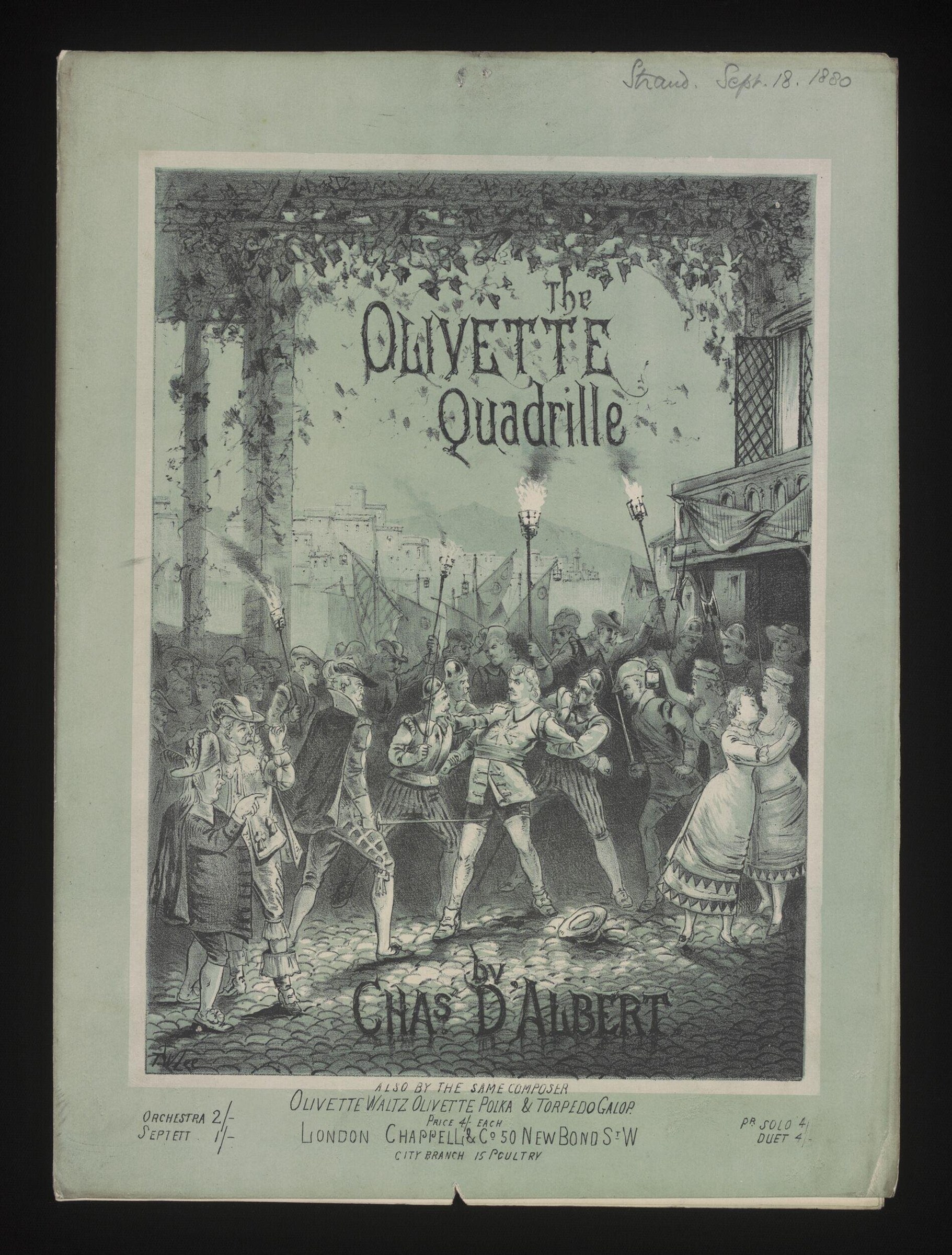
A crowded street or plaza scene in what appears to be a European town, viewed through an elaborate ivy-draped archway. At the center, four men in military or formal dress uniforms stand prominently on a cobbled street, positioned as if leading or demonstrating movement to a gathered crowd. The figures around them—civilians in period dress including women in long skirts and bonnets, and men in coats—form an audience or participatory crowd. Gas lamps line the street, and buildings with shuttered windows frame the background. The composition suggests a public entertainment or ceremonial moment, with the central figures commanding attention through their stance and positioning. The engraving technique creates strong contrasts between the detailed foreground figures and the more loosely rendered crowd and architecture beyond.
The dancing
The four central men stand in a loose formation across the street, their bodies upright and composed, facing partially toward each other and the surrounding crowd. Their arms are variously positioned—some at their sides, some gesturing outward—in a manner suggesting formal deportment rather than vigorous movement. The surrounding figures are densely packed, many standing still and watching, with some women's skirts rendered in detail suggesting the voluminous silhouettes of the 1880s. The overall frame is one of restrained, formal movement rather than dynamic dancing—the central figures maintain an orderly, almost processional quality.
The dance depicted
This is a quadrille, the most popular ballroom figure dance of the 19th century, particularly during the Victorian era when this work was likely created. The quadrille involved four couples (or in this public demonstration, possibly pairs or formations) executing a series of set figures—typically including chassés, balancés, and other movements arranged in strict geometric patterns. The presence of uniformed men at the center and the public, spectatorial arrangement suggests this may depict a social or military demonstration rather than a private ballroom scene. The orderly spacing and formal bearing of the dancers reflects the quadrille's characteristic emphasis on precision, symmetry, and decorous movement over theatrical virtuosity.
How it was made
This is an engraving, likely wood-engraved or steel-engraved, as evidenced by the fine cross-hatching throughout the image, the precise linear definition of forms, and the characteristic printed appearance. The technique allowed for mass circulation as sheet music illustration or as a standalone print—quadrilles were popular published entertainment, and imagery of fashionable dances was widely distributed to the middle-class audience that danced them. The publisher's imprint at the foot (London: Chappell & Co., 50 New Bond Street) confirms commercial distribution for sale to the public. The decorative ivy-framed composition suggests this served both as practical illustration and as an elegant object for the homes of people who danced.
About this work
This is a commercial engraving illustrating The Olivette Quadrille, a dance composition by Charles D'Albert, likely from the 1880s. It depicts not a private ball but a public demonstration of the quadrille—one of the central social dances of Victorian ballroom culture—set in an idealized European town square surrounded by an admiring crowd. The work functions simultaneously as an advertisement for the music, a visual instruction in the dance's formal character, and an artifact of the mid- to late-19th-century explosion in published dance imagery. It belongs in this collection as a primary document of how quadrilles were understood, taught, and circulated in the era of their greatest popularity.
The Olivette Quadrille sits within a broader Victorian culture of dance publication and consumption. Sheet music for quadrilles and other ballroom dances was a major commercial product, and publishers invested in attractive cover illustrations to draw purchasers. This engraving served that commercial purpose while also functioning as a visual narrative—showing not just the geometry of the dance but its social meaning as a public, orderly, respectable entertainment that could draw crowds and command attention.
How to look at it
The viewer should attend to the formal, almost architectural spacing of the four central dancers and the way the surrounding crowd frames them as objects of attention and instruction rather than as wild entertainers. Notice how the artist has rendered the quadrille not as an explosive moment of movement but as a moment of orderly assembly—the dancers are paused in formal positions, their bodies upright, their movements restrained. This reflects the Victorian ballroom aesthetic: the quadrille was meant to demonstrate grace, symmetry, and social order, not individual expressiveness. The engraving's fine detail and the structured composition reinforce this message of careful propriety. The crowd, rendered in looser detail, looks on with apparent approval, suggesting that the quadrille's appeal lay partly in its public, demonstrable respectability.
The artist
Charles D'Albert (also known as D'Albert or Dalbert) was a composer and dance musician active in the second half of the 19th century. He composed numerous quadrilles, galops, and other fashionable ballroom dances, many of which were published with illustrated covers by London publishers such as Chappell & Co. His work exemplifies the prolific commercial production of dance music during the Victorian era, when composers churned out variations on standard dance forms to feed the enormous middle-class appetite for ballroom entertainment. D'Albert's music and its attendant imagery represent the mechanized, commodified side of 19th-century dance culture—popular, reproducible, and designed for consumption by amateur dancers.
The period
The 1880s saw the quadrille at the zenith of its social importance. Although the waltz had become extremely popular from the 1820s onward, the quadrille remained the standard opening dance at formal balls and the primary dance taught to young people entering society. Victorian ballroom culture was intensely visual and public: dance instruction was widely available through printed manuals and illustrated sheet music, dance halls were prominent urban institutions, and fashionable dances were constant subjects of artistic representation. This was also the era of the Savoy Operas (beginning 1875), in which quadrilles featured prominently, and of the explosion of illustrated periodicals that made dance imagery widely circulated. The commercial print culture surrounding dance had reached unprecedented sophistication by the 1880s.
Where it lives
This work comes from the Victoria and Albert Museum collection, where it is held as a document of Victorian commercial design and dance culture. It is a published print issued by the London music publisher Chappell & Co., and was sold on the open market as sheet music cover art, making it part of the mass-produced visual culture of 19th-century ballroom dance.
Dance in this work
Questions about this work
What is a quadrille and why was it so important?
The quadrille is a ballroom dance for four couples arranged in a square, performed to music in 2/4 time, consisting of a sequence of set figures performed in strict order. It originated in 18th-century France and dominated middle- and upper-class ballroom culture throughout the 19th century. Every person of respectable social standing was expected to know how to dance it, and it remained the standard opening dance at balls even as waltzes and other dances gained popularity. Its importance lay not in virtuosity but in its role as a marker of social respectability, coordination, and refinement.
Why does this engraving show spectators rather than a private ball?
This appears to be a promotional or demonstration image created as sheet music cover art rather than a realistic depiction of an actual ballroom. Publishers used idealized scenes of public appreciation to market the music and to elevate the status of the dance. The spectators frame the dance as worthy of attention and admiration, reinforcing the idea that the quadrille was a respectable, pleasurable, socially significant activity. It also serves an instructional function, allowing viewers to see the general spatial relationships and formal bearing of the dancers.
How were people taught to dance quadrilles?
Quadrilles were learned through a combination of dancing masters' instruction (in group classes or private lessons), published written instructions and diagrams in dance manuals, and practice at public balls and private dances. This engraving itself serves a quasi-instructional purpose: it shows the orderly, symmetrical arrangement and the formal carriage expected of quadrille dancers. Published sheet music with illustrated covers like this one made dance knowledge widely available and served as visual reminders of proper form for amateur dancers.
Who was Charles D'Albert?
Charles D'Albert was a 19th-century composer specializing in ballroom dance music, particularly quadrilles, galops, and other fashionable forms. Little is known of his personal life, but his prolific output and publication by major London publishers like Chappell & Co. indicate he was a commercially successful composer serving the enormous Victorian appetite for dance music. His quadrilles represent the industrialized, standardized side of 19th-century dance—music and movement designed for rapid consumption and amateur performance rather than virtuosic display.
More Quadrille artwork