40 works in this view — arrow keys or swipe to move between them.
Dance in Art
Patience Quadrille
D'Albert
- Dance:
- Quadrille
- Era:
- Late 1800s (Victorian Ballroom)
- Source:
- Victoria and Albert Museum
- Rights:
- Rights vary by item — check the source record before reusing this image. Source record ↗
- Recorded as:
- Check V&A creditLine
This work reveals the intimate link between ballroom dance and visual popular culture in the Victorian era. It shows how composers and publishers deployed emotional and narrative imagery to sell dance music to amateurs, and how the ballroom dance was understood as a vehicle for sentimental storytelling, not merely social choreography.
What you are looking at
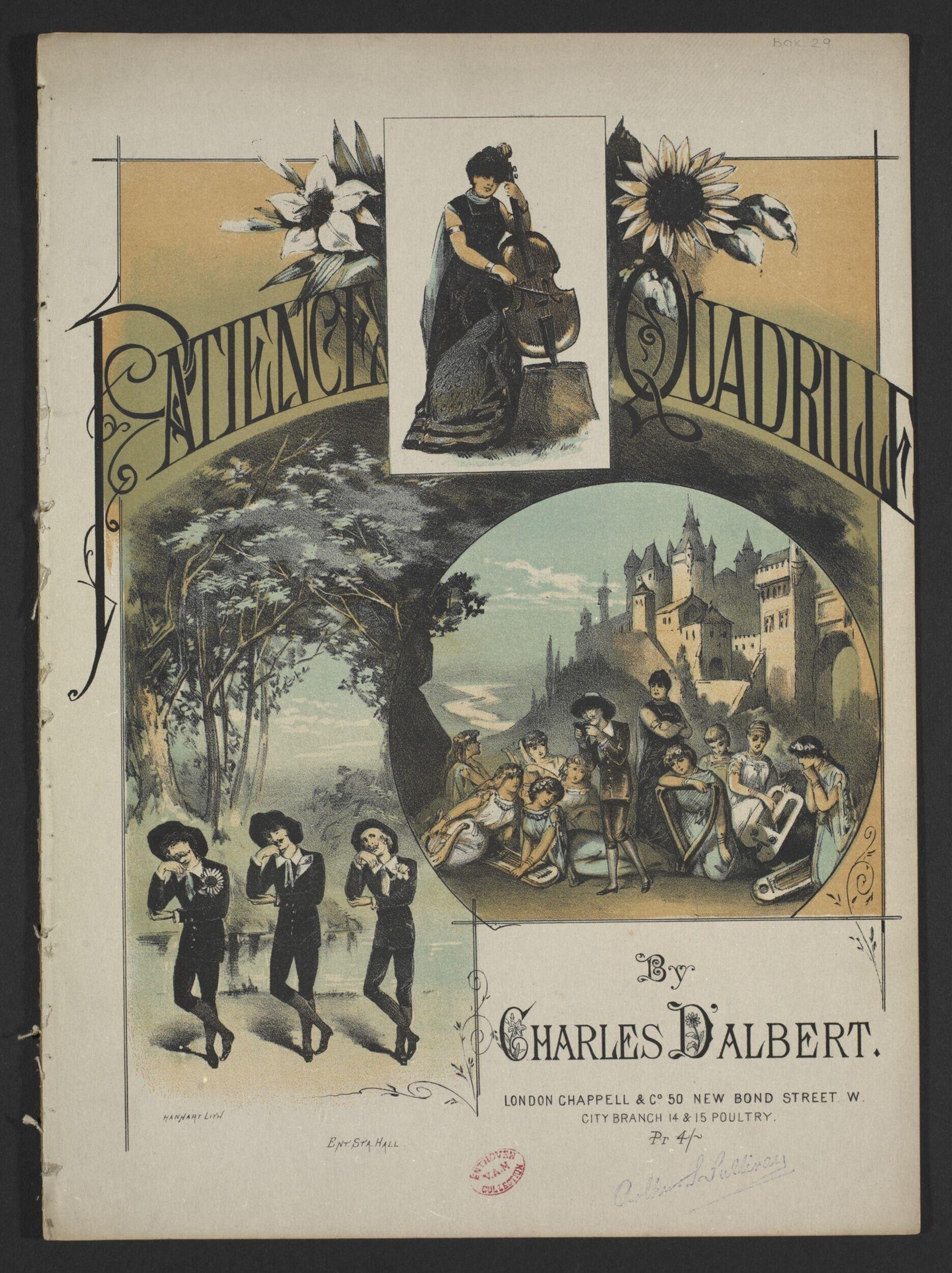
This is a decorative title page for a musical quadrille, printed in color with ornamental lettering. The composition is framed by the words "Patience Quadrille" in stylized script at top left and right. At center top is a vignette showing a young woman in black dress and hat, seated and looking pensively downward, holding what appears to be a fan or small object. She is flanked by sunflowers—one in bloom at upper left, one drooping at upper right. Below this central portrait, a large oval frame contains a castle scene with a group of figures in classical or theatrical dress gathered on the ground before a medieval fortress. Three figures in dark formal wear stand at lower left, positioned as if observing or approaching the scene. The entire composition uses earth tones—ochre, tan, gray, and black—with careful attention to shading and depth. The publisher's imprint appears at bottom: "By Charles D'Albert, London Chappell & Co 50 New Bond Street W, City Branch 14 & 15 Poultry, Price 4/6."
The dancing
The central seated figure is posed in an attitude of melancholy or introspection, with the head tilted downward and supported by one hand—a gesture associated with sentimental portraiture of the period. The three standing figures at lower left are shown in profile, dressed in formal Victorian evening wear, suggesting observers or principals in a formal dance. In the castle scene, the gathered figures appear to be in upright, composed poses suggesting either a procession, formal greeting, or tableau vivant arrangement rather than active dancing.
The dance depicted
The title identifies this as a Patience Quadrille, a form of dance music for the quadrille that dominated Victorian ballroom culture from the 1830s onward. The quadrille was a square dance for four couples performed in formal dress at public balls and private entertainments. The imagery here does not depict actual quadrille dancing—no couples in hold, no floor pattern visible. Instead, it uses romantic and theatrical conventions to sell the sheet music: the melancholic portrait suggests emotional narrative, while the castle scene evokes literary or operatic sources that might inspire the music's character. This was standard marketing for dance music of the Gilded Age.
How it was made
This is a color lithograph, evident from the way the tones have been laid and the slight registration variation between color layers. Lithography allowed economical production of illustrated sheet music covers in quantity, reaching amateur musicians and dance teachers across the middle and upper classes. The decorative lettering and framing suggest this is a cover or title page for published sheet music rather than a performance record. The technique's capacity for fine tonal gradation is used here to create atmospheric depth, particularly in the castle scene.
About this work
This is a commercial music cover for a Victorian ballroom dance, produced by a London music publisher in the late 19th century. The Patience Quadrille belongs to the enormous repertoire of quadrille music that supplied ballrooms and drawing rooms throughout the Gilded Age. Charles D'Albert was a prolific composer and arranger of such dances. The image does not document actual quadrille performance, but rather uses romantic visual language—a pensive heroine, a castle, theatrical tableau—to market the music to a public that consumed such dances as both social ritual and emotional narrative. It is a document of how dance music was sold and imagined in this period, as much as what was actually danced.
How to look at it
Attend first to the contrast between the two main images: the seated, introspective figure above and the active, grouped tableau below. This contrast was intentional—the former speaks to emotional narrative, the latter to social or theatrical action. The three dark-clad observers at bottom left serve as surrogates for the viewer, inviting us to regard the castle scene as a spectacle. The ornamental framing and lettering should be read as part of the sales apparatus: the design announces luxury and refinement, addressing prospective buyers who saw the quadrille as a mark of gentility.
The artist
Charles D'Albert (often listed as D'Albert) was a prolific Victorian composer and arranger, primarily of ballroom music and quadrilles. He published prolifically through Chappell & Co, one of London's leading music publishers. His work typifies the mid-to-late 19th-century ballroom music trade: each dance had a title with narrative or sentimental associations, and covers often featured corresponding imagery. D'Albert's output reflects the enormous demand for dance music among the growing middle class.
The period
The quadrille dominated Western ballroom culture from approximately 1820 to 1914. By the 1880s–1890s, when this cover was likely produced, the quadrille remained standard repertoire, though the waltz and later the Two-Step had become increasingly popular. The Victorian era saw the professionalization of ballroom dancing as both amateur social practice and commercial entertainment. Sheet music covers became more elaborate and illustrated as competition for customers intensified. The visual language here—the melancholic heroine, the castle, the romantic tone—reflects the wider Victorian taste for sentiment and narrative in the arts.
Where it lives
This is a printed sheet music cover from the Victoria and Albert Museum collection. It is a commercially published object, part of the vast corpus of Victorian-era ballroom music distributed through music publishers' networks across Britain and the English-speaking world.
Dance in this work
Questions about this work
What is a Patience Quadrille?
A Patience Quadrille is a set of music composed for the quadrille, a square dance performed by two or more couples in a formal ballroom setting. The quadrille was danced to multiple figures, each with its own music. The title "Patience" suggests a sentimental or romantic character. Such quadrilles were stock repertoire for ballroom musicians and dancing masters throughout the 19th century.
Did people actually dance the way they are shown here?
No. This is a decorative cover, not a documentation of dance. The central portrait and castle scene are romantic or theatrical imagery designed to sell the music, using narrative and sentiment to appeal to consumers. The three observers at lower left are a visual device inviting the viewer to imagine themselves in a ballroom scene.
Who was Charles D'Albert?
D'Albert was a Victorian composer and arranger known for publishing large quantities of ballroom dance music, particularly quadrilles, through the London publisher Chappell & Co. His prolific output reflects the enormous commercial demand for dance music among amateur musicians and ballroom patrons in the 19th century.
More Quadrille artwork