39 works in this view — arrow keys or swipe to move between them.
Dance in Art
State Ball Quadrille
Charles Handel Rand Marriott
- Dance:
- Quadrille
- Era:
- Late 1800s (Victorian Ballroom)
- Source:
- Victoria and Albert Museum
- Rights:
- Rights vary by item — check the source record before reusing this image. Source record ↗
- Recorded as:
- Check V&A creditLine
The quadrille was the foundational ballroom dance of the 19th century, requiring memorized figures performed in strict formation—this print shows not just the dance but the built environment and social ritual that defined it. For social dancers and historians, the image is invaluable documentation of posture, costume, spacing, and the relationship between architecture and ballroom culture at the height of Victorian formality.
What you are looking at
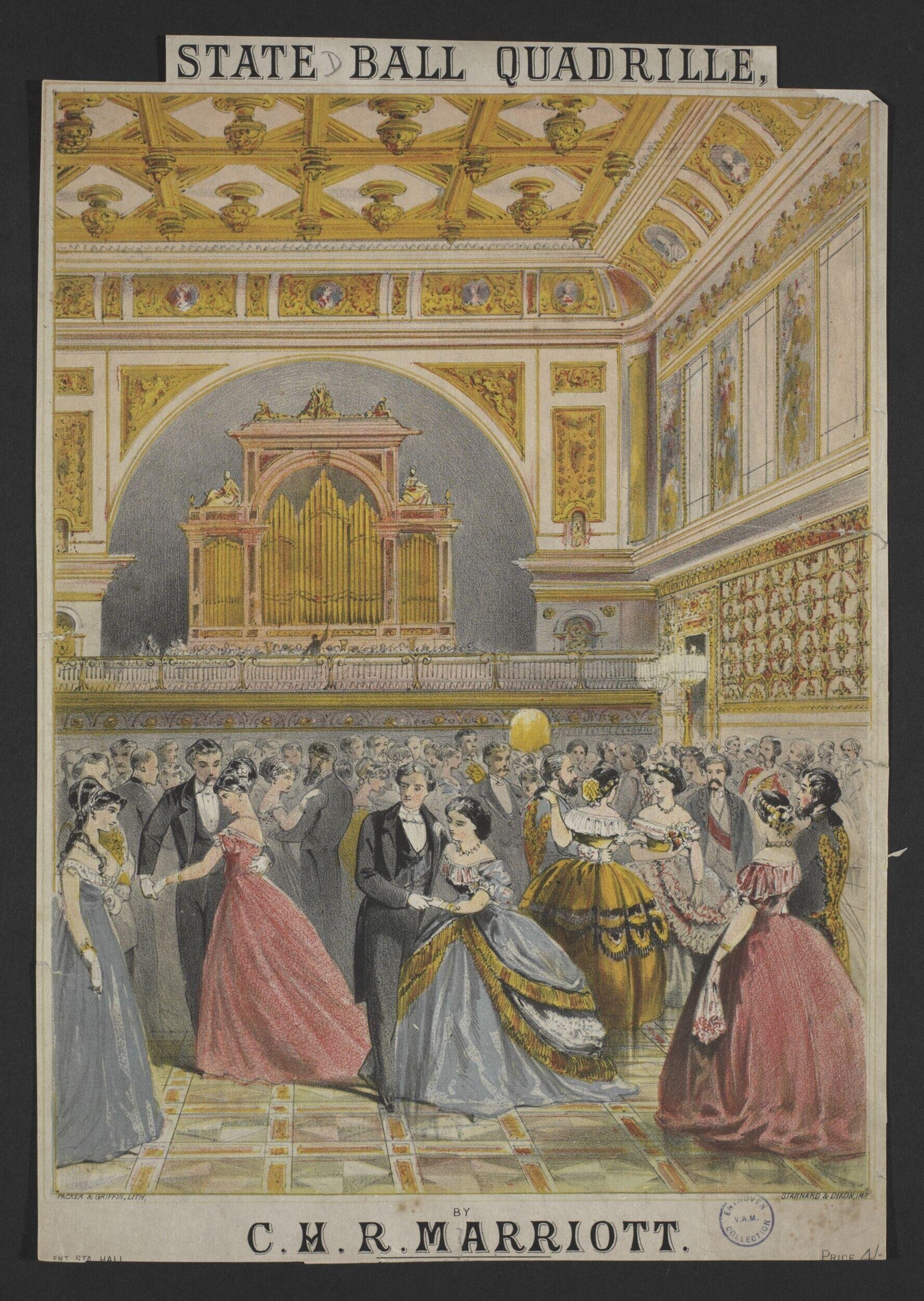
A formal ballroom filled with fashionably dressed dancers in mid-performance, viewed from an elevated angle that emphasizes the ornate architecture. The space is a grand hall with a coffered and gilded ceiling, elaborate wall panels decorated in gold leaf, and a massive pipe organ dominating the upper stage behind a white balustrade. The floor is a geometric pattern of light and dark tiles. Approximately thirty figures in evening dress move through the space—men in black tailcoats, women in full-skirted gowns of varied colors (rose, white, gold, grey)—arranged in the characteristic scattered formation of a quadrille mid-sequence. The lighting is warm and diffuse, emanating from the gilt surfaces and suggesting gaslight or candlelight typical of Victorian-era formal events.
The dancing
The dancers maintain the upright, formal posture required of Victorian ballroom etiquette. Most figures stand or step in positions suggesting they are between figures of the dance—some facing partners, others turned toward the group formation. The women's postures show the constrained elegance of tight corseting, with arms held in gentle curves at the sides or extended toward partners. Men stand erect with hands positioned for hold or gesture. No violent or acrobatic movement is visible; instead the composition captures a moment of relative stillness or transitional step typical of the quadrille's geometric pattern-work, where groups shift, circle, and reform in place rather than traveling across the floor.
The dance depicted
This depicts a state ball quadrille, a highly formal variant of the quadrille danced at official court or government functions. The quadrille was the dominant ballroom form for couples and small groups throughout the Victorian era, structured in five figures with specific choreography known to all dancers of that class. The formal setting—a state ballroom with organ and grand architecture—and the social composition of the assembly (officers, debutantes, and members of society) indicate this is the version performed at official ceremonies and high diplomatic occasions, not a private or public assembly room dance. The scene captures the quadrille at a moment when multiple couples are executing the geometric formations that defined the dance: the positions suggest dancers mid-figure, standing ready or moving into the next phrase rather than performing a traveling step.
How it was made
This is a hand-colored engraving or lithograph, a mass-produced print format typical of Victorian popular imagery. The technique allowed for wide circulation and affordability—such prints were sold as sheet music covers, book illustrations, and cheap decorative prints for middle-class homes. The skilled hand-coloring (visible in the graduated shading of the women's skirts and the careful gilding on the architectural details) was applied after printing, a labor-intensive process that preserved the crispness of the engraved line while adding visual richness. This production method indicates the work was intended for a broad audience interested in fashionable society life, dance customs, and domestic entertainment rather than a restricted collector's market. The artist's name appears at the bottom: C. H. R. Marriott.
About this work
This hand-colored print documents a state ball quadrille in the height of Victorian formality, capturing both the architectural grandeur and the strict social choreography of mid-to-late 19th-century official entertainment. The quadrille, a structured ballroom dance for four couples arranged in a square, was the universal social dance of the era and essential to any formal occasion—this image shows it in its most prestigious context, performed before an organ in a gilded state ballroom. The work belongs in a dance gallery as evidence of how the Victorian middle and upper classes codified and circulated knowledge of fashionable movement: prints like this taught people what they should aspire to look like on a ballroom floor, transmitted dance etiquette to provincial audiences, and memorialized the specific architecture, dress, and social order within which ballroom dancing took place.
How to look at it
Observe the careful distribution of figures across the floor: the quadrille always involved four couples (eight dancers minimum), though this ballroom contains many more people, suggesting simultaneous quadrilles or a crowded state event where several squares danced at once. Notice the women's posture—rigid spines, constrained arms, small steps—which reflects the heavily boned corsetry of the 1870s–1880s. The moment chosen is not a leap or peak of movement but a moment of social interaction and geometric arrangement, which is what the quadrille *was*: not virtuosic display but the perfect execution of memorized steps in synchrony with partners and the group. The organ in the background is not incidental—the quadrille was typically performed to live instrumental music, and a state ball would feature serious musicians, not a dance band.
The artist
Charles Handel Rand Marriott was a Victorian commercial artist and illustrator specializing in theatrical and social scenes. The signature at the base indicates this was part of a series or commercial publishing venture. Little beyond the signature remains readily accessible, but the professional quality of the composition and coloring suggests Marriott was an experienced hand in the genre of fashionable-life illustration, which was a thriving commercial category in Victorian Britain.
The period
The quadrille reached its peak of fashion and social importance in the mid-Victorian era (1850s–1880s), particularly as a state and formal social dance. Unlike earlier ballroom forms (minuet, cotillion), the quadrille was more dynamic and less solemn, yet more structured and rule-bound than the waltzes and polkas that coexisted with it. By the date of this print, the quadrille was already becoming slightly old-fashioned among the very young (the waltz was gaining ground), but it remained the required form for debutante balls, state functions, and official occasions. Prints of ballroom scenes were a standard genre of Victorian popular culture, serving both as fashion plates and as windows into aspirational middle-class social life. The ornate state ballroom setting suggests this print may have commemorated a specific historical event or was designed to appeal to patrons of civic institutions.
Where it lives
The work is recorded as part of the Victoria and Albert Museum collection with source designation 'va'. It is catalogued as a Late Victorian work (era label: Late 1800s, Victorian Ballroom), though the specific date of creation and publication is not recorded in the catalogue entry provided.
Dance in this work
Questions about this work
What is a quadrille and how was it danced?
A quadrille is a ballroom dance for four couples arranged in a square formation. It consists of five figures, each with specific choreographed steps and formations (advances, retreats, circles, chassés, and exchanges of place). All dancers knew the figures, so every quadrille followed a standard pattern, though musicians could vary the tempo and character. By the Victorian era it was the dance of formal occasions, debutante presentations, and state balls—the very event shown in this print.
Why do all the women's dresses look so full and constrained?
Victorian women's evening wear was constructed with rigid boning (stays or corsets) and multiple layers of underskirts and petticoats that created the characteristic bell-shaped silhouette. This severely restricted movement—women could not bend at the waist, take large steps, or raise their arms high. The quadrille was specifically choreographed to work within these constraints: it emphasizes small, precise steps, arm gestures, and geometric group movement rather than traveling or athletic action.
Is this a real event or a generic scene?
The catalogue record does not specify whether this commemorates a particular state ball or was a generalized scene created to represent fashionable ballroom culture. The architectural detail and the inscription 'State Ball Quadrille' suggest it may be based on a real ballroom or event, but without additional documentation, this cannot be confirmed. It may equally have been created as an aspirational or instructional image—showing the public what a formal quadrille looked like and where such dances took place.
What is the organ doing in a ballroom?
State balls and grand formal occasions sometimes featured full orchestras or pipe organs as a mark of ceremonial importance. The organ here signals this is not a private subscription ball or a public assembly room dance, but an official state function. Most ordinary ballrooms used smaller ensembles or a piano. The organ's prominence in the composition underlines the social rank and formality of the event being depicted.
More Quadrille artwork