37 works in this view — arrow keys or swipe to move between them.
Dance in Art
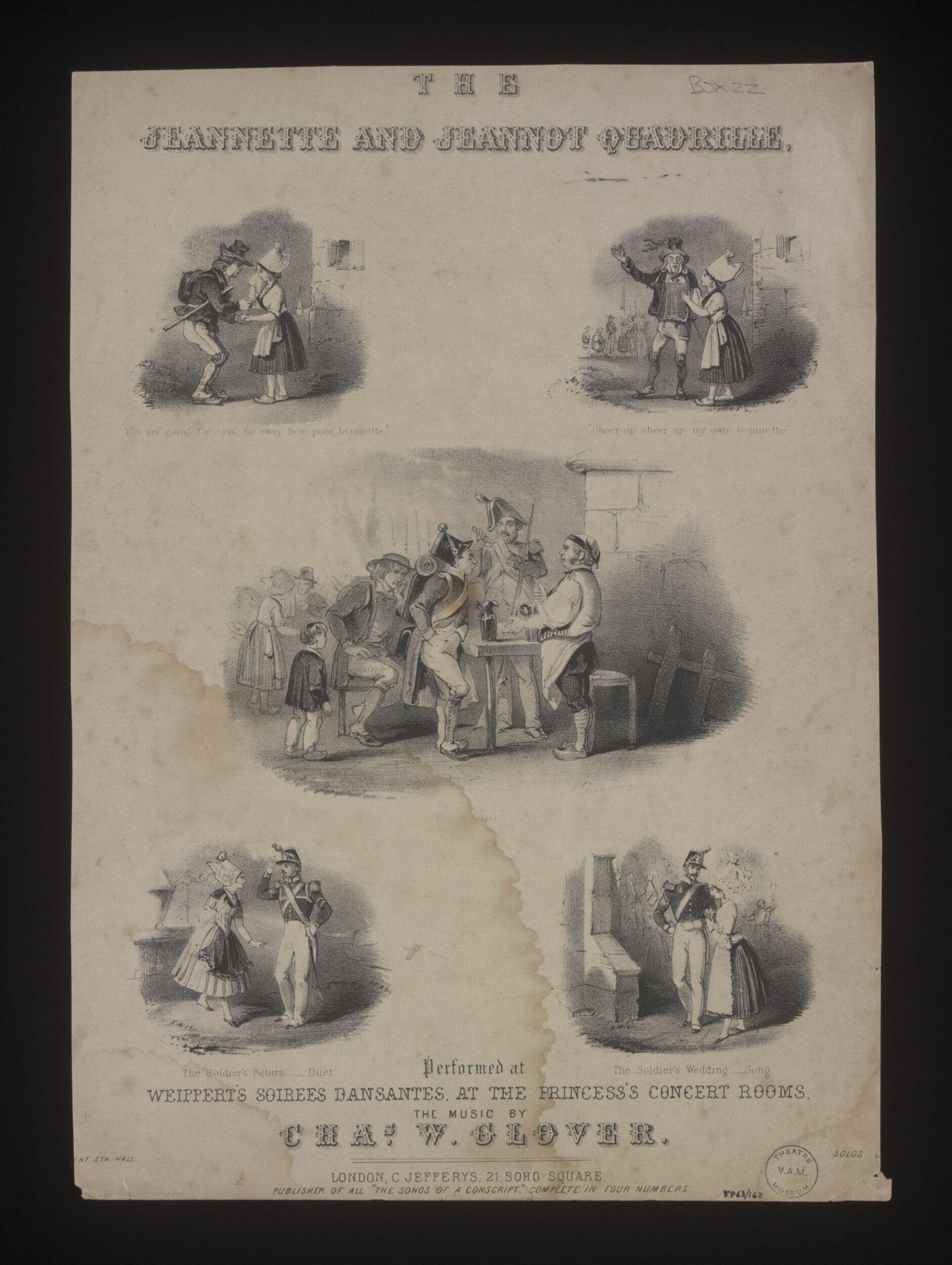
The Jeannette and Jeannot Quadrille
Jefferys, Charles
- Dance:
- Quadrille
- Source:
- Victoria and Albert Museum
- Rights:
- Rights vary by item — check the source record before reusing this image. Source record ↗
- Recorded as:
- Check V&A creditLine
This print is rare visual documentation of how a specific 19th-century theatrical quadrille was choreographed and performed, showing the narrative and social content embedded in what might otherwise appear as pure geometric pattern. For dancers and historians, it demonstrates that quadrilles were not merely mechanical exercises but mini-dramas staged for paying audiences, with character and plot woven into the figures.
What you are looking at
This is a composite illustration of five scenes from 'The Jeannette and Jeannot Quadrille,' a theatrical work performed at Weippert's Soirées Dansantes at the Princess Concert Rooms with music by C. W. Glover. The central, largest scene depicts an indoor gathering—likely a parlor or ballroom—where multiple figures in early 19th-century dress assemble around what appears to be a table or central feature. The four smaller vignettes frame this central image: upper left shows an adult figure (possibly a gentleman in military or formal dress) bending toward a young child; upper right mirrors this with a standing adult and child in a similar spatial relationship; lower left presents two figures—one in uniform and one in a dress—in conversation or courtship; lower right shows a uniformed figure with a woman in an interior doorway or alcove. The dress throughout is consistent with the Regency or early Victorian era: women wear high-waisted gowns with full skirts, and men wear breeches, coats, and formal jackets, some with military insignia. The engraving employs fine stippled shading to suggest interior light and fabric texture, and the composition emphasizes narrative progression from intimate two-figure encounters to a larger social assembly.
The dancing
The figures move with restrained elegance characteristic of formal Regency deportment. In the central scene, bodies are arranged in loose groupings rather than tight holds, suggesting the lined-up, processional spacing of quadrille formation. The smaller scenes show bodies angled toward one another—in the upper panels, adults lean down to child-height in what may depict a greeting or instruction; in the side panels, figures stand at a conversational distance with upper bodies turned toward partners. Arm positions are generally controlled and at the sides or engaged in gesture rather than elevated holds. The women's full skirts dominate visually, their silhouettes creating vertical emphasis and allowing their partners to maintain some distance. Children appear in at least two vignettes, marking this as a family or social occasion rather than a performance-only context.
The dance depicted
This is a quadrille, a formal group dance for four couples arranged in a square, hugely popular in English ballrooms from the Regency through the Victorian era. The title character names—Jeannette and Jeannot—suggest this is a specific choreographed version, possibly one of the theme-and-variation quadrilles that were fashionable theatrical attractions in the 1830s–1850s. The central scene's arrangement of multiple figures and the narrative progression through the side vignettes suggest the quadrille unfolds through distinct 'figures'—individual movements or configurations—as was standard in the dance form. The presence of children and the theatrical framing indicate this was performed as a spectacle rather than as social dancing; Weippert's Soirées Dansantes were fashionable London entertainments that presented dance as visual art for an audience rather than participation.
How it was made
This is a steel or copperplate engraving, recognizable from the fine parallel hatching and stippled tone that define form and shadow, and from the crisp linear quality of the outlines. The technique allowed the publisher C. Jefferys to produce multiple copies for commercial sale, and the hand-coloring visible in some impressions suggests these were luxury items for the parlor walls of dance enthusiasts. Engraving was the standard medium for theatrical dance documentation in this period, cheaper and more reproducible than lithography but still capable of considerable detail. The multiple-scene layout on a single plate was economical and narrative, allowing the publisher to tell a story—the 'plot' of the quadrille—rather than freeze a single moment.
About this work
This engraving documents a specific theatrical quadrille, 'The Jeannette and Jeannot,' performed as public entertainment in 1830s–1840s London. The quadrille was the dominant ballroom dance of the era, but this version was choreographed for the stage and performed by professionals at a fashionable subscription entertainment. The work survives as material evidence of how quadrilles were performed in theaters, how they were marketed to the public through prints, and how dance was understood as a form of genteel domestic spectacle. The image shows the dance not as an abstract pattern but as a sequence of human encounters—greetings, courtships, assemblies—woven into the formal structure of the dance itself. It is one of many such theatrical quadrille prints from the period, collectively documenting a now-vanished tradition of dance as parlor theater.
How to look at it
The viewer should follow the sequence of the five scenes as a narrative: the side and corner vignettes show intimate moments or character encounters, while the central scene shows how these encounters combine into the larger social form of the dance. Notice how the artist has chosen to depict the quadrille not as a overhead geometric view (as in dance notation) but from a participant's eye level, showing faces, costumes, and the spatial relationships between dancers. The engraving technique creates a sense of movement through the subtle gradation of light and the implied weight of the figures; despite the stillness of the printed form, the bodies feel poised and momentary rather than static. The presence of children and the domestic interior setting emphasize that this dance, though theatrical, was understood as a form of genteel social conduct and family entertainment.
The artist
Charles Jefferys was an engraver and publisher active in London in the mid-19th century, specializing in theatrical and social subjects. His prints of dance, theater, and fashionable life were aimed at the expanding middle-class market for parlor wall decoration and theatrical souvenirs. The technical quality of his engravings and the detail given to costume and setting suggest he worked from drawings by theatrical designers or choreographers, translating live performance into a durable commercial form.
The period
The quadrille arrived in England from France around 1815 and became the dominant ballroom dance of the Regency and Victorian eras, eventually displacing the cotillion. By the 1830s–1840s, when this print was published, quadrilles had become a staple of theatrical entertainment as well as ballroom dancing. Fashionable Londoners attended subscription concerts and 'soirées' at venues like the Princess Concert Rooms specifically to watch professional dancers perform choreographed quadrilles, often with elaborate costumes and narrative frames—as suggested by the character names here. At the same time, the quadrille was becoming standardized through printed instruction books, and engravings like this one served both as souvenirs of performances and as visual guides to the figures for home dancers. The music by C. W. Glover indicates this was a professionally commissioned work, with composer, choreographer, and dancers all credited as it would be for a theatrical production.
Where it lives
This engraving is held in the Victoria and Albert Museum's collections, which include one of the world's largest collections of theatrical prints and dance documentation from the 18th and 19th centuries. It was published in London by C. Jefferys at 21 Soho Square, as stated in the imprint. The plate number and printing information suggest it was part of a series of theatrical dance prints issued by this publisher.
Dance in this work
Questions about this work
Was this a real dance that people did at balls, or just a theatrical spectacle?
Both. The quadrille was the central ballroom dance of the 19th century and was danced by thousands of ordinary people at private balls and assemblies. But choreographers also created elaborate theatrical versions for public performance, often with added story, characters, and stage effects, like this one. This particular quadrille was designed for performance at a fashionable London entertainment venue, though the figures it contains would have been recognizable to any educated ballroom dancer of the period.
What are the different scenes showing?
The central scene appears to show the full assembly of dancers in the main quadrille formation. The four surrounding scenes likely depict key moments or 'figures' from the dance—moments of greeting, courtship, or character interaction that would have occurred in sequence. This narrative framing was common in theatrical quadrilles, which often told a story or presented a sequence of character encounters woven into the formal dance structure.
How do we know this is actually a quadrille?
The title names it explicitly as a quadrille. The central scene shows the characteristic arrangement of multiple figures in a confined space, which is how a quadrille—danced by four couples in a square formation—would appear indoors. The repetition of paired dancers in formal dress, the Regency-era costume, and the theatrical framing all confirm this as a fashionable early 19th-century ballroom dance rather than any other form.
Why does this print matter for dance history?
It is one of the few surviving visual records of how a specific choreographed quadrille was staged, what it looked like in performance, and how it was marketed to the public. Most dance history from this period survives through written descriptions or notation; prints like this one are rare evidence of actual movement, costume, spacing, and the theatrical context in which professional dancers performed for audiences.
More Quadrille artwork