34 works in this view — arrow keys or swipe to move between them.
Dance in Art
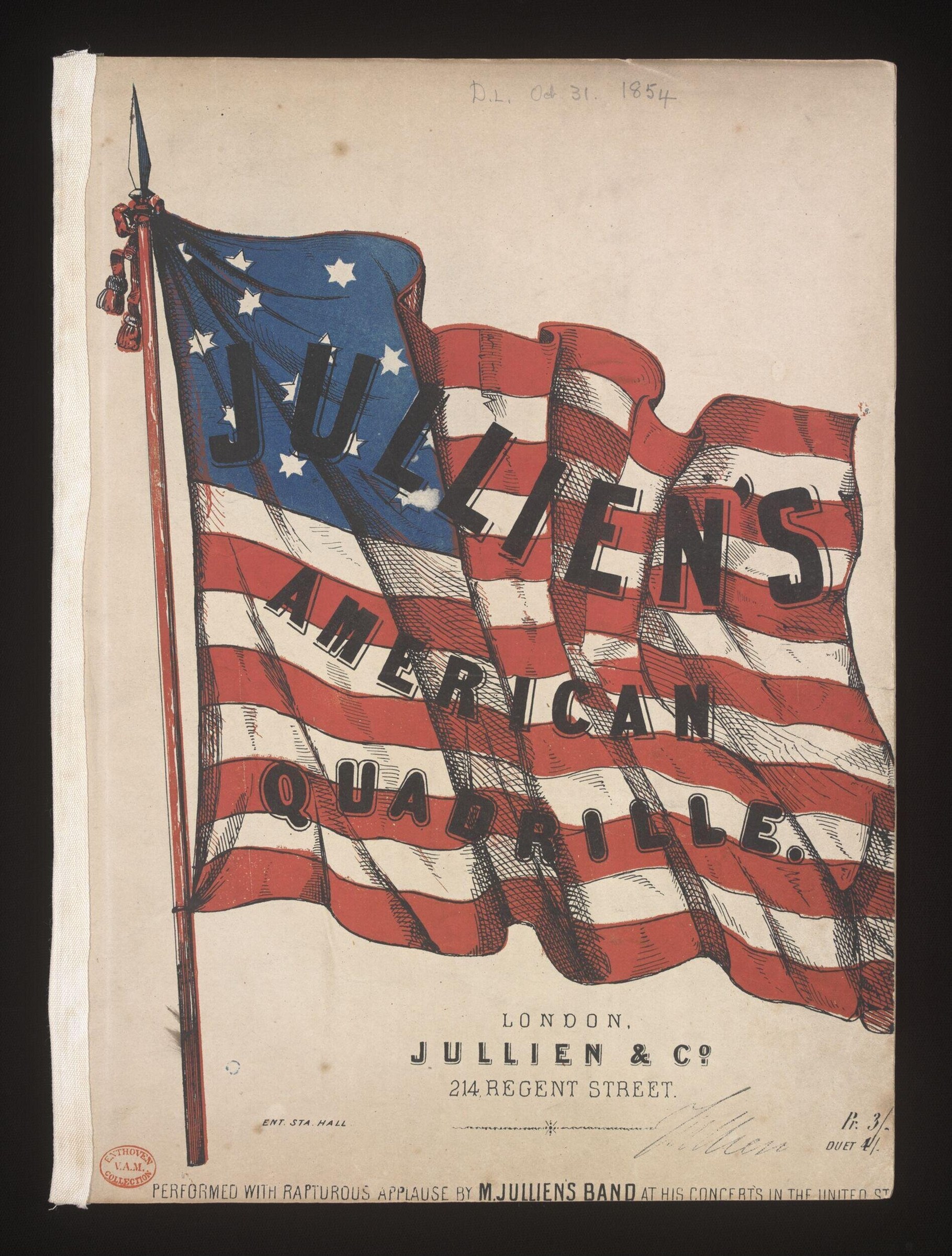
Jullien's American Quadrille
Jullien
- Dance:
- Quadrille
- Era:
- Mid 1800s (Polka Era)
- Source:
- Victoria and Albert Museum
- Rights:
- Rights vary by item — check the source record before reusing this image. Source record ↗
- Recorded as:
- Check V&A creditLine
This work documents Jullien's crucial role in the professionalization and promotion of ballroom dance through concert performance, and reveals how a European dance form (the quadrille) became a medium for American nationalism and transatlantic cultural commerce. For historians of dance and print culture, it illustrates the relationship between concert performance, published music, and domestic social dancing in the Victorian era.
What you are looking at
A patriotic printed score cover features an American flag as its central motif, rendered in full color with vivid red and white stripes and a blue canton scattered with white stars. The flag is mounted on an ornate staff topped with a spear point and decorative tassels. Overlaid across the flag in bold lettering are the words "JULLIEN'S" (top), "AMERICAN QUADRILLE" (center-right), and "QUADRILLE" (bottom), with additional text identifying the publisher as "JULLIEN & Co" of "214 REGENT STREET" in "LONDON." The composition treats the flag as a dynamic, billowing form rather than a flat geometric shape, suggesting motion and celebration. At the bottom, smaller text notes the work was "PERFORMED WITH RAPTUROUS APPLAUSE BY M.JULLIENS BAND AT HIS CONCERTS IN THE UNITED STATES." The overall effect is one of commercial patriotic display, designed to appeal to audiences on both sides of the Atlantic during the height of the quadrille's social popularity.
The dancing
No human figures appear in this image. This is a printed score cover, not a depiction of dancers in action.
The dance depicted
The title explicitly identifies this as a quadrille—a four-couple square dance that was the dominant ballroom form of the 19th century. The quadrille typically comprised five figures, each with distinct formations and movements, danced to 64-bar phrases in 2/4 time. Jullien's "American Quadrille" is a commercial arrangement marketed to English audiences, capitalizing on both the popularity of the dance form and the novelty of American subject matter. The work would have been performed by Jullien's orchestra at his celebrated concert series in the United States, then marketed back to London audiences through this printed score. The quadrille at this period was danced by four couples in a square formation, involving turns, promenades, and figure patterns requiring coordination and social grace.
How it was made
This is a chromolithograph or hand-colored engraving/lithograph, evident from the layered color printing (distinct red, blue, white, and black separations), the fine line work on the staff and lettering, and the hatching technique visible in the flag's shading. The technique allowed for relatively inexpensive mass production of sheet music covers, making this an accessible commodity for middle-class domestic music-making and public performance promotion. The quality of color registration and detail suggests a commercial London printer of some sophistication, consistent with the Regent Street address.
About this work
This is a commercial printed score cover for a quadrille, the dominant social ballroom dance of the mid-19th century. Jullien's "American Quadrille" exploits contemporary fascination with the United States by pairing patriotic American imagery with one of Europe's most fashionable dance forms. The work documents the transatlantic circulation of both music and dance styles, and the role of celebrated bandleader Louis-Antoine Jullien in promoting concert performances of music for social dancing. As a piece of printed ephemera, it also reveals how the dance publishing industry marketed music to domestic performers and concert audiences simultaneously.
The quadrille in this period represented the height of ballroom sophistication—a form requiring coordination, memory, and social standing to perform well. Jullien's arrangement, performed with "rapturous applause" in American concert halls and then exported back to London, exemplifies the way a single dance form could become a vehicle for cultural exchange, commercial promotion, and nationalist sentiment in the 19th century.
How to look at it
Observe how the artist has animated the flag, making it billow and wave rather than hang flat—the composition treats the national emblem as a living, moving thing rather than a static symbol. This choice connects the visual dynamism of the printed image to the dynamic movement of the dancers who would have performed this quadrille. Notice the careful hierarchy of text: the composer's name dominates, followed by the work's title, then the publisher's London address, and finally the promotional claim about American "rapturous applause." This arrangement tells a story about commercial circulation and cultural prestige: the work moves from America to London, validated by applause, endorsed by the prestigious Regent Street publisher.
The artist
Louis-Antoine Jullien (1812–1860) was a French conductor and impresario who became one of the most celebrated musicians of the mid-19th century. He is best known for his spectacular "Monster Concerts" and "Promenade Concerts" in London and the United States, where he combined orchestral music with popular dance music, ballroom sequences, and theatrical effects. Jullien was a virtuoso promoter who understood how to market music to diverse audiences; he published thousands of arrangement of dances—quadrilles, polkas, waltzes, galops—many incorporating national themes and topical references. His tours to the United States in the 1850s were hugely successful, and this quadrille commemorates both his American performances and his ability to package European musical fashion with American subject matter for the London market.
The period
The quadrille dominated European and American ballrooms from the 1820s through the 1880s, reaching its peak in the 1850s. This period saw intense commercial development of dance music publishing, with every notable event, location, or theme spawning topical quadrilles. The mid-19th century was also a moment of transatlantic cultural exchange, particularly around 1854, when American themes and imagery held romantic appeal for European audiences. Jullien's concerts, which blended serious orchestral music with popular dance and spectacular visual presentation, helped elevate the social status of dance music and made ballroom dance a subject of public performance and critical attention, not merely private domestic practice.
Where it lives
This is a printed score cover in the Victoria and Albert Museum collection. It is one of thousands of published quadrille and dance music covers from the mid-19th century, representing both the commercial publishing industry and the central role of ballroom dance in popular culture of the period.
Dance in this work
Questions about this work
What is a quadrille?
A quadrille is a ballroom dance for four couples arranged in a square formation, performed to lively music typically in 2/4 time. It consisted of five figures or sections, each with prescribed movements including turns, promenades, and coordinated passages. The quadrille was the dominant social dance of the 19th century, requiring memory, coordination, and social polish; it was danced at every significant social occasion from royal balls to middle-class assemblies.
Who was Jullien?
Louis-Antoine Jullien (1812–1860) was a French conductor and impresario renowned for his spectacular public concerts that combined orchestral music, popular dances, and theatrical effects. He gave enormously successful concert tours of the United States in the 1850s, performing to large audiences and publishing hundreds of dance music arrangements. He is credited with elevating the social status of dance music and introducing the "promenade concert" format.
Why is this cover decorated with an American flag?
The flag was used as a commercial patriotic appeal, both to American audiences who had heard Jullien perform and to London audiences fascinated by American themes. The cover advertises that the work was performed with "rapturous applause" in the United States, leveraging American enthusiasm to market the piece back in London. Topical quadrilles incorporating national themes, geographical locations, or current events were common commercial practices in 19th-century dance music publishing.
How would this music have been used?
This score would have been purchased by music teachers, orchestras, amateur musicians, and domestic performers who wanted to learn and perform the quadrille. Jullien's arrangement would have been performed both in concert settings (as he did) and in private ballrooms and dance halls. The publication of the score extended the life and geographical reach of a piece far beyond Jullien's own performances.
More Quadrille artwork