31 works in this view — arrow keys or swipe to move between them.
Dance in Art
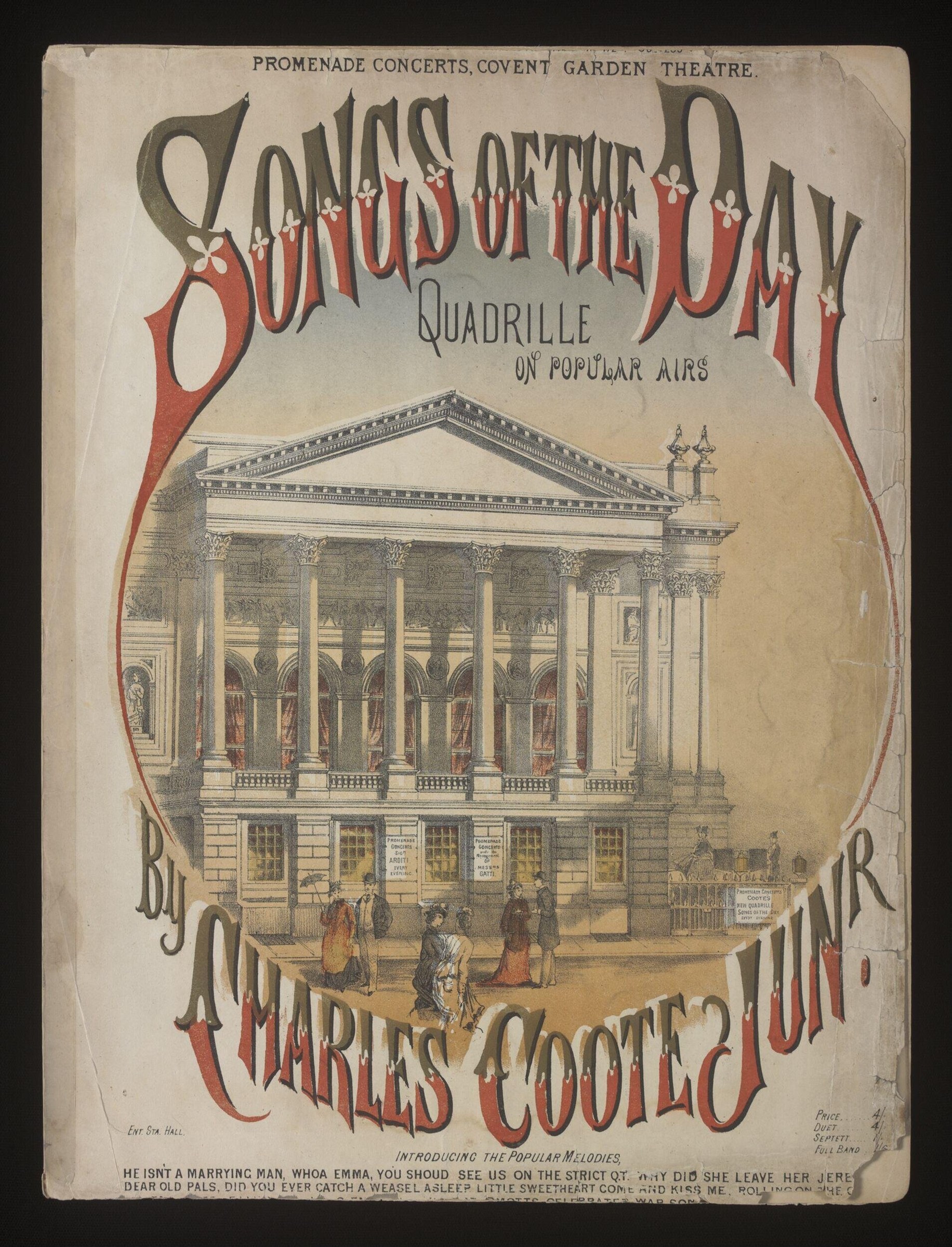
Songs Of The Day: Quadrille On Popular Airs
Coote, Charles Junior
- Dance:
- Quadrille
- Era:
- Late 1800s (Victorian Ballroom)
- Source:
- Victoria and Albert Museum
- Rights:
- Rights vary by item — check the source record before reusing this image. Source record ↗
- Recorded as:
- Check V&A creditLine
Quadrille covers and scores are primary evidence for how the dance was circulated and valued in late 19th-century society—not as a folk or even purely aristocratic form, but as a commercial concert entertainment and a staple of respectable ballroom culture. The emphasis on "popular airs" shows how composers made the quadrille accessible and fashionable by reusing recognizable melodies. For dance historians, such printed materials reveal what repertories dancers learned and performed, what venues hosted them, and how the dance was marketed to the paying public.
What you are looking at
This is a decorative cover for a printed quadrille score or arrangement by Charles Coote Junior, issued for the Promenade Concerts at Covent Garden Theatre. A classical building façade—clearly the Theatre Royal, Drury Lane or a similar London playhouse—occupies the center, with its fluted Corinthian columns, pediment, and ground-floor arcades rendered in detailed architectural line work. The building is framed by a large oval cartouche in red and gold, tied at top and bottom with red ribbon bows adorned with white flowers. The typography is ambitious: "Songs of the Day" in theatrical blackletter fills the top arc; "Quadrille on Popular Airs" sits below in smaller serif capitals; and "By Charles Coote Jr." appears in the lower arc. A handful of figures in period dress—top hats, long coats, bustles—mill about the theatre front in the foreground, their small scale emphasizing the monumental architecture. The paper is aged cream, and the composition is symmetrical and formal, designed to sit on a music stand or in a household music collection.
The dancing
The foreground figures are incidental—tiny silhouettes against the grand setting, rendered with enough detail to suggest fashionable 1890s dress but without anatomical specificity that would convey dance technique. They appear to be standing or walking, not dancing. No closed holds, no arm positions, no footwork is visible or intended to be read. The figures function as props establishing the social context (theatre-going public, promenade society) rather than as dancers to be studied.
The dance depicted
This is a quadrille score, a form of social ballroom dance organized in squares of four couples, danced to music built on popular melodies. The title promises arrangements of well-known airs adapted to the quadrille structure. Quadrilles were the dominant social dance in middle-class ballrooms from the 1820s onward, and this 1893 publication sits late in the tradition—the Waltz Revolution had already begun to displace it in favor of the waltz and other pair dances, but quadrilles remained respectable and were still taught and danced. The image does not depict the dance itself but rather advertises the music for it, situating the quadrille as entertainment at a fashionable London concert venue.
How it was made
This is a chromolithograph, a color printing process in which separate stone plates (one for each color layer—here primarily cream, black line-work, and red with gold accents) are printed in registration. Chromolithography allowed for detailed architectural rendering and decorative color effects at a cost lower than hand-coloring, making it ideal for commercial music covers and theatrical ephemera. The technique required skill in color separation and registration, producing a glossy, durable product suitable for display and repeated handling. This circulated as a printed music cover, likely sold with or bound into the full score.
About this work
This is a commercial music cover for a quadrille score published in London in 1893, the height of the era when quadrilles were performed at fashionable concert venues and in ballrooms, even as they were beginning to cede ground to the waltz. The image presents not the dance itself but the social and architectural context in which it was consumed—the grand theatre, the fashionable public, the repertory of "popular airs" on which composers drew. It is an artifact of the relationship between ballroom dance, commercial entertainment, and domestic music-making in the Gilded Age. The work belongs in a dance archive because it documents how and where quadrilles were packaged, promoted, and transmitted to dancers.
How to look at it
This cover is a document of marketing and social context rather than a representation of bodily movement. Attend to the architectural grandeur and the tiny figures: the designer has emphasized the prestige of the venue over the physicality of the dancers. The choice to feature the theatre rather than dancers reflects how the quadrille was sold—not as an exciting or novel dance form, but as a respectable, entertainment-venue-based social practice. The decorative framing and classical typography signal a middle-class, fashion-conscious audience buying music to perform at home or to attend as a concert spectator.
The artist
Charles Coote Junior (fl. 1870s–1890s) was a London composer and arranger specializing in quadrille music, dances for the theatre, and arrangements of popular songs. He published numerous quadrille scores for the concert halls and ballroom market, contributing to a large catalog of such commercial dance music. He represents the professional music trade that supplied both concert performers and home dancers with choreographed arrangements of fashionable and familiar material.
The period
The 1890s were a period of transition in ballroom dance. The quadrille, which had dominated social dancing since the 1820s Regency period, was rapidly losing ground to the Waltz and, soon, to newer dances like the Two-Step and the Tango. However, quadrilles remained part of the respectable ballroom repertory, especially at formal gatherings and in printed concert programs. Covent Garden and similar venues offered promenade concerts—relatively informal, standing-room social events—where such music provided the soundtrack. At the same time, music publishing and chromolithographic printing had made such covers standard commercial products, part of a mass market for domestic and public dance music.
Where it lives
The work is recorded in the Victoria and Albert Museum collection and is catalogued as Early 1800s (Waltz Revolution) era, though the image and publication details indicate 1893. It is a printed music cover, a category of commercial ephemera that survives widely in library and museum collections.
Dance in this work
Questions about this work
What is a quadrille?
A quadrille is a social ballroom dance for four couples arranged in a square, popular from the early 1800s through the early 1900s. It was structured in five fixed figures (movements), each accompanied by a different musical section. Quadrilles were danced at balls, assemblies, and concert venues, and they were the dominant ballroom dance until the waltz and later dances displaced them in the late 19th century.
Why does this cover show a theatre instead of dancers?
The cover advertises the music for a quadrille performed at Covent Garden Theatre's Promenade Concerts—a commercial, fashionable venue. The theatrical architecture signals prestige and status, assuring buyers that this was respectable music for a respectable social occasion. The absence of dancers emphasizes that this is a published commodity and a concert experience, not a how-to guide for dancers.
What does 'on popular airs' mean?
It means the quadrille was composed using well-known melodies—popular songs, folk tunes, or operatic themes that audiences would already recognize. This made the dance music more appealing and accessible to home musicians and dancers, who could enjoy performing familiar tunes in the quadrille structure.
Why is this work dated 1893 but catalogued as Early 1800s?
The catalogue record is likely misdated. The style, typography, and printing technique all point to the 1890s, and the reference to the Waltz Revolution—which accelerated in the 1880s–1890s—supports a late-century date. The quadrille was already old-fashioned by 1893, which is why such commercial reissues of arranged "popular airs" were still being marketed.
More Quadrille artwork