30 works in this view — arrow keys or swipe to move between them.
Dance in Art
The Jeannette and Jeannot Quadrille
Glover, Charles W.
- Dance:
- Quadrille
- Era:
- Mid 1800s (Polka Era)
- Source:
- Victoria and Albert Museum
- Rights:
- Rights vary by item — check the source record before reusing this image. Source record ↗
- Recorded as:
- Check V&A creditLine
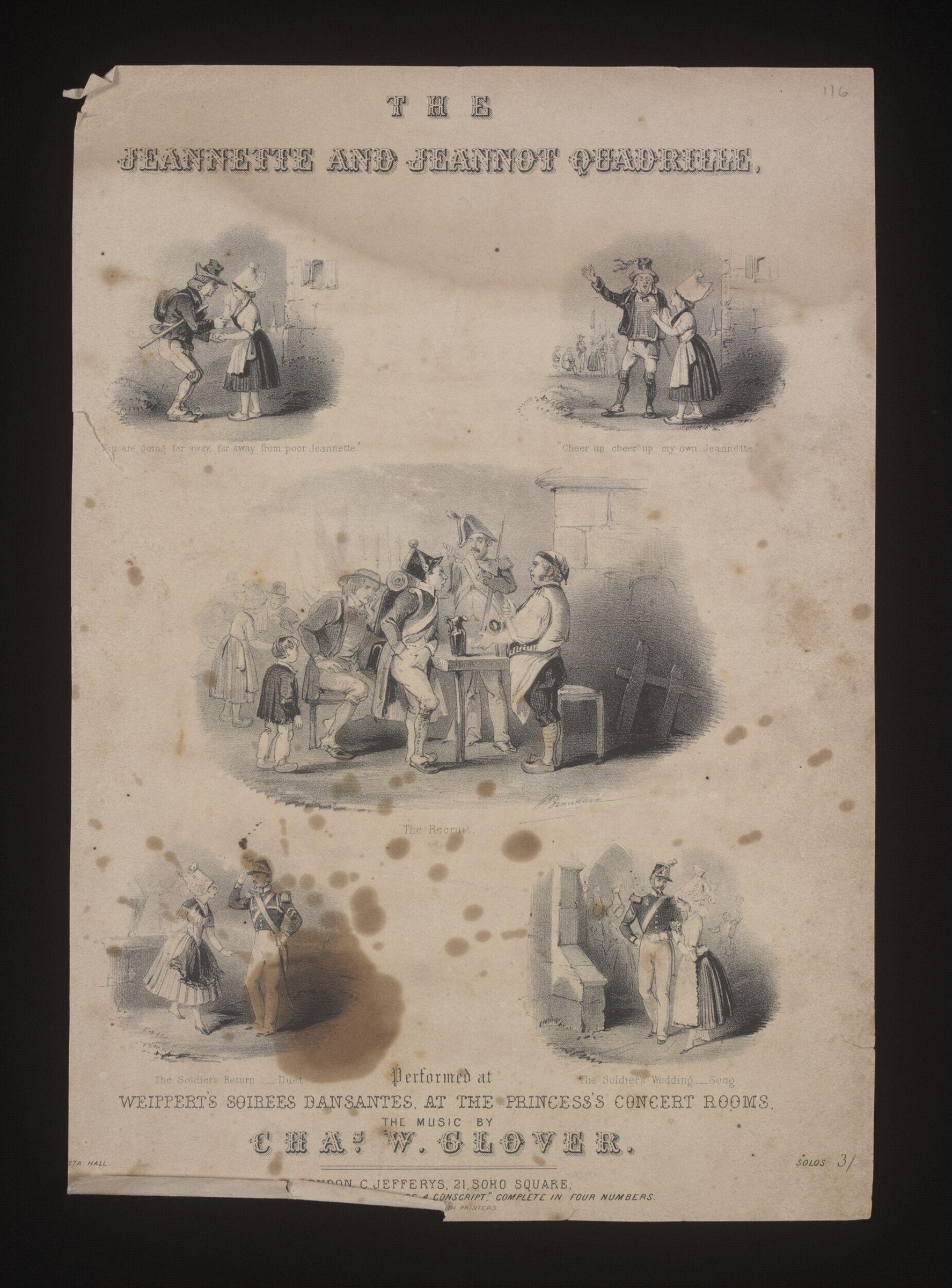
This broadside reveals how quadrilles, though structured and codified dances, were understood and marketed as vehicles for narrative and character rather than as abstract form. It documents the theatrical promotion of social dance in the mid-19th century and shows how a single dance work could exist simultaneously as sheet music, as live performance, as advertisement, and as narrative spectacle. For historians, it provides concrete evidence of how the dance was costumed, gestured, and framed for a paying audience.
What you are looking at
This is a sheet music cover or theatrical broadside depicting five scenes from *The Jeannette and Jeannot Quadrille*, a social dance performance. The uppermost scenes show two pairs of figures in domestic or street settings: on the left, a woman extends her hand toward a man in a bowing gesture; on the right, a man gestures expansively to a woman. The central and largest scene, titled "The Repast," shows a formal gathering of multiple figures around a table laden with food and drink, suggesting a feast or celebration. Below this are two further scenes: on the left, a couple in formal dress appear to be in conversation or courtship; on the right, a uniformed soldier (suggesting military dress) stands at a doorway with a woman. The engraving style, hand-coloring, and narrative sequence across multiple vignettes are characteristic of 19th-century theatrical documentation. The overall tone is lighthearted social comedy, with the scenarios suggesting a narrative arc of courtship, festivity, and reunion.
The dancing
The figures throughout are rendered in the genteel posture conventions of Regency-era social dance and theatrical performance. The men display exaggerated courtly bows and expansive arm gestures; the women hold themselves upright with modest bearing typical of the period. In the central feast scene, figures are seated and standing around furniture, their bodies oriented toward one another in conversation rather than in close dance hold. The dress—formal coats, high-waisted gowns, bonnets, and military uniform—indicates a social elite. The groupings are loose and varied rather than arranged in the rigid formations of figure dancing, suggesting narrative vignettes bracketing the actual dance.
The dance depicted
The quadrille was the dominant social dance form of the 1840s–1850s, a figure dance for four couples arranged in a square set, composed of five distinct figures with named sequences. This broadside likely documents a theatrical or parlor adaptation with narrative content—the scenes framing a story of courtship and celebration rather than presenting the dance itself in technical detail. The title *Jeannette and Jeannot* suggests a romantic comedy plot (the diminutive names suggest a French setting or sensibility). The music was by Charles W. Glover, who composed for theatrical and social contexts. The quadrille by this date was danced in drawing rooms and at public concerts; the notation "Performed at Weipfert's Soirées Dansantes at the Princess's Concert Rooms" anchors this as a commercial entertainment, likely combining choreographed dance with theatrical staging. The images emphasize narrative and gesture over the geometric formations the dance itself would have required.
How it was made
This is a printed theatrical broadside or music cover, executed as an engraving with hand-coloring, a common format for marketing both sheet music and public performances in the 1840s–1850s. The medium allowed rapid, affordable reproduction for distribution to audiences and music purchasers. The five narrative vignettes are arranged symmetrically around a title block and publication information, a layout common to illustrated songsheets and dance advertisements of the period. The engraving technique permitted fine detail in costume and facial expression while remaining reproducible. The inclusion of publisher information ("London: C. Jefferys, 21 Soho Square") and the note that the work was "Complete in Four Numbers" suggests this was part of a serial music publication, a format that allowed composers and publishers to release dances and theatrical music in installments.
About this work
This is a broadside advertising and documenting a theatrical performance of a quadrille with narrative content, performed at a London concert venue in the 1850s. The quadrille was the reigning social dance form of the era, and this image captures the moment when such dances moved from the ballroom into the commercial theater, packaged as entertainment with plot, music, and staged gesture. The work sits at the intersection of social dance, theatrical performance, and print culture: it is simultaneously a music cover, an advertisement, a narrative illustration, and a document of how a fashionable dance was adapted for public consumption. The five scenes frame the quadrille not as abstract geometry but as a human story—courtship, celebration, reunion—suggesting that even formal figure dances were understood through the lens of sentiment and social drama.
How to look at it
The viewer should attend first to the symmetrical arrangement of the five scenes and notice how the narrative framing (the courtship, the feast, the reunion) dominates the visual composition, with the title and music publication details at the bottom. The central feast scene is the largest and most detailed, suggesting it was the dramatic climax. Observe the precision of costume and facial expression in the engraving—the artist has been attentive to rank, dress, and gesture as markers of character and social position. Finally, notice that in none of the scenes do we see the quadrille itself danced in formation; instead, we see the human relationships and narrative moments that the dance was understood to express. This reflects the 19th-century view of dance as a vehicle for social and emotional content rather than as formal abstraction.
The artist
Charles W. Glover was a British composer and musician active in London during the 1840s–1850s, working in theatrical and ballroom contexts. He composed dances, songs, and instrumental pieces for public performances and domestic use. The notation that this work was "Performed at Weipfert's Soirées Dansantes at the Princess's Concert Rooms" suggests Glover was part of a commercial entertainment network serving London's middle and upper-middle classes. His output includes numerous quadrilles and other fashionable dances, positioning him as a working composer responsive to popular taste rather than a major artistic figure.
The period
The quadrille dominated European and American social dancing from roughly 1830 to 1860, having arrived from France in the 1820s as a more orderly and structured alternative to earlier country dances. By the 1850s, it was so established that it could be adapted for theatrical performance and parlor entertainment without loss of prestige. The same decade saw the rise of the waltz as a concert piece and the increasing theatricalization of social dance—the line between ballroom and stage was becoming permeable. Commercially published dance music and theatrical broadside advertising were booming; the 1850s marked the peak of the illustrated songsheet and music cover as both functional and collectible objects. This work sits squarely in that moment when social dance was at once a serious accomplishment, a commercial entertainment, and a narrative vehicle for sentiment and comedy.
Where it lives
The work is held in the Victoria and Albert Museum collection and was published by C. Jefferys of Soho Square, London. It is identified as part of the "va" source designation in the holding record. The notation "Complete in Four Numbers" suggests this was the cover or advertising material for a serialized music publication.
Dance in this work
Questions about this work
What is a quadrille?
A quadrille is a social dance for four couples arranged in a square. Composed of five distinct figures, it dominated ballrooms from the 1830s to 1860s. It was more structured and easier to learn than earlier country dances, and its orderly geometry made it suitable for formal occasions. By the 1850s, it had become so fashionable that it was adapted for theatrical performance and concert halls.
Who were Jeannette and Jeannot?
These are likely characters in a comic or sentimental narrative created by Glover for this theatrical adaptation. The diminutive French names suggest a story of courtship or adventure. The broadside does not give us a plot synopsis, but the five scenes hint at a journey from courtship through festivity to reunion.
Where would audiences have seen this performed?
According to the broadside, this quadrille was performed at Weipfert's Soirées Dansantes at the Princess's Concert Rooms in London. These were commercial entertainment venues catering to the middle and upper-middle classes who could afford tickets to dance performances. The work was also sold as sheet music through C. Jefferys's music shop on Soho Square, allowing amateurs to learn and perform it at home.
What does this tell us about how the quadrille was actually danced?
This broadside emphasizes narrative and character rather than showing the geometric formations the quadrille required. It suggests that even a highly structured dance was understood and marketed through human emotion and social drama. The detailed costume and expression in the engraving show that dancers were expected to perform with clear characterization and refined gesture—this was not merely steps and figures, but social theater.
More Quadrille artwork