29 works in this view — arrow keys or swipe to move between them.
Dance in Art
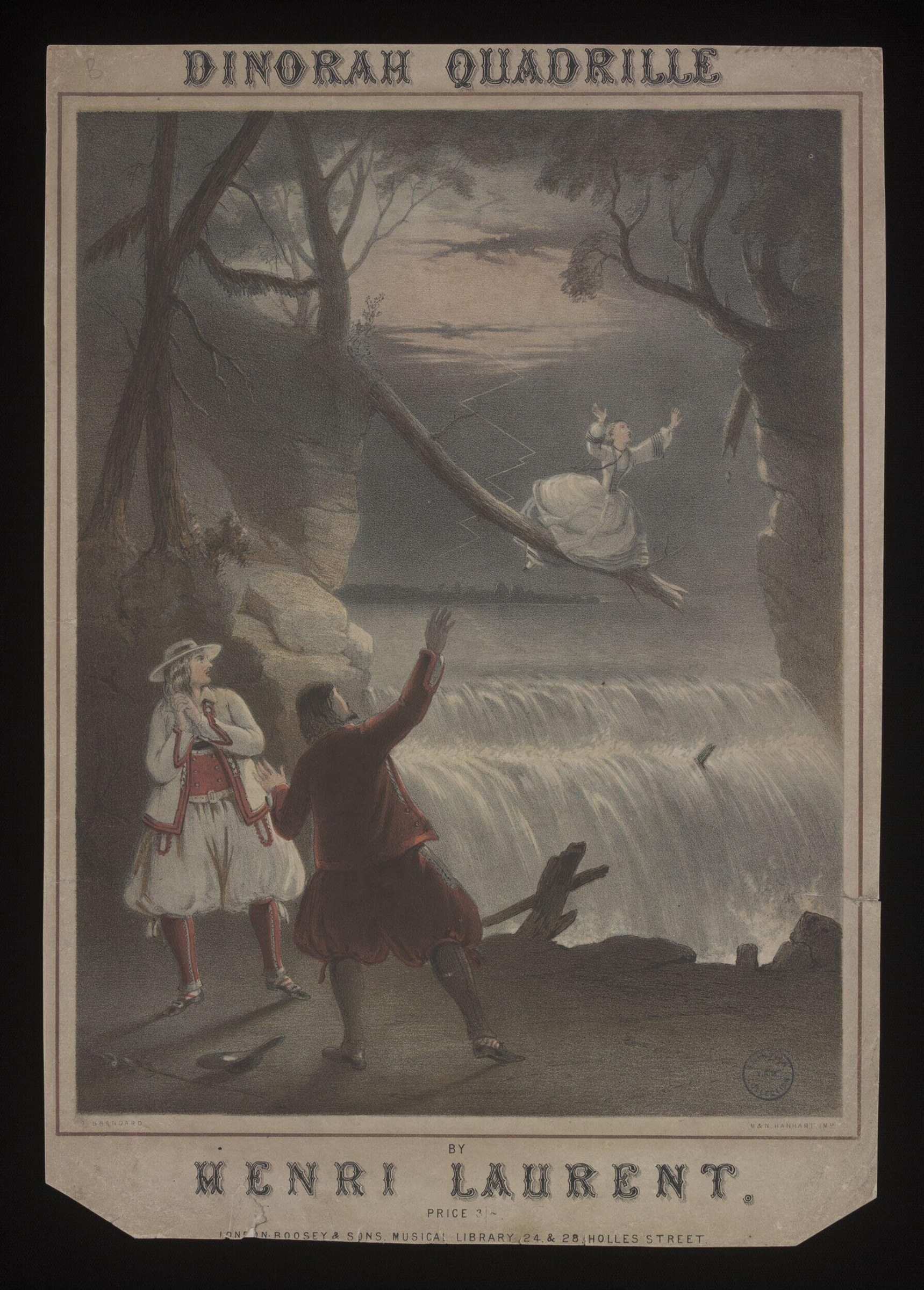
Dinorah Quadrille
Henri Laurent
- Dance:
- Quadrille
- Era:
- Late 1800s (Victorian Ballroom)
- Source:
- Victoria and Albert Museum
- Rights:
- Rights vary by item — check the source record before reusing this image. Source record ↗
- Recorded as:
- Check V&A creditLine
This image documents a crucial moment in dance history: the transition of the quadrille from aristocratic drawing room to theatrical stage, and the birth of narrative spectacle dance. It shows us that 19th-century audiences experienced dance not only as social participation but as visual narrative, magic, and athletic display—a lineage that runs directly to modern theater dance and ballet.
What you are looking at
A moonlit woodland clearing beside a rushing waterfall forms the setting for this romantic scene. Two figures in classical dress occupy the foreground: a man in dark breeches and coat gestures upward toward the water, his body angled in supplication or wonder, while a woman in a pale, high-waisted gown swings from a rope or vine suspended over the cascade, her body extended horizontally in flight, one arm raised. A second woman in white stands to the left, watching. The composition is deeply theatrical: dense trees frame the scene on both sides, their trunks and branches creating a dark proscenium arch; the water is rendered in pale, energetic brushstrokes suggesting movement and danger; the figures are lit as if by spotlights against the shadowed landscape. The mood is one of supernatural intervention or magical rescue—the woman in mid-swing appears to be defying gravity or being drawn upward by invisible forces.
The dancing
The suspended woman's body is fully extended horizontally, creating a dramatic line of flight; her arm reaches upward as if grasping or being pulled toward safety or the heavens. The man below adopts a pose of appeal—one arm raised, his weight shifted back on his heels, his gaze directed upward. The woman on the left stands in a more static, observational posture. The positioning and gestures suggest narrative theater rather than social dance: these are dramatic attitudes in response to a supernatural or perilous event, not steps in a choreographed sequence.
The dance depicted
This is not a depiction of social dance but of theatrical spectacle within a narrative context. The catalogue identifies this as a quadrille, likely meaning the work illustrates a scene from a theatrical quadrille—a staged narrative dance-drama that was fashionable in 19th-century French theater, in which dramatic tableaux and magical effects were framed as quadrille figures. The swinging woman suggests the acrobatic or aerial elements that such works incorporated. Quadrilles of this type were performed at the Opéra and in music halls, often drawing on fairy tales or Romantic literary subjects.
How it was made
The image is a hand-colored engraving or lithograph, evidenced by the linear technique, the tonal gradations achieved through cross-hatching and stippling, and the characteristic pale finish. The inscription and decorative border suggest this is a commercial print—a theatrical souvenir or advertisement. The technique was well suited to theatrical distribution: prints of popular scenes from operas and spectacles were sold to audiences during and after performances, making them a primary means by which stage productions reached a wider public. The hand coloring adds theatrical emphasis to the moonlight and the emotional tone.
About this work
This is a theatrical souvenir print documenting a scene from a mid-19th-century French theatrical quadrille, likely from the 1830s–1840s based on costume and artistic style. The quadrille was originally a social dance, but in this period it was increasingly adapted for the stage as a vehicle for spectacle, storytelling, and technical display. The print captures a moment of supernatural or dramatic intervention within a fairy-tale narrative, with the swinging woman at its center suggesting the acrobatic and magical elements that distinguished theatrical quadrilles from their social cousins. The work belongs to a tradition of Romantic-era theater in which dance, pantomime, and visual spectacle were fused into a unified dramatic form.
How to look at it
Attend to the moment of suspension: the artist has frozen the woman at the apex of her swing, creating a moment of weightlessness that defies gravity and narrative logic. This is not a step in a dance sequence but a tableau—a frozen emotional and dramatic climax. The composition uses the pale, extended body of the swinging woman against the dark woodland frame to draw all attention and emotion toward her; the waterfall and the watching figures establish a narrative context. The print records not the sequence of a dance but the visual and emotional apex of a theatrical scene, the moment an audience would gasp.
The artist
Henri Laurent was a 19th-century French engraver and lithographer specializing in theatrical prints. Little biographical detail is commonly recorded, but his practice situates him within the Paris theater print industry—a commercial enterprise that produced affordable color prints of popular stage scenes for immediate sale to audiences. Theatrical prints were a primary visual record of performance in an era before photography, and their artists performed essential work as documentarians and marketers of theatrical spectacle.
The period
The theatrical quadrille emerged in the 1830s as part of the Romantic movement's fascination with exotic, supernatural, and fairy-tale narratives. Works like Adolphe Adam's *Le Dieu et la Bayadère* (1840) and Théophile Gautier's libretti wove quadrille figures into spectacular stage works that combined dance, pantomime, and visual effects. The form flourished at the Paris Opéra and in music halls, reaching peak popularity through the mid-Victorian era. Simultaneously, chromolithography and hand-colored engraving were becoming industrialized, making theatrical prints affordable mass products rather than luxury items. The aesthetic of the image—its Romantic landscaping, supernatural imagery, and costume—aligns precisely with this moment.
Where it lives
This is a commercial theatrical souvenir print, likely produced for sale at the theater or through print vendors in Paris. The V&A Museum's holding suggests it was recognized as a historical document of 19th-century performance and theatrical design. The price notation ("1/-") on the print indicates it was an affordable, mass-market item, not a luxury commission.
Dance in this work
Questions about this work
What is a theatrical quadrille?
A theatrical quadrille is a staged spectacle that adapted the social quadrille dance into a narrative form for theater. Rather than a four-couple social dance, it became a vehicle for storytelling, pantomime, and visual effects, often based on fairy tales or Romantic literary subjects. Popular in French theaters from the 1830s onward, theatrical quadrilles combined professional dancers, acrobatics, sets, and machinery to create a total theatrical experience.
Was this dance performed socially?
The quadrille itself was a social dance performed in ballrooms, but this particular scene is a theatrical production. However, the boundary between social and theatrical was fluid in the 19th century—quadrilles from famous stage productions would be adapted and danced in ballrooms, and social quadrilles would influence stage choreography.
What does the swinging figure represent?
The woman swinging over the waterfall likely represents a moment of rescue, flight, or magical intervention within the narrative. The acrobatic element suggests both the technical sophistication of professional dancers and the Romantic aesthetic of transcendence or supernatural escape. Similar aerial effects appear in other theatrical spectacles of the period.
Who was Henri Laurent?
Laurent was a Parisian engraver and lithographer whose practice focused on theatrical and operatic prints. Like many theater print artists of his time, he worked commercially to document and advertise stage productions, creating affordable color prints for sale to audiences. Few biographical details survive, as his work was part of an industrial rather than fine-art tradition.
More Quadrille artwork