25 works in this view — arrow keys or swipe to move between them.
Dance in Art
Dance at Bougival
Pierre-Auguste Renoir
- Medium:
- oil on canvas
- Era:
- Late 1800s (Victorian Ballroom)
- Source:
- Wikimedia Commons
- Rights:
- Public domain — free to use, share and adapt.
- Recorded as:
- public_domain
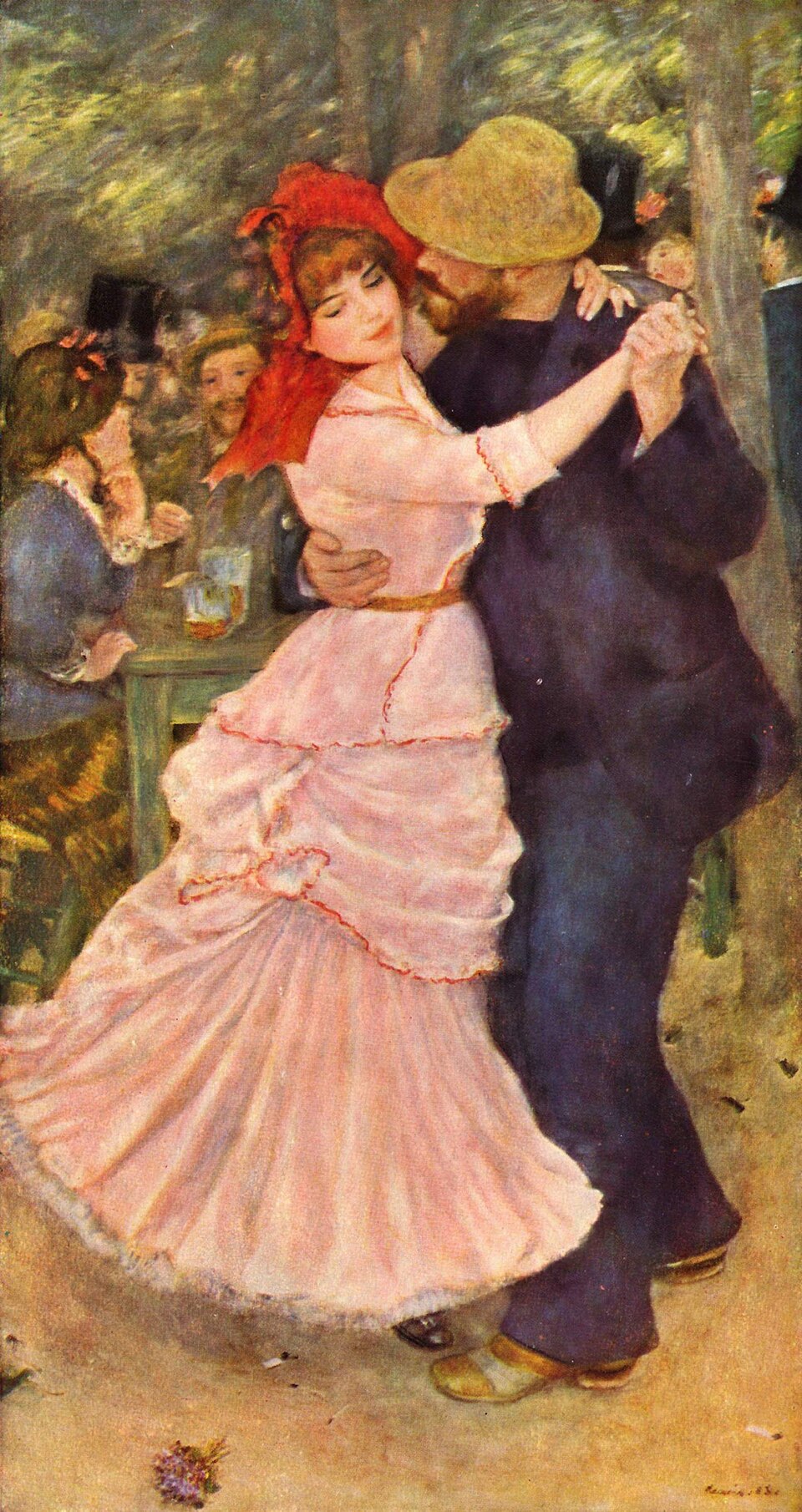
Renoir's dance paintings are among the few major artworks that treat ballroom social dancing with the same serious aesthetic attention usually reserved for ballet or theatrical spectacle. This work documents the waltz not as an elite court practice but as the vernacular dance of the middle classes—and in doing so, it reveals when and how that shift occurred. For anyone studying how dance appears in art, this painting is essential: it shows an artist of the first rank choosing to paint ordinariness, pleasure, and the female body in motion as worthy subjects.
What you are looking at
A couple waltzes outdoors in dappled sunlight filtering through tall trees, likely at an open-air dance pavilion. The woman wears a pale pink dress with a fitted bodice and voluminous skirt trimmed with red ribbons or ruffles; her reddish hair is crowned with a large red bonnet. Her partner, in dark suit and straw hat, holds her in closed waltz position as she leans back slightly in the turn. Behind them, other dancers and musicians blur into shadow—a small orchestra and several couples suggest an established social gathering rather than an intimate moment. The foreground is warm and luminous, the background atmospheric and cool, creating spatial depth. A small table with what appears to be a glass sits at lower left, anchoring the scene in leisure and sociability.
The dancing
The couple is in a closed ballroom hold: the man's right hand at the woman's back, her left hand resting on his shoulder, their free hands linked at about chest height. Her weight appears to be moving through a backward sway typical of the waltz's rotational movement, her body angled away from vertical in a controlled lean that suggests the man is leading firmly. Her posture is relaxed and trusting rather than stiff. The composition freezes the moment mid-turn, with her skirt caught in motion—evidence the artist understood the continuous rotating action of the waltz rather than a static pose.
The dance depicted
This is a waltz—identifiable from the closed partnered hold, the woman's backward lean during rotation, and the elegant outdoor ballroom setting typical of mid-to-late 19th-century leisure culture. The waltz was the dominant social dance of the era, and its presence at Bougival—a popular village near Paris with outdoor dance halls—is entirely consistent with historical records. The painting captures not the technical precision of a performance waltz, but the ease and pleasure of social dancing among the respectable middle classes. The artist has rendered the characteristic sway and rotation of the three-quarter rhythm accurately enough that a dancer would recognize the style.
How it was made
Oil on canvas, a medium that allowed Renoir to build luminosity through layered translucent glazes—visible in the treatment of the woman's skin and the dappled light falling through foliage. The softness of the paint surface and the warm palette are characteristic of Impressionist technique, which prioritized the optical sensation of light and color over sharp outline. Oil paint required access to an established studio and wealthy patronage; this was not a work made for mass reproduction but for a collector's wall, marking it as a high-art engagement with an ostensibly popular subject.
About this work
This is one of Renoir's celebrated treatments of leisure and dance in 1870s–1880s France, a period when open-air dancing had become both a democratic pleasure and a subject worthy of serious artistic attention. The waltz was the waltz of the bourgeoisie—respectable, regulated, partnered—and the painting celebrates it not as spectacle but as lived experience: the warmth of summer, the ease of a well-led turn, the lightness of fabric and mood. For social historians, it documents the geography and class character of Parisian leisure; for students of dance, it shows how thoroughly the waltz had become naturalized by the 1880s, so familiar that it could be painted as an intimate moment rather than an exotic novelty. The work is a cornerstone of how 19th-century visual art registered and celebrated social dance as a marker of civilization and happiness.
How to look at it
Focus on the woman's body in space: her spine arches slightly backward, her shoulders drop, her free arm reaches behind—this is the characteristic posture of being led through a waltz turn. The artist has caught the moment of maximum lean in the rotation, when the follower's weight is most obviously committed to the lead. Notice also how Renoir has used light and blur to suggest motion: her skirt is caught mid-swirl, the background couples dissolve into shadow and brushwork, while the central pair remains sharp and luminous. The contrast between the precise rendering of faces and hands and the looser treatment of fabric and distance creates a sense of intimate presence—we are close enough to see the pleasure on their faces, but distant enough to see the full arc of their bodies.
The artist
Pierre-Auguste Renoir (1841–1919) was a founding figure of Impressionism and specialized in scenes of leisure, outdoor entertainment, and the pleasures of Parisian and suburban social life. He painted dance and music repeatedly throughout the 1870s and 1880s—*Luncheon of the Boating Party* (1881) and *Dance at Bougival* are among his most famous works in this vein. His treatment of movement was informed by his training in figure painting and his fascination with how light and color could convey the sensation of a moment, including the moment of motion. Unlike many academic painters, Renoir was drawn to the informal and the contemporary, treating suburban entertainment and middle-class sociability as worthy of the same artistic investment as historical or mythological subjects.
The period
By the 1880s, the waltz had been the dominant social dance for nearly a century, but it retained an association with modernity, leisure, and female pleasure that made it a favored subject for Impressionist painters. The open-air dance halls of the suburbs near Paris—Bougival, Rennes-les-Bains, the Moulin de la Galette—had become accessible to the respectable middle classes and were celebrated as sites of democratic enjoyment. Concurrently, Impressionism itself was moving toward greater acceptance in official circles, and Renoir's choice to paint social dancing reflected both the movement's investment in contemporary life and the period's growing comfort with representing leisure as a subject fit for serious art. The painting dates to a moment when photography was emerging as a rival medium, yet oil painting on canvas remained the marker of artistic prestige and permanent value.
Where it lives
The work is held in a private collection according to available records; the image comes via Wikimedia Commons. As a major work by a well-known artist, it has been widely reproduced and studied, but precise ownership history is not recorded in the current catalogue.
Dance in this work
Questions about this work
Is this actually a waltz, or just a couple dancing?
The hold, the woman's backward lean during rotation, and the overall posture are all consistent with the waltz as danced in the 1880s. The closed position with the man's hand at the woman's back and the rotational movement visible in her body angle are defining features of the waltz, not generic social dancing. The setting—an outdoor dance hall—is also historically typical for waltz venues.
Why did Renoir paint dance so often?
Renoir was fascinated by light, color, and movement, and social dancing provided all three in a contemporary, respectable context. Dance also interested him as a subject that united pleasure, female beauty, and modern leisure—themes central to Impressionism. Unlike ballet, which was theatrical and professional, social dancing was democratic and accessible, fitting his interest in ordinary life.
What can we learn about 1880s fashion from this painting?
The woman's dress shows the silhouette typical of the 1880s: a fitted bodice with a narrow waist (likely achieved with tight corseting) and a voluminous skirt that allowed movement while maintaining shape. The straw hat and outdoor setting indicate leisure wear for the respectable middle class, not formal evening dress. The red accents—bonnet and ribbon trim—suggest a deliberate choice to stand out, marking her as confident and fashionable.
Why are outdoor dance halls important to dance history?
Outdoor pavilions and garden halls like Bougival democratized dancing: they were cheaper than ballrooms, less formal, and accessible to clerks, shopkeepers, and their families, not just aristocrats. They became sites where new social attitudes toward pleasure, mixed-gender sociability, and bodily freedom could develop. Impressionist painters documented these spaces as evidence of modern, secular leisure culture.
More dance artwork