10 works in this view — arrow keys or swipe to move between them.
Dance in Art
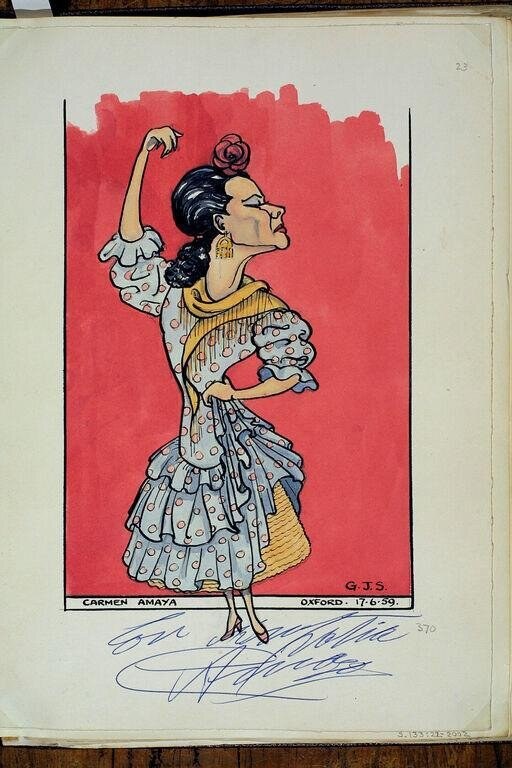
Flamenco dancer Carmen Amaya
Sommerlad, Gilbert
- Dance:
- Spanish/Flamenco
- Era:
- 1950-1980 (Rock & Roll / Disco)
- Source:
- Victoria and Albert Museum
- Rights:
- Rights vary by item — check the source record before reusing this image. Source record ↗
- Recorded as:
- Check V&A creditLine
Carmen Amaya revolutionized flamenco by introducing technically difficult footwork and male-coded movement vocabulary into women's performance, breaking rigid gender conventions in the form. This caricature, made during her later career, testifies to her lasting fame and the theatrical glamour with which flamenco was marketed and understood in postwar European culture.
What you are looking at
A caricature portrait of a woman dancer in Spanish flamenco dress, shown full-length against a brilliant red ground. She stands in a commanding upright pose with one arm raised overhead in a dramatic flourish, the other holding what appears to be a castanет or similar prop. Her costume comprises a short white blouse with puffed sleeves trimmed in gold braid, and a tiered ruffled skirt in white with intricate black patterning or embroidery. Her dark hair is pulled back smoothly. The style is highly stylized and exaggerated in the manner of theatrical caricature—the face is presented in sharp profile with pronounced features, and the overall proportions emphasize the dancer's theatrical presence rather than naturalistic form. The name "CARMEN AMAYA" and location "OXFORD, 17.6.59" are inscribed in the bottom margin.
The dancing
The dancer occupies the full height of the frame in a single, isolated figure. Her posture is upright and proud, the raised arm extended skyward with wrist flexed in a characteristic flamenco gesture of drama and celebration. The frame emphasizes verticality and theatrical display; there is no partnering or group choreography. The costume and stance convey the intensity and spectacle of the flamenco performer on stage.
The dance depicted
This is a portrait of Carmen Amaya, a legendary flamenco dancer of the twentieth century. The image captures the visual signature of flamenco performance: the elaborate tiered skirts, the proud carriage, the dramatic arm gestures, and the sense of passionate display that defines the genre. The costume and pose suggest alegrías or a similar festive flamenco form, though the work is a stage portrait rather than a study of specific choreography. Carmen Amaya was famous for her virtuosity and her innovation of flamenco, particularly her incorporation of male footwork vocabulary into women's dance.
How it was made
This is a caricature drawing, worked in colored pencil, watercolor, or gouache—the inscription notes suggest this is a theatrical souvenir or program illustration. The style is that of theatrical portraiture popular in mid-twentieth-century Britain and Europe: quick, expressive, and designed for immediate recognition of the subject. The bold red ground, gold accents, and sharp line work suggest it was made for print or theatrical publication, possibly as a program cover or dance criticism illustration.
About this work
This caricature portrait celebrates Carmen Amaya, one of the defining flamenco artists of the twentieth century, captured at a performance or appearance in Oxford in June 1959. The artist, identified as Sommerlad, has rendered her in the exaggerated but affectionate idiom of theatrical caricature—all drama, pride, and costume spectacle. The work belongs in a gallery of dance art because it documents both a major artist at the height of her fame and the conventions of how flamenco was visualized and celebrated in mid-century European performance culture. Amaya's presence in British venues and her caricature in the society press reflect her status as an international star who brought flamenco to audiences far beyond Spain.
How to look at it
Attend to the artist's choice to present Amaya in a moment of maximum theatrical impact—arm aloft, costume displayed in full, face turned in profile for maximum characterization. This is not a dancer caught mid-movement but a performer frozen in a pose of triumph and display. Note the exaggeration of feature and form typical of caricature: the elongated face, the emphasized costume details, the bright color. The technique allowed Sommerlad to capture not anatomical accuracy but the essence of Amaya's stage presence—her pride, her command of space, her visual impact.
The artist
Gilbert Sommerlad was a British theatrical caricaturist and illustrator active in the mid-twentieth century, known for quick, expressive portraits of visiting performers and celebrities. His style—bold line, exaggerated feature work, and use of bright color—was typical of theatrical program art and newspaper illustration of the period. He worked in a tradition of European salon caricature that celebrated performance artists through affectionate exaggeration.
The period
In 1959, flamenco was enjoying renewed international prestige following its prominence in European concert halls and film throughout the 1950s. Carmen Amaya had become an international celebrity after appearing in Hollywood films in the 1940s and touring Europe extensively. In Britain, Spanish dance and flamenco represented an exotic, romantic aesthetic that appealed to postwar audiences hungry for color, spectacle, and continental glamour. Simultaneously, flamenco was undergoing artistic evolution in Spain itself, with new generations of artists developing nuevo flamenco forms. Amaya's visit to Oxford and Sommerlad's caricature of her reflect the appetite for live flamenco performance among educated British audiences.
Where it lives
This work is held in the collection of the Victoria and Albert Museum, labeled as a theatrical illustration and dated 17 June 1959, when Amaya was performing in or visiting Oxford. The inscription and dating suggest it may have been made for a program, press notice, or theatrical souvenir.
Dance in this work
Questions about this work
Who was Carmen Amaya?
Carmen Amaya (1913–1963) was a Spanish flamenco dancer born in Barcelona to a family of gitano performers. She became an international star through her technical virtuosity, her emotional intensity, and her controversial innovation of dancing with footwork and movement vocabulary traditionally reserved for men. She performed in Europe, the Americas, and appeared in Hollywood films, making her one of the most famous flamenco artists of the twentieth century.
Why is she raising her arm like that?
The raised arm is a signature gesture in flamenco, especially in festive forms like alegrías. It expresses joy, defiance, and proud display—the dancer celebrates and commands the space. In performance, the arm gesture is often accompanied by hand clapping, finger snapping, or the flourish of a shawl, and it marks moments of peak emotional or rhythmic intensity.
What is caricature doing in a dance archive?
Caricature is a major source for dance history because it records how performers were seen by audiences, what aspects of their performance seemed most iconic or memorable, and how dance was marketed and understood in popular culture. A caricature tells us what the artist (and the public) thought defined this dancer—what made her unmistakably herself on stage.
Why is the costume so elaborate?
The multi-tiered ruffled skirt, gold-trimmed blouse, and careful styling are the dress of formal flamenco performance—the gitana costume. The ruffles, called volantes, are essential to the visual impact of flamenco; they catch the light, create movement separate from the dancer's body, and add drama and volume to the silhouette.
More Spanish/Flamenco artwork