35 works in this view — arrow keys or swipe to move between them.
Dance in Art
The Dance
Lancret, Nicolas
- Dance:
- Ballroom
- Era:
- 1700s (Enlightenment/Minuet Era)
- Source:
- Victoria and Albert Museum
- Rights:
- Rights vary by item — check the source record before reusing this image. Source record ↗
- Recorded as:
- Check V&A creditLine
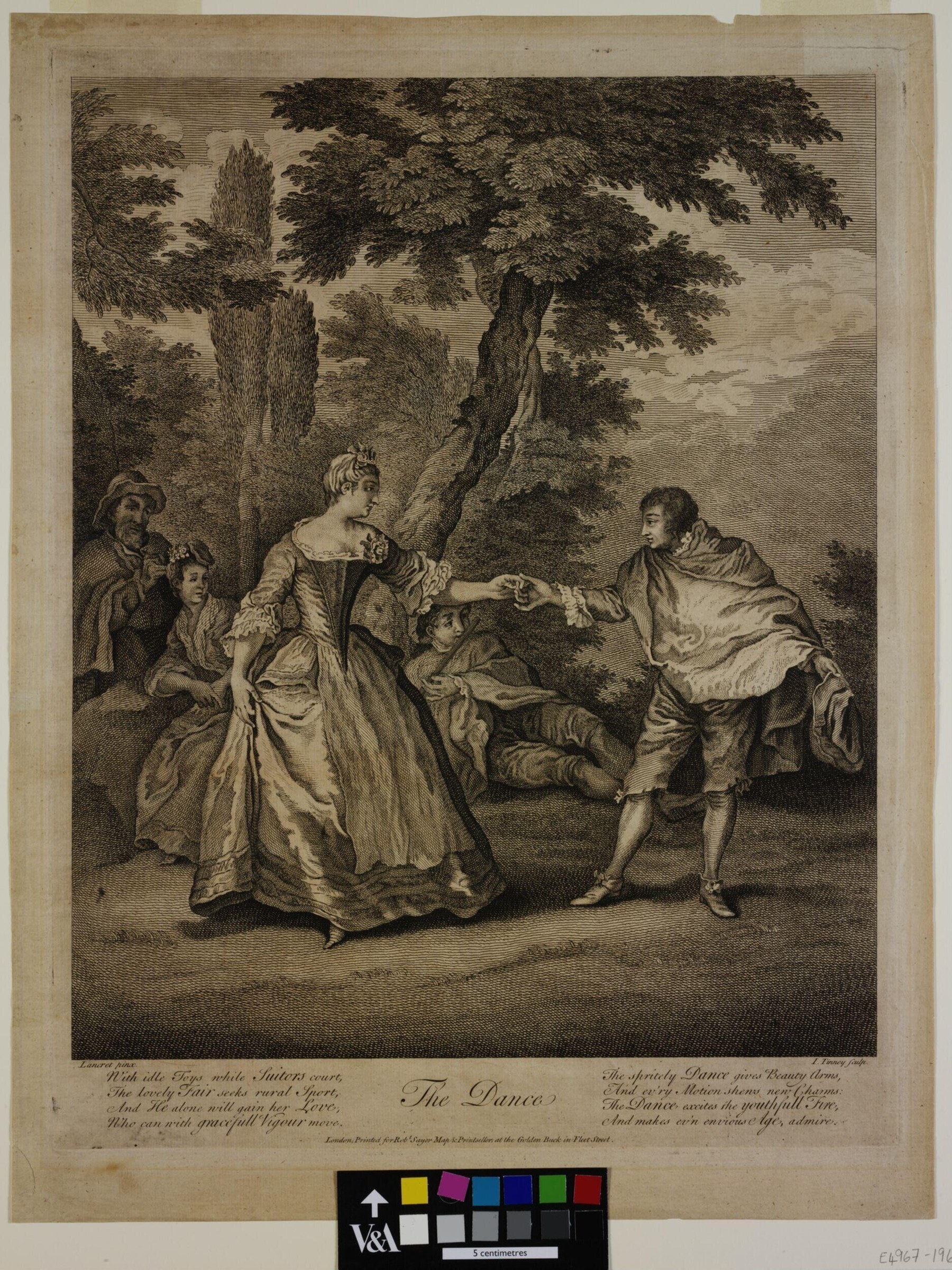
This work documents the social meaning of dance in the 18th century: the approach, the bow, the invitation were performances as carefully choreographed as the steps themselves. For historians of ballroom culture and courtship ritual, it shows how dance operated as a form of social negotiation and romantic display. For dancers studying period style, it exemplifies the posture, line, and restraint expected of aristocratic bodies in formal settings.
What you are looking at
A formal garden scene under spreading trees, where a fashionably dressed woman in an elaborate gown stands at the center of attention. She gestures gracefully toward a young man in draped clothing who approaches from the right, while two children flank her—one seated on the ground, another standing close by. Behind them, two older figures in hats observe the encounter. The woman's posture is open and inviting, her arms extended in a welcoming gesture; the man leans forward with one knee bent as if in the act of approaching or bowing. The lighting is soft and classical, rendered through the delicate hatching typical of 18th-century engraving. The trees frame the scene with dark foliage, creating an intimate clearing for this social moment.
The dancing
The central woman holds an upright, poised posture with both arms extended in a gesture of social engagement—one arm reaching toward the approaching man, the other positioned near her torso. The man moves toward her with a flexed knee and forward lean, suggesting a bow or a step into the dance. The children are positioned below the main action, creating a compositional pyramid. All figures are rendered in the flowing, graceful line work characteristic of aristocratic portraiture, with emphasis on the elegant extension of limbs and the drape of clothing rather than musculature or strain.
The dance depicted
This depicts a courtship dance or social minuet-era encounter rather than an active dance. The title *The Dance* and the verse inscription below (visible but not legible in this reproduction) suggest the work illustrates a moment of courtly flirtation or romantic approach. The woman's welcoming gesture and the man's deferential bow or approach are consistent with the social choreography of 18th-century ballroom etiquette, where the initiation of a dance was itself a ritualized performance. The presence of observing figures—the children and the seated couple—places this within the convention of the promenade or the social gathering where dancing was a form of courtship display.
How it was made
This is an engraving, identifiable by the parallel hatching lines used to create tonal depth and shadow, the clean linear definition of forms, and the even, controlled line weight throughout. Engraving required a copper plate and specialist printmaking skill, making it a prestigious and expensive medium suited to reproducing works for educated, wealthy audiences. The inscription below the image in a printer's typeface indicates this is a reproductive print, likely made from a painting; the credit line would have named the original artist and the engraver separately. This medium allowed for wide circulation of the composition among collectors of prints and admirers of fashionable manners.
About this work
This engraved print depicts a moment of courtly encounter in a garden setting, illustrating the social choreography of 18th-century aristocratic life. The work sits within the tradition of conversational pieces and prints celebrating refined, courteous behavior. The catalogue attributes it to Nicolas Lancret, an 18th-century French painter celebrated for scenes of fêtes galantes and aristocratic leisure. The image is placed in the era labeled Enlightenment/Minuet Era and tagged as ballroom dance, though the work represents the social and romantic conventions that framed the initiation of dance rather than dance technique itself. It belongs in a dance archive because courtship, social hierarchy, and the ritual of the approach were integral to how ballroom dancing functioned in this period—the dance began before the bodies moved in unison.
How to look at it
Notice the posture of both figures: the woman's upright carriage and extended arms, the man's forward lean and bent knee. This is the vocabulary of courtly greeting and approach. Observe how the artist has chosen a moment not of active dancing but of the social prelude to it—the invitation, the acceptance, the moment of recognition. The presence of the watching figures (the children, the older couple) reminds us that in aristocratic society, dancing and courtship were public, observed performances. The garden setting is not incidental; it is the stage for this social choreography, a space designed for display.
The artist
Nicolas Lancret (1690–1743) was a French painter specializing in fêtes galantes and scenes of aristocratic leisure. He trained under Claude Gillot and adopted the style of pastoral and garden scenes popularized by Watteau, but with a lighter, more playful tone. Lancret was particularly celebrated for scenes of social gathering, courtship, and entertainment among the French nobility. His works were engraved and circulated widely, making him influential in establishing the visual language of refined 18th-century manners for a broad audience.
The period
The 18th century, particularly the rococo period in France, saw dance and social interaction elevated to an art form. The minuet was the dominant social dance of the aristocracy, and mastery of its steps, posture, and social protocol was essential to courtship and social standing. Prints like this one were part of a broader culture of instruction and aspiration: they taught viewers how refined people moved, gestured, and interacted. The garden setting reflects the vogue for pastoral themes and the idealization of leisure. Engraved prints after paintings by successful artists like Lancret were a primary medium through which fashion, manners, and taste were disseminated to the educated classes.
Where it lives
The work is held in the Victoria and Albert Museum collection. It is catalogued as a print from the 1700s, though the catalogue record provides no accession number, engraver's name, or publication details here. The notation 'source: va' identifies it as a V&A holding; such prints were typically made for collectors of engravings and admirers of fashionable manners.
Dance in this work
Questions about this work
Is this a painting or a print?
This is an engraving, a printmaking technique that allowed multiple copies to be made from a single copper plate. Engraved prints like this one were often made after paintings by celebrated artists, allowing their designs to reach a much wider audience. The parallel hatching lines visible throughout are characteristic of engraving technique.
What dance is being shown?
No dance steps are being performed in this image. Instead, it depicts the social moment before the dance—the approach, the greeting, the invitation. In 18th-century aristocratic culture, this prelude was itself a choreographed ritual. The painting illustrates the manners and social protocol that surrounded minuet dancing and courtship.
Who was Nicolas Lancret?
Lancret (1690–1743) was a French rococo painter famous for scenes of aristocratic leisure, garden parties, and courtship. He was less famous than Watteau but widely admired and extensively engraved. His works defined the visual style of refined 18th-century society and were collected and circulated throughout Europe.
Why would this be in a dance archive?
Dance history includes not just steps and technique but also the social context, manners, and ritual that made dance meaningful. This print shows how ballroom dancing was inseparable from courtship, social hierarchy, and refined gesture. Understanding the dance requires understanding the world that framed it.
More Ballroom artwork