33 works in this view — arrow keys or swipe to move between them.
Dance in Art
Alvin Aliey American Dance Theater
Eccles, Andrew
- Dance:
- Ballroom
- Source:
- Victoria and Albert Museum
- Rights:
- Rights vary by item — check the source record before reusing this image. Source record ↗
- Recorded as:
- Check V&A creditLine
The Alvin Ailey American Dance Theater revolutionized access to modern dance by integrating Black and white dancers and by teaching a technique that was explicitly designed to include multiple movement vocabularies. This photograph documents that legacy at a moment when the company was touring internationally, demonstrating that excellence in contemporary dance was inseparable from the company's commitment to inclusivity. For historians of dance and photography, the image is a record of how professional dance promoted itself and was consumed in the digital age.
What you are looking at
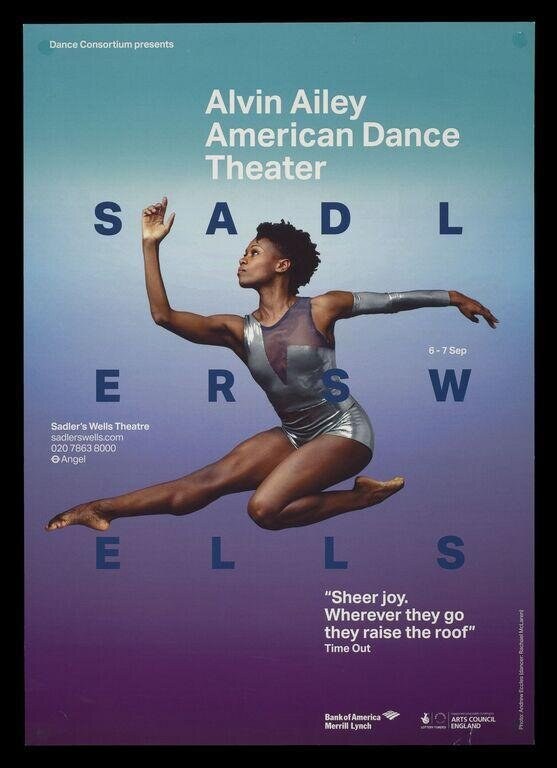
A promotional photograph for the Alvin Ailey American Dance Theater captures a single dancer in mid-leap against a gradient background transitioning from teal to deep purple. The dancer, photographed in profile facing stage left, executes a grand jeté with the classical line of modern dance: the back leg fully extended in arabesque, the front leg bent in attitude, arms reaching expressively—one raised overhead, the other extended horizontally. The dancer wears a sleeveless contemporary leotard in neutral tones with metallic accents, and the feet are bare, indicating modern or contemporary technique rather than classical ballet pointe work. The composition is dynamic and vertical, emphasizing the height and power of the leap. Large letters spelling "SADLER'S WELLS" are overlaid across the upper portion of the image, with performance dates "6-7 Sep" in the lower right. The overall aesthetic is clean, modern, and promotional, designed to convey athleticism, joy, and theatrical presence.
The dancing
A single dancer executes a grand jeté with technical precision: the supporting leg has just left the ground, the extended back leg reaches full height in arabesque, and the front leg is flexed in attitude. The dancer's torso is upright with excellent alignment, the arms frame the body expressively—one reaching skyward, one extended to the side—creating an open, celebratory upper body. The bare feet and the line of the legs show control and extension characteristic of modern technique with ballet foundations. The weight appears suspended at the apex of the jump, capturing a moment of pure elevation.
The dance depicted
This image depicts contemporary or modern dance, most likely from the Alvin Ailey American Dance Theater's classical modern vocabulary. The grand jeté is a foundational jump in both ballet and Alvin Ailey's Horton-based technique, and the quality of extension, the neutral leotard, and the expressive arm carriage are consistent with mid-to-late 20th-century American modern dance as codified by Ailey. The photograph documents not a specific choreography but the technical excellence and athletic joy that became the company's signature. Ailey's technique synthesized ballet, jazz, and African diaspora movement, and this image captures the balletic clarity that underpinned the company's inclusive approach to modern dance.
How it was made
This is a professional colour photograph, likely shot for promotional and marketing purposes. The controlled studio lighting, neutral gradient background, and precise capture of the dancer's extension indicate high-end theatrical photography. The clean, high-contrast aesthetic and the overlay of text and branding information are typical of early 21st-century dance promotion. Photography allowed the dance field to document and circulate images of Black dancers and modern dance technique to audiences far beyond the theatre, making this work part of the visual archive through which Ailey's democratic vision of dance reached the public.
About this work
This is a professional promotional photograph for the Alvin Ailey American Dance Theater during a London season at Sadler's Wells Theatre. It documents a single dancer captured at the apex of a grand jeté, embodying the technical excellence and expressive power that defined the company's approach to modern dance. The image is neither artwork nor archival document in the traditional sense, but rather a piece of theatrical marketing—yet it is an important visual record of how contemporary Black dance excellence was presented and circulated in the early 21st century.
The photograph sits within a long tradition of dance photography that serves both promotional and documentary functions. It captures not a moment from a specific choreography, but rather an instant of pure technical mastery—a demonstration of what a trained body moving through space looks like when it has synthesized decades of Horton technique, ballet, and the Ailey method. For viewers seeking to understand how contemporary modern dance presents itself to the world, this image is exemplary.
How to look at it
Attend to the precise moment the photographer chose: the apex of the jump, where the dancer is momentarily weightless and the extension is maximum. The gradient background—absent of any theatre set or context—isolates the body and directs all focus to the line of the jump itself. Notice how the arm positions frame and enhance the height rather than anchoring the body; this is characteristic of modern dance's evolution from ballet, where such expressive arm use would have been less expected. The bare feet, the quality of the extension, and the overall composition are all designed to communicate technical mastery and joy in movement to a general audience.
The artist
Andrew Eccles is a British portrait and commercial photographer who has documented theatre, dance, and high-profile figures since the 1980s. His work for dance organizations and theatre companies is characterized by clean, high-contrast studio photography that emphasizes the body's line and the drama of performance. Eccles's photographs have been published in major publications and are held in institutional collections including the Victoria and Albert Museum, where his work serves as part of the visual record of contemporary British theatre and dance.
The period
This photograph dates to 2016, a moment when the Alvin Ailey American Dance Theater—founded in 1958 and now over fifty years old—had become an institution with an international touring schedule and a secure place in the modern dance canon. By 2016, the company had expanded beyond New York City to maintain a London base and to tour globally. The photograph reflects the mature, institutionalized presentation of what had once been a revolutionary integrated company. In the broader context of dance photography, 2016 sits at the tail end of the era in which high-end theatrical photography was still produced primarily in studios with controlled lighting; the subsequent shift to digital documentation and social media would gradually change how dance companies circulated images.
Where it lives
This photograph is held in the Victoria and Albert Museum collection. It was created as promotional material for the Alvin Ailey American Dance Theater and is typical of the kind of high-end theatrical photography that major dance companies produce for distribution to press, venues, and archives. It entered the V&A collection as part of that institution's commitment to documenting contemporary performance practice.
Dance in this work
Questions about this work
Is this a performance photograph or a studio photograph?
This is a studio photograph taken for promotional purposes, not documentation of a performance moment. The neutral gradient background, professional lighting, and lack of costume or theatrical context make clear that this was a dedicated photo shoot. However, the image is designed to convey what the dancer looks like on stage.
What technique is this dancer using?
The dancer is executing a grand jeté using the Horton-based modern technique taught by the Alvin Ailey American Dance Theater. This technique synthesizes ballet (visible in the extension and line), African diaspora movement principles (visible in the torso and center), and contemporary modern dance. The bare feet, the quality of the jump, and the arm carriage are all consistent with Ailey's method.
Why does this matter to dance history?
The Alvin Ailey American Dance Theater was groundbreaking in integrating dancers of all races and in creating a technique that was explicitly multicultural. This photograph is a record of how the company presented itself internationally in the 21st century, documenting the maturation and global reach of what had been a revolutionary vision of democratic dance.
More Ballroom artwork