32 works in this view — arrow keys or swipe to move between them.
Dance in Art
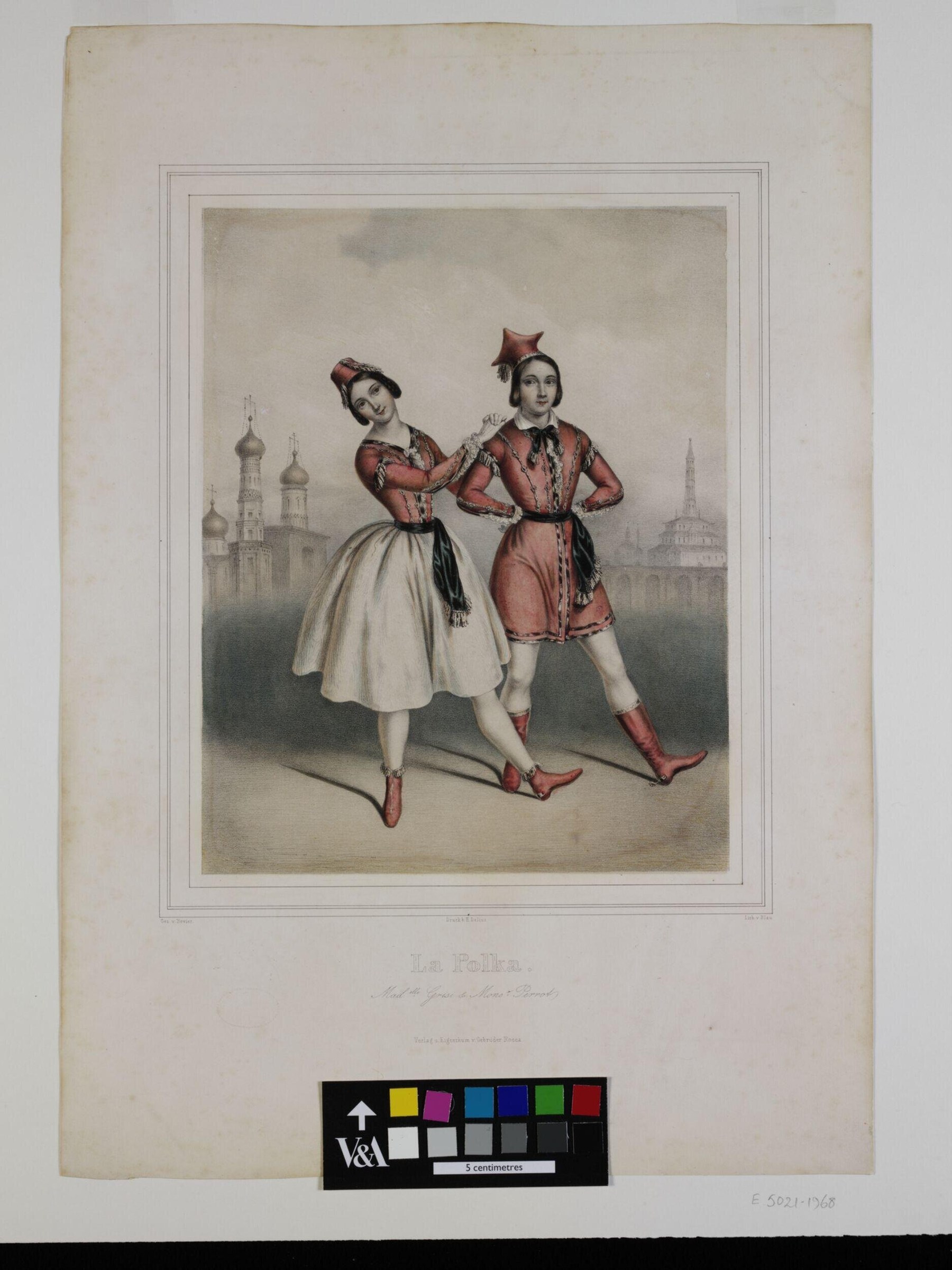
La Polka. Madelle Grisi & Monsr Perrot
Bouvier, Jules
- Dance:
- Ballroom
- Era:
- Mid 1800s (Polka Era)
- Source:
- Victoria and Albert Museum
- Rights:
- Rights vary by item — check the source record before reusing this image. Source record ↗
- Recorded as:
- Check V&A creditLine
This image provides direct evidence of how the polka was performed and staged in the 1840s, including costume, body position, and the theatrical styling of what began as a social dance. For historians of ballroom and theatrical dance, it documents the named performers and the commercial machinery of dance promotion in the nineteenth century—how performances were publicized, consumed, and circulated through popular prints.
What you are looking at
Two dancers in Russian or Eastern European dress perform the polka before a backdrop of onion-domed churches and minarets—likely Moscow or a Russian imperial city. The figure on the left wears a white full skirt with a fitted red jacket, a red hat with a turned-up brim, and red boots; the figure on the right is dressed in a shorter red tunic or sarafan with white leggings and matching red boots and hat. Both are captured in a lively moment: the left dancer springs into the air with knees raised, while the right dancer stands with hand on hip in a confident pose. The theatrical composition and hand-colored engraving technique—with its careful shading and the crisp outlines of the figures against the softened architectural background—suggests this is a commercial print, likely created to document or promote a fashionable dance performance of the 1840s.
The dancing
The dancers are positioned as equals in the frame, neither in a closed ballroom hold. The left figure is captured mid-jump or hop, with the legs raised and the body lifted—a classic polka bounce or hop. The right dancer stands grounded with a relaxed but theatrical posture, one hand at the hip. Both maintain upright torsos and carry themselves with the stylized elegance expected in mid-nineteenth-century theatrical dance. The gap between them and their loose spatial relationship suggests either a moment of separation within the dance or a posed group portrait rather than documentation of continuous partnered movement.
The dance depicted
This is a theatrical polka, almost certainly performed by the named dancers Madelle Grisi and Monsieur Perrot during the 1840s. The polka emerged in Prague around 1830 and became the dominant popular dance of European ballrooms and theaters from the 1840s onward, rivaling and eventually displacing the waltz. This engraving appears to document or celebrate a specific performance, possibly at the Paris Opéra or another major venue where both dancers were active. The theatrical setting, the formal printed presentation, and the named performers indicate this is not ballroom polka but the staged, stylized version that appeared in ballet and variety performance—a theatrical polka.
How it was made
Hand-colored engraving or aquatint, printed and then individually tinted with watercolor or hand-applied pigment. The even lines and fine detail work suggest line engraving rather than etching. The technique allowed for mass production and wide circulation among the theater-going public and those who collected prints of popular dancers and performances. The careful hand-coloring—especially the precise application of red to costumes and boots—indicates this was a commercial product aimed at middle-class audiences, more affordable than oil portraiture but still requiring craft labor in the finishing. Such prints were typical merchandise sold in theater lobbies during this period.
About this work
This hand-colored engraving documents a polka performance by two named dancers of the 1840s, Madelle Grisi and Monsieur Perrot, staged against a backdrop suggesting a Russian imperial setting. The work belongs to the tradition of theatrical portraiture and performance documentation that flourished in the mid-nineteenth century, when lithographs and engravings of popular dancers and their signature roles became important commercial products. It captures a pivotal moment in dance history: the polka's rise from Prague ballrooms to dominance in both social and theatrical dance across Europe, and documents how that dance appeared on the legitimate stage in a major theater during the waltz revolution era.
How to look at it
Attend to the precise moment the artist chose: not a steady pose or a closed ballroom hold, but a dynamic instant of separation and elevation, with the left figure caught mid-bound. This captures the essential character of the polka—a lively, bouncing couple dance that was thrilling precisely because of its energy and speed, so different from the sustained glide of the waltz. The theatrical staging, the named performers, and the use of folk or national costume also suggest how the polka was marketed to audiences: as a colorful, energetic, and exotically foreign (Czech/Slavic) alternative to aristocratic European ballroom conventions.
The artist
Jules Bouvier was a prolific French lithographer and engraver specializing in theatrical and dance subjects during the mid-nineteenth century. He is known for producing hand-colored prints of ballet dancers, popular performers, and theatrical scenes, often working from live performance or from designs supplied by theater management. His works circulated as commercial prints sold to theater audiences and collectors of dance imagery, making him an important visual documentarian of 1840s performance practice.
The period
The 1840s were the height of the 'waltz revolution' in ballroom dance, yet this was also the moment the polka emerged as a serious rival, eventually supplanting the waltz in popular favor. On the theatrical stage, this was the age of Romantic ballet and the rise of the ballerina as prima donna, yet social dances like the polka were also routinely staged in variety performances and between acts of longer works. The era saw intense commercial interest in dance as a spectacle and product: dancers became celebrities whose likenesses were mass-produced and sold, making theatrical dance accessible to a far wider public than could attend performances.
Where it lives
The work is held by the Victoria and Albert Museum, accession number E.5621-1968. It is part of the V&A's extensive collection of nineteenth-century theatrical and dance prints, which document the visual culture of performance in Europe during this period. Such prints were typically ephemeral merchandise; the museum's holdings represent both the scale of their original production and their survival as important historical sources.
Dance in this work
Questions about this work
Who were Madelle Grisi and Monsieur Perrot?
Both were prominent dancers in Paris during the 1840s. Carlotta Grisi was a celebrated Italian ballerina known for the role of Giselle; Jules Perrot was a French dancer and choreographer of major importance. Both also appeared in theatrical polka performances and variety entertainment, not only in classical ballet. The print documents one such theatrical appearance.
Is this a ballroom dance or a stage dance?
It is both and neither in the strict sense. The polka was invented as a social/ballroom dance but was extremely rapidly adopted for theatrical performance. This print documents a stage version by named professional performers, styled for spectacle with national costume and theatrical backdrop, but depicting the same dance that was performed in ballrooms across Europe.
What does 'hand-colored' mean and why does it matter?
The image was first printed in black and white via engraving, then each copy was individually tinted by hand with watercolor or paint. This was expensive and labor-intensive but cheaper than oil painting, and it created a more vivid, colored image than pure engraving. It suggests a commercial product made for a broad but affluent audience—theater-goers who could afford hand-tinted prints but not original artworks.
Why is the setting Russian if the polka is Czech?
The polka became fashionable across all of Europe, including Russia, and the exotic backdrop may have been part of the theatrical concept—suggesting a different cultural context or adding visual interest to a stage performance. Alternatively, this may have been a performance at a Russian venue or before Russian audiences, or simply an artistic choice to create visual interest.
More Ballroom artwork