47 works in this view — arrow keys or swipe to move between them.
Dance in Art
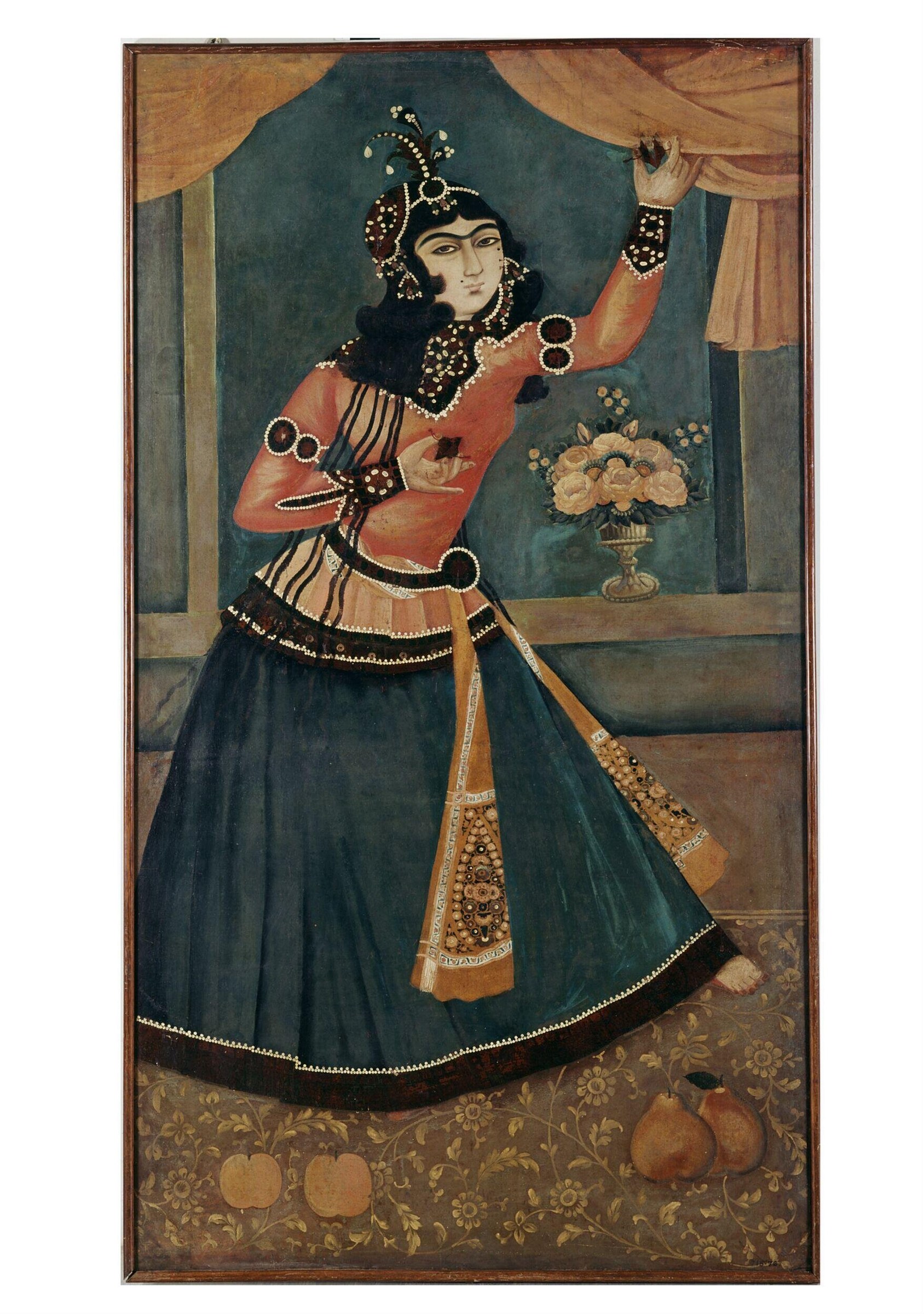
Lady Dancing and Playing Castanets
Unknown
- Dance:
- Folk/Country
- Era:
- Early 1800s (Waltz Revolution)
- Source:
- Victoria and Albert Museum
- Rights:
- Rights vary by item — check the source record before reusing this image. Source record ↗
- Recorded as:
- Check V&A creditLine
This image preserves evidence of how classical Indian dance was performed and presented in elite circles during the early 19th century, including the precise styling of costume, jewelry, and headdress that shaped the dancer's visual presence. It demonstrates that dance — and dancers — were subjects worthy of formal, detailed artistic attention in Indo-Persian court culture, and that the dancer's body and adornment were understood as aesthetic objects in their own right. For historians of dance practice, this work provides material documentation of pose, line, and presentation that cannot be obtained from written accounts alone.
What you are looking at
A single female figure occupies the center of the composition, posed in a moment of dynamic movement within an interior theatrical space. She stands in a contrapposto stance with her left arm raised gracefully overhead and her right arm angled across her body, her pose suggesting mid-turn or mid-gesture rather than stillness. The figure wears an elaborate costume consisting of a coral or rust-colored fitted upper garment with dense jeweled embellishment, a deep teal full skirt, and richly decorated borders in cream and gold thread. Her headdress is equally ornate: a tall, structured construction adorned with pearls and jeweled chains that frame her face and drape down the sides, anchoring her in a specific cultural tradition. The setting is a draped interior with deep teal-green walls, warm golden-tan fabric swags at top and sides suggesting stage curtains, and a patterned floor in browns and golds. A single small vase of cream-colored flowers sits on a ledge or table behind her. The palette is warm in the figure and furnishings but cool in the architectural surround, creating visual depth and focus on the dancer.
The dancing
The figure's pose suggests a trained, controlled gesture vocabulary rather than a naturalistic stance. The raised left arm curves softly overhead; the right arm bends across the torso at the elbow, fingers extended. Her weight appears centered, legs straight but not locked, with the hips held level despite the lifted arm. The posture suggests an understanding of elongation and line — the kind of deliberate formal training that characterized courtly and classical dance traditions. Her face turns slightly to viewer's left, creating a slight twist in the upper torso that adds vitality without compromising the verticality of the overall frame.
The dance depicted
The image depicts a female court dancer or professional performer, most likely from South Asian classical dance tradition based on the costume, jewelry, and headdress style — characteristics consistent with Indian classical dance of the 18th–19th century. The pose itself is neither a specific recognizable mudra nor a frozen moment of a known choreographic sequence, but rather a formal portrait pose adapted from dance vocabulary. The dancer wears the jeweled costume typical of professional dancers (devadasis) or highly trained courtesans who performed classical dance repertoire. The composition treats the figure as a subject for display and admiration rather than as a narrative or dramatic moment; this was common in Mughal and Rajasthani court culture. Without inscription or additional context, the specific dance form cannot be conclusively identified from posture alone, though the overall presentation suggests classical rather than folk tradition.
How it was made
This appears to be a work on paper using opaque pigments — likely gouache or similar water-based media — in the style of Mughal or Rajasthani miniature painting, though it is larger than typical miniatures and shows the influence of both Persian and Indian artistic traditions. The technique allows for precise rendering of jewelry, textile pattern, and facial features, with careful attention to decorative detail. The warm, earthy palette and the flattened, elegant treatment of the figure are characteristic of Indo-Persian court painting from the 18th and early 19th centuries. The work may have been created for a royal collection or noble household as a record of a performer or as a study in elegant deportment.
About this work
This is a formal portrait of a female court dancer in early 19th-century style, rendered in gouache or similar opaque pigment on what appears to be paper prepared in the Mughal or Rajasthani tradition. The figure is shown in a graceful, controlled pose that references dance training without depicting a narrative moment of performance. The costume — jeweled upper garment, flowing skirt, and elaborate headdress — identifies her as a professional or highly trained performer in classical Indian dance tradition. The work is a document of both dance practice and courtly display during a period when such dancers held significant cultural status and were the subject of artistic commissions.
How to look at it
The artist has chosen not a moment of maximum dynamism but a posed moment of elegance and display — the dancer faces the viewer almost frontally while her raised arm creates diagonal interest and lifts the composition. Notice how the headdress and jewelry occupy as much visual attention as the body itself; this reflects the cultural understanding that the dancer's adornment was integral to her identity and role. The careful rendering of the textile pattern and jeweled detail shows that the costume itself was being documented with the same care as the human figure. The still, formal setting and the single decorative accent (the flowers) frame the figure as a subject of contemplation rather than as a participant in narrative action.
The period
In early 19th-century India, professional female dancers occupied a complex social position: highly trained in classical repertoire, often attached to courts or wealthy households, and subject to both patronage and stigma. The Mughal empire had fragmented, but Indo-Persian cultural forms persisted, especially in regional courts of Rajasthan and the Deccan. Artistic practices blended Persian miniature traditions with Indian aesthetic principles. This was also a period of significant European colonial presence and influence on Indian visual culture. Dance remained a courtly and elite practice rather than a public entertainment. The costume visible here — the jeweled embellishment, the structured headdress, the fitted upper garment — reflects the aesthetic ideals and practical performance attire of this period's classical dancers.
Where it lives
The work is held in the Victoria and Albert Museum collection and is recorded as being from the early 19th century. It is not further identified as to provenance, artist, commission, or previous ownership in the available record.
Dance in this work
Questions about this work
What kind of dance is this?
Based on the costume, headdress, and jewelry style, this is almost certainly a classical Indian dance tradition, likely kathak or a closely related form, performed in a court context. The figure appears to be a professional dancer or court performer rather than a social dancer. However, the pose itself is a formal portrait stance rather than a depiction of a specific choreographic moment, so the exact style cannot be determined from the image alone.
Who was she?
The artist and the dancer's identity are not recorded. She was a professional or highly trained performer in an Indian court during the early 19th century, wearing the costume and jewelry appropriate to that role and status. Many such dancers were commissioned as artistic subjects, but individual records often did not survive.
Why is she dressed so elaborately?
In classical Indian court dance, the dancer's costume and jewelry were essential to the performance and the performer's identity. The jewels, the headdress, and the embellished garments were not merely decorative; they signaled her training, her status, and her role within the court hierarchy. They were also costly and therefore a display of the patron's wealth and taste.
Is this a painting or a print?
This appears to be a gouache or similar opaque water-based pigment on paper, in the style of Mughal and Rajasthani court painting. It is not a print, though it may have been produced in a workshop context where multiple similar works were created. The medium and style are consistent with Indo-Persian artistic traditions of the 18th and early 19th centuries.
More Folk/Country artwork