46 works in this view — arrow keys or swipe to move between them.
Dance in Art
Woman Dancing
Unknown
- Dance:
- Folk/Country
- Era:
- Early 1800s (Waltz Revolution)
- Source:
- Victoria and Albert Museum
- Rights:
- Rights vary by item — check the source record before reusing this image. Source record ↗
- Recorded as:
- Check V&A creditLine
This image preserves a specific moment when European courts were reinventing historical costume as theatre, and when women's bodies in movement—even in rigid, formal garments—became a subject worthy of careful artistic documentation. The work shows that the choreography of court spectacle was as much about posture, gesture, and the visual display of costume as it was about footwork, making it essential for understanding how performance traditions shaped professional ballet's emergence.
What you are looking at
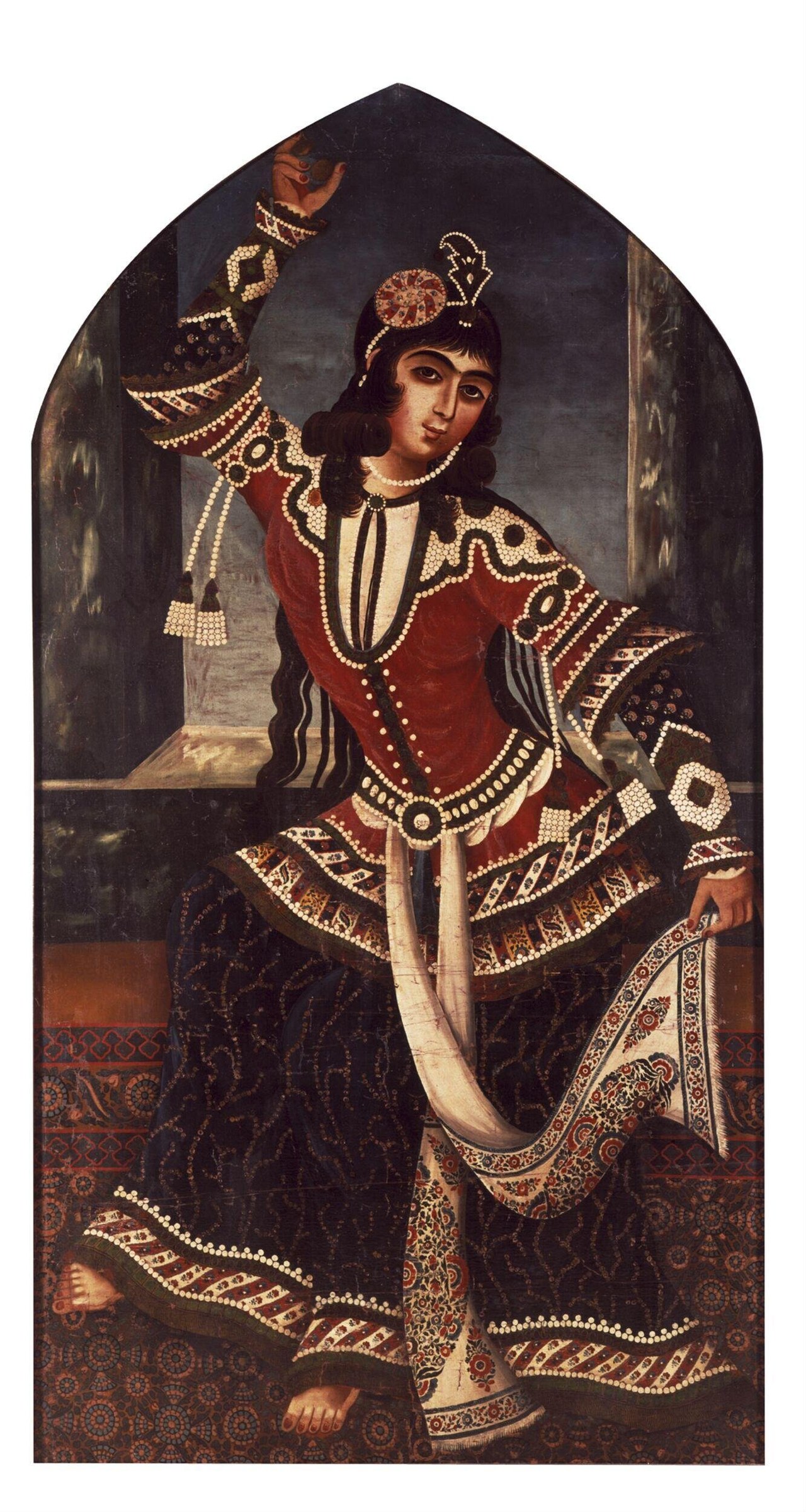
A young woman in elaborate court dress stands alone in an arched stone chamber, captured in a moment of theatrical pose or dance. She wears a striking red silk sarafan (long Russian tunic) lavishly embroidered with gold thread in geometric patterns, worn over a white linen shirt with a gold-embroidered neckline. Her dark hair is dressed with a tall kokoshnik headdress of gold and pearls, set with a large jewel at the center. She holds her right arm raised in a graceful gesture, the opposite arm extended lower, her body caught in a turning movement. Her posture conveys both formality and a moment of movement—the skirts of her long black undergown showing beneath the red tunic. The setting is minimal: pale stone walls with a dark arched ceiling and a suggestion of a window or doorway, creating an austere interior frame that emphasizes the brilliance of her costume. The painting style suggests early 19th-century academic work, with careful attention to fabric, embroidery, and the interplay of rich colors against the muted background.
The dancing
The dancer stands in a single, isolated figure—no partner or ensemble present. Her upper body is lifted and turned, the raised arm held at shoulder height with a gentle curve to the wrist, the lower arm extended more horizontally. Her torso twists in an elegant spiral, and the full weight of her body appears centered or slightly forward, as if in the midst of a turning phrase. The long, heavy skirts move with her, creating volume and emphasizing the rotational movement. The posture and arm frame suggest formal theatrical training rather than folk dance naturalism.
The dance depicted
This appears to depict a solo dance performance in the Russian Imperial court tradition, most likely from early 19th-century St. Petersburg. The woman is dressed in elaborate boyar costume—the historical Russian noble dress that became a staple of court spectacles and ballets of the period. The formal, stylized pose, the turned-out carriage, and the theatrical framing all point toward either a court entertainment or a stage performance. The work is consistent with early Romantic-era ballet's fascination with historical and exotic costume, though the isolated figure and the emphasis on costume over narrative movement suggests this may be a portrait of a dancer or a commemorative image of a court performance rather than a scene from a narrative ballet.
How it was made
Judging from the rendering style, surface qualities, and color handling, this appears to be an oil painting on canvas. The technique shows careful attention to the luminosity and texture of fabrics—the translucent qualities of silk, the sheen of embroidery, and the weight of layers are all rendered with precision. The background is kept deliberately muted and undefined, focusing all attention on the figure. The painting style is consistent with early 19th-century academic portraiture and theatrical costume documentation, suggesting it was made for display as a commemorative or decorative work rather than for narrative or genre purpose.
About this work
This is an early 19th-century portrait of a dancer—likely a performer or noble at the Russian Imperial court—posed in full theatrical dress. The image documents both a moment of dance movement and the elaborate visual vocabulary of court spectacle during the Romantic era. The work sits at the intersection of dance history and costume history, recording not just a pose but an entire tradition of performance that merged historical pageantry with emerging ballet technique. It is a rare surviving visual record of how Russian court dancers were costumed and how they presented the relationship between noble identity and theatrical movement in the early 1800s.
How to look at it
Notice how the artist has frozen a moment of pivoting or turning rather than a static pose—the body is not motionless but captured mid-movement, which conveys animation and virtuosity. Look closely at how the artist has rendered each layer of the costume: the sheen of the red silk, the geometric gold embroidery, the white linen beneath, the heavy black skirts underneath. The headdress is painted with as much care as the face, indicating its importance as a symbol of status and theatricality. The arched architecture frames the figure without competing for attention, a convention of costume documentation of the period.
The period
The image dates to the early 19th century, a period when Russian Imperial court culture was at its height and when ballet was beginning to emerge as a distinct artistic form. The Waltz Revolution was transforming European ballroom and theatrical dance, but court spectacles still drew heavily on historical costume and pageantry. The Romantic era (1820–1850s) would soon invest ballet with ethereal, otherworldly qualities, but in this earlier moment, the focus was still on the grandeur and visual splendor of the performer's appearance. Russian court culture was particularly invested in elaborate costume as a marker of power and taste, and this portrait documents that aesthetic.
Where it lives
Listed as from the Victoria and Albert Museum collection. The Victoria and Albert Museum holds extensive examples of costume documentation and dance-related artwork from this period, often acquired as records of theatrical practice and court culture rather than as 'fine art' in the strictest sense.
Dance in this work
Questions about this work
Is this a real dancer or an imaginary portrait?
That cannot be determined from the image alone. The catalogue record does not identify the sitter. The careful documentation of costume and the formal presentation suggest it may commemorate a specific performer or court spectacle, but without additional documentation, the subject remains unknown.
What is the headdress?
It is a kokoshnik, the traditional tall, decorated headdress worn by Russian nobility and peasants. In this elaborate gold and pearl version, it was worn for court performances and formal occasions. The kokoshnik was part of boyar (noble) costume that became fashionable for court theatricals in the early 19th century.
What dance is being performed?
The specific dance is not identifiable from the pose alone. The formal posture and the context suggest a court entertainment or theatrical spectacle rather than a specific ballroom dance or folk form. The image documents the dancer in costume rather than in a moment that reveals the grammar of a particular dance technique.
Why is she alone?
Court spectacles and early ballets often featured solo performers in elaborate costume as part of larger productions. An isolated portrait or commemorative image of a dancer would have focused on the individual figure and the splendor of her costume, which is what we see here.
More Folk/Country artwork