42 works in this view — arrow keys or swipe to move between them.
Dance in Art
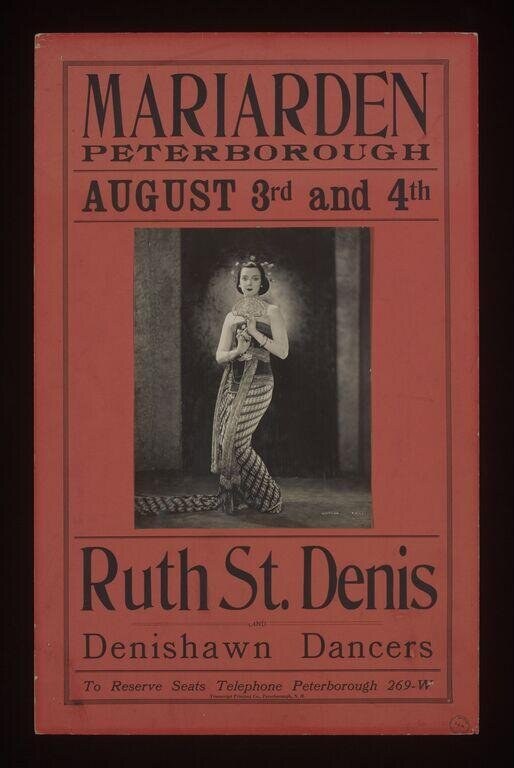
Poster advertising Ruth St. Denis and the Denishawn Dancers, 1923
Transcript Printing Co
- Dance:
- Folk/Country
- Era:
- 1920-1950 (Swing Era)
- Source:
- Victoria and Albert Museum
- Rights:
- Rights vary by item — check the source record before reusing this image. Source record ↗
- Recorded as:
- Check V&A creditLine
Ruth St. Denis was one of the three or four most influential figures in 20th-century American concert dance, and this poster captures the visual and promotional machinery that made her work famous. For historians and dancers, the image reveals how an influential artist positioned herself—the costume choices, the photography, the language of the poster—and how early modern dance was marketed to audiences.
What you are looking at
A theatrical poster on coral-red paper announces a performance by Ruth St. Denis and the Denishawn Dancers at Mariarden, Peterborough, on August 3rd and 4th. The focal point is a large black and white photograph of a soloist in an exotic costume: she stands in a relaxed contrapposto against draped fabric backings, wearing a patterned wrap skirt with geometric designs, a beaded or sequined bodice, and an ornate crown or headdress. Her arms are raised in an open, fluid position, one hand near her face, the other extended. The lighting is soft and theatrical, with strong modeling that emphasizes the contours of her body and the richness of her costume. She gazes toward the viewer with composed dignity. The typography is bold and hierarchical: "MARIARDEN PETERBOROUGH" dominates the top, "AUGUST 3rd and 4th" below it in large capitals, and the dancer's name "Ruth St. Denis" centered beneath the photograph in substantial serif letters. "Denishawn Dancers" appears smaller below, followed by a contact line for seat reservations. The overall effect is one of prestige and exotic spectacle, positioning St. Denis as the principal attraction.
The dancing
A single female figure occupies the photograph, posed in a standing position with a relaxed, almost languid quality. Her weight appears settled on one leg, while the other is slightly softened. Both arms are held at shoulder height or above in an open, expressive frame—not the rigid verticality of classical ballet, but something more organic and flowing. The gesture conveys a kind of Eastern mysticism or ceremonial formality, with the raised hand near the face suggesting a moment of emotional or spiritual intensity. Her gaze is direct and composed. The costume—draped, patterned, and heavily ornamented—covers the legs and torso, making specific footwork invisible, but the overall bearing suggests controlled, deliberate movement rather than virtuosic speed.
The dance depicted
This is almost certainly one of Ruth St. Denis's signature solo works, most likely *Radha* (1906) or another of her "Denishawn orientalist" pieces that formed the core of her repertory in the 1920s. St. Denis pioneered a form of theatrical dance that drew (sometimes loosely) on Indian, Egyptian, and Japanese movement vocabularies, performed in elaborate costumes and staged with dramatic lighting. The photograph reveals her approach: the movement is stately and posed rather than kinetic; the costume and visual presentation are as much the subject as the body itself. This is not ballet and not folk dance, but a theatrical fusion that blended concert dance with exotica and spiritual exploration—exactly what audiences of the 1920s expected from a "Denishawn" performance.
How it was made
This is a printed poster, most likely a lithograph or letterpress production (the record credits Transcript Printing Co). The central image is a photograph—either an original halftone or a photomechanical reproduction—printed in black and white and integrated into a two-color design (red/coral and black). This technique allowed mass production of promotional materials that could circulate to theaters and via post. The photographic image itself appears to be a professional studio portrait, carefully composed and lit to present St. Denis as both a serious artist and an exotic spectacle. The combination of photograph, typography, and color printing was standard for theatrical promotion in the 1920s and made such posters accessible and collectible.
About this work
This is a theatrical poster advertising a 1923 performance by Ruth St. Denis and the Denishawn Dancers, the most famous concert dance company of the early 20th century. St. Denis, a pioneer of American modern dance and an icon of the 1920s, built her career on "Denishawn Orientalism"—a theatrical fusion of concert dance with imagined Eastern aesthetics. The poster uses a glamorous studio photograph to market St. Denis as both a serious artist and a spectacle, reflecting the era's hunger for exotic entertainment and the emerging status of dance as a high art form. The work belongs in a dance gallery because it documents not just a performance, but an entire aesthetic movement and a crucial moment in American dance history when concert dance was establishing itself as a legitimate theatrical form distinct from vaudeville.
How to look at it
The photograph captures a moment of stillness rather than movement—a posed moment rather than a frozen action. This is deliberate: St. Denis's style often emphasized held positions, spiritual presence, and visual impact over dynamic motion. Note the costume's function: the garments are not incidental to the movement but central to it, framing the body and codifying an imagined exotic identity. The studio lighting models the figure with theatrical elegance, emphasizing the contours of the arms and the richness of the textiles. The poster's function is equally important: this is not a document of what the audience would see, but a promise and an invitation—the image sells both the artist's glamour and the novelty of her work.
The artist
Transcript Printing Co was a commercial printing firm based in the early 20th century (precise location and dates not established from the record). The company produced theatrical posters and promotional materials for touring companies, likely many in the British Midlands region where Peterborough is located. The firm's work is identifiable by its typography and color printing techniques typical of the period, but no individual designer or artist is named on this poster.
The period
The 1920s saw the rapid professionalization and theatricalization of concert dance in both America and Britain. Ruth St. Denis and her Denishawn Company represented a new category: dance as art rather than entertainment, performed in theaters rather than vaudeville halls, with touring circuits that reached provincial cities like Peterborough. Simultaneously, the visual culture of dance—photographs, posters, periodicals—was becoming sophisticated and central to the marketing of dance companies. This poster sits at the intersection of artistic ambition and popular entertainment, reflecting the cultural moment when modern dance was establishing itself as legitimate theater.
Where it lives
The work is held in the Victoria and Albert Museum collection. It is a printed promotional poster, the kind produced in quantities for distribution to theaters and press offices during the tour, and survives as one artifact of the touring circuit that brought concert dance to provincial British audiences in the 1920s.
Dance in this work
Questions about this work
Who was Ruth St. Denis?
Ruth St. Denis (1879–1968) was an American dancer and choreographer who pioneered concert dance in the early 20th century. She created the Denishawn School and Company with her husband Ted Shawn, which trained and toured extensively, establishing modern dance as a serious theatrical art form. She was known for her exotic, orientalist works and her efforts to elevate dance to the status of fine art.
What is 'Denishawn Orientalism'?
Denishawn Orientalism refers to a style of concert dance created by Ruth St. Denis and the Denishawn Company that drew (often loosely) on Asian, Indian, and Egyptian movement and aesthetic traditions. These works were theatrical fantasies rather than ethnographic studies, designed to appeal to Western audiences' fascination with the exotic while positioning concert dance as a high art form worthy of serious attention.
Why does the record say 'Folk/Country' when this is clearly theatrical?
The catalogue record's genre label is inaccurate. This is a theatrical concert dance piece by a major modernist artist, not a folk or regional form. The mislabeling may reflect how the work was catalogued before more precise dance taxonomy was available, or it may simply be an error in the initial record.
What would the actual performance have looked like?
This photograph is a studio portrait, not a document of the stage performance. The actual show would have featured the dancers (St. Denis and the Denishawn ensemble) on a theatrical stage with curtains, drops, and dramatic lighting. St. Denis's style emphasized slow, controlled movements, expressive arm work, and the visual impact of costumes and staging over virtuosic footwork.
More Folk/Country artwork