49 works in this view — arrow keys or swipe to move between them.
Dance in Art
[Recueil. Ballet chinois, production d'Eugène Pirou. Paper prints]
Unknown artist
- Dance:
- Ballet
- Era:
- Late 1800s (Victorian Ballroom)
- Source:
- Bibliothèque nationale de France (Gallica)
- Rights:
- Public domain — free to use, share and adapt.
- Recorded as:
- domaine public
This is one of the earliest filmed records of Chinese performance tradition in European cinema, capturing a moment when cinema technology was first being used to document and distribute dance and theatrical movement across cultures. For dance historians and historians of cinema, it documents both the aesthetics of late-19th-century Chinese theatrical staging and the European reception and repackaging of Asian performance—showing how cinema became a tool for circulating images of the exotic and unfamiliar. The film strip format is itself historically significant: it represents an early form of cinema distribution and promotion that predates modern video and anticipates how cinema would eventually become a universal medium for preserving and sharing movement.
What you are looking at
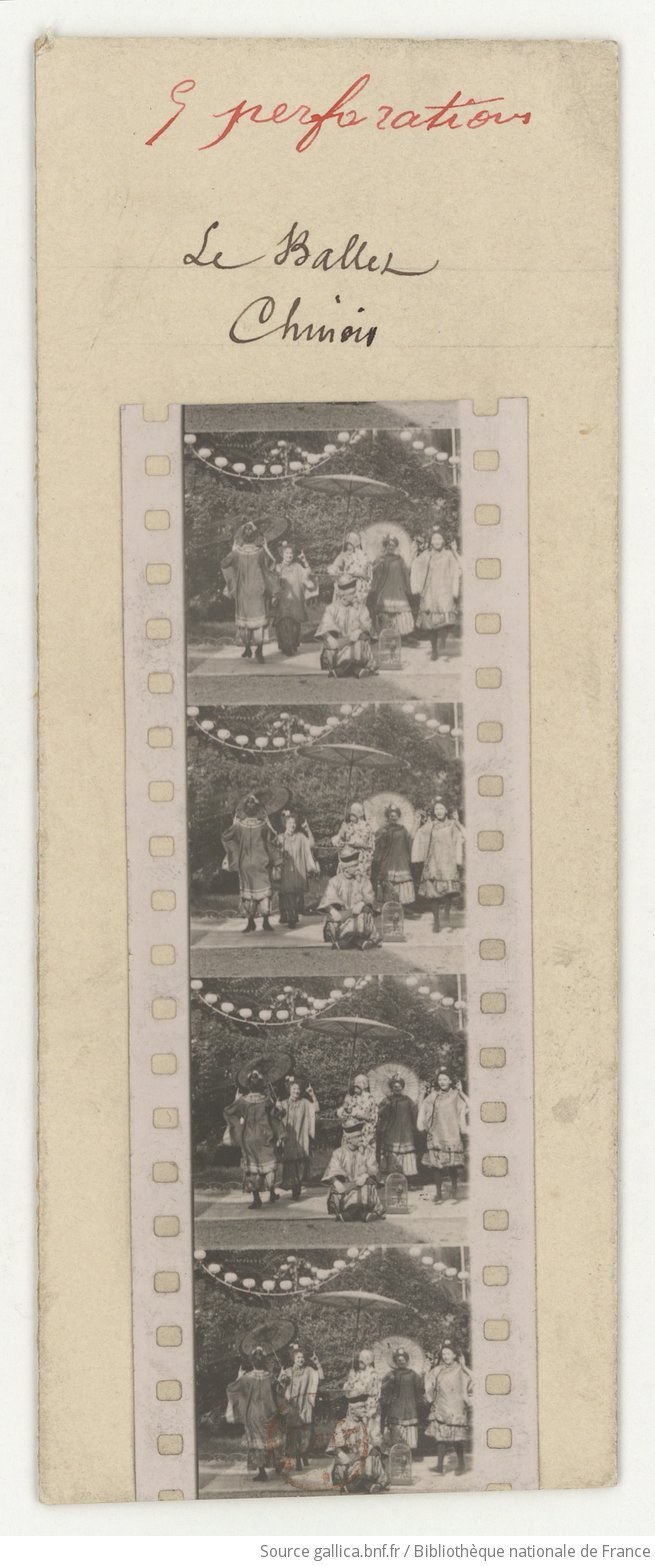
This is a film strip—a sequence of four consecutive frames from a motion picture—showing a theatrical Chinese dance production. Each frame captures the same scene from a slightly different moment in the action, allowing a viewer to read the progression of movement. The setting is an interior stage with a painted backdrop showing flowering branches or garden scenery in the upper portion of each frame. A group of performers in costume stands in an arranged tableau: some figures wear long robes in pale fabrics, others darker garments. The figures are posed in a loose semicircle or grouped arrangement rather than a strict line. In the foreground of each frame, one or two figures in lighter dress sit or crouch on the ground, their bodies angled toward the standing group. Strands of what appear to be beaded or pearl garlands hang across the top of the set, suggesting an ornamental interior or temple space. The lighting is even and frontal, typical of early cinema, with no dramatic chiaroscuro. The film stock itself is visible—the characteristic perforations of 35mm film run down both sides of the strip, and the frames are separated by clear title cards bearing frame numbers or shot identifiers.
The dancing
The standing figures maintain upright postures with arms at their sides or gesturing modestly outward; there is no evidence of balletic extension or the high ports de bras of European classical dance. The seated or crouching figures in the foreground lean forward with flexed joints, their torsos inclined toward the standing group in a posture of deference or ritual address. The overall composition emphasizes symmetry and frontal presentation rather than dynamic diagonal movement across space. The bodies do not appear to be in closed partnered holds or classical ballet formations; instead, they occupy discrete positions within a arranged group, which suggests processional, ceremonial, or tableau-based choreography rather than the continuous flowing movement of European theatrical forms.
The dance depicted
This is a filmed record of a Chinese dance or theatrical production, likely a staged dramatization set in a Chinese interior or temple setting. The title "Le Ballet Chinois" (The Chinese Ballet) reflects late-19th-century European terminology, which applied the word "ballet" loosely to any formal non-European dance spectacle. The dance appears to be narrative or ceremonial in character rather than virtuosic technical ballet; the grouped arrangement and ritual quality of the poses suggest either a scene of court ceremony, greeting, or worship. The film was produced by Eugène Pirou, an early French cinematographer and producer active in the 1890s, indicating this is documentation of a stage production or performance that toured or played in France during that period. The static, frontal camera placement and the choice to repeat the same action across multiple frames suggests the producer was interested in capturing the full visual detail and sequence of movement rather than editing for dramatic effect.
How it was made
This is a film strip—four consecutive frames cut from a motion picture reel and adhered to paper or card stock. The photographic process and frame-by-frame structure indicate this is a celluloid film still or a promotional strip printed or distributed after the film was shot. The visible film perforations and frame divisions confirm this is actual cinema stock, not a lithograph or hand-drawn sequence. The even, slightly soft focus and the frontal lighting are characteristic of early cinema (circa 1890s), when light sources were limited and camera positions fixed. The fact that the same action is repeated across four frames suggests this was either extracted from a longer continuous shot or that Pirou deliberately shot the same movement multiple times from the same angle. The printing or mounting on paper stock indicates this was a promotional or archival object—a way to distribute or preserve scenes from the film without requiring a projector, making it accessible to a wider audience or for press and advertising purposes.
About this work
This is a rare surviving example of early cinema documentation of Chinese theatrical performance, filmed and distributed by the French cinematographer Eugène Pirou in the late 1890s. At a moment when cinema was still a novelty and European audiences had limited direct exposure to non-Western performance traditions, such films served as both entertainment and a form of visual ethnography or cultural spectacle. The production itself—titled "Le Ballet Chinois" and presented as a theatrical event—was likely a staged performance by Chinese performers or a European interpretation of Chinese aesthetics performed for French audiences. The film strip format, with its four sequential frames printed on paper, is a significant artifact of early cinema distribution: it allowed scenes to circulate as promotional material, collectibles, or educational documents long before home video or digital reproduction. The work belongs in a gallery of dance in art because it documents how non-Western movement traditions were encountered, framed, and consumed in the European imagination at the threshold of cinema itself.
How to look at it
The viewer should attend to the repetition of the frames and what it reveals about the movement: because the same moment is captured four times in slightly different phases, the eye can follow the subtle shifts in gesture and weight from frame to frame, reconstructing the motion as if watching a slow-motion sequence. Notice how the figures in the foreground shift position slightly between frames, and how the standing figures maintain their formal arrangement; this shows that the choreography emphasizes gradual, measured transition and ritual stillness rather than rapid or virtuosic movement. The painted backdrop and the strands of beads or ornaments frame the action and create a sense of interior depth and theatrical artificiality—this is not a documentary of actual ritual, but a staged theatrical production designed for European audiences. Finally, observe the frontal, statue-like quality of many of the poses, which suggests influence from traditional Chinese or Asian performance traditions in which the body occupies discrete, formally composed positions rather than flowing continuously through space in the manner of European classical ballet.
The artist
Eugène Pirou (1841–1909) was a French cinematographer, producer, and pioneer of early cinema. He was active in the 1890s when the Lumière Brothers and other inventors were establishing the basic techniques and business models of motion picture production. Pirou is known for producing a diverse range of short films documenting contemporary life, theater, and exotic subjects—subjects that appealed to the curious audiences of the cinema's earliest years. His productions often had a documentary or promotional character, capturing stage performances, scenic views, and cultural spectacles. The production of "Le Ballet Chinois" reflects Pirou's interest in theatrical subjects and the broader late-19th-century European fascination with non-Western cultures, aesthetics, and performance traditions.
The period
In the 1890s, European theater and visual culture were in the midst of aesthetic movements that incorporated Asian and non-Western influences: Japonisme was at its height in visual art and design, and Asian theatrical traditions were beginning to be encountered directly through touring performers and international exhibitions. At the same time, cinema was emerging as a new medium for capturing and distributing images of theatrical performance and daily life. The Lumière Brothers' first public film screenings (1895) had sparked rapid growth in cinema production, and producers like Pirou were quick to recognize that filmed performances—both of conventional European theater and of exotic or unfamiliar spectacles—would draw audiences. The labeling of this production as "ballet" reflects the European convention of the era, in which any formal group dance or choreographed movement from non-European cultures was subsumed under the category of ballet, which was the reigning European form of theatrical dance.
Where it lives
This object is held in the Bibliothèque nationale de France as part of the Gallica digital library, France's national digital library. It is a film strip—a sequence of frames from a motion picture—printed or mounted on paper or card stock, likely created as a promotional or archival document in the late 1890s or early 1900s. The production is attributed to Eugène Pirou, a French cinematographer and producer of early cinema.
Dance in this work
Questions about this work
Is this a real Chinese dance or a European fantasy?
The title "Le Ballet Chinois" and the theatrical setting suggest this is a staged production—either a performance by Chinese dancers for European audiences or a European theatrical interpretation of Chinese aesthetics. The formal arrangement and ritual character of the movement point to an engagement with actual Asian performance traditions, but the framing and presentation are entirely European. This is documentary of a theatrical spectacle, not an ethnographic record of native practice.
Why are the same frames repeated four times?
Early cinema was often made of very long, continuous shots, and distributors would sometimes extract and repeat individual frames or sequences to emphasize key moments or to create a promotional strip that could circulate independently of the full film reel. The repetition allows a viewer to see the subtle progression of movement from frame to frame, much like a modern slow-motion replay.
What is the film strip format and why does it matter?
A film strip is a series of frames cut from a motion picture reel and mounted on paper or card stock. Before video and digital reproduction, film strips were distributed as educational, promotional, and collectible objects—allowing people to view and study cinema without a projector. This format was especially important in the early cinema era, when access to films was limited and the technology for home viewing did not yet exist.
Who was Eugène Pirou and why did he make this?
Eugène Pirou was a French cinematographer active in the 1890s, when cinema was a brand-new medium and producers were eager to film any subject that would attract audiences—theater performances, exotic spectacles, and cultural novelties among them. The production of this Chinese dance spectacle reflects both the technical capabilities of early cinema and the broader European fascination with non-Western performance during this period.
More Ballet artwork