49 works in this view — arrow keys or swipe to move between them.
Dance in Art
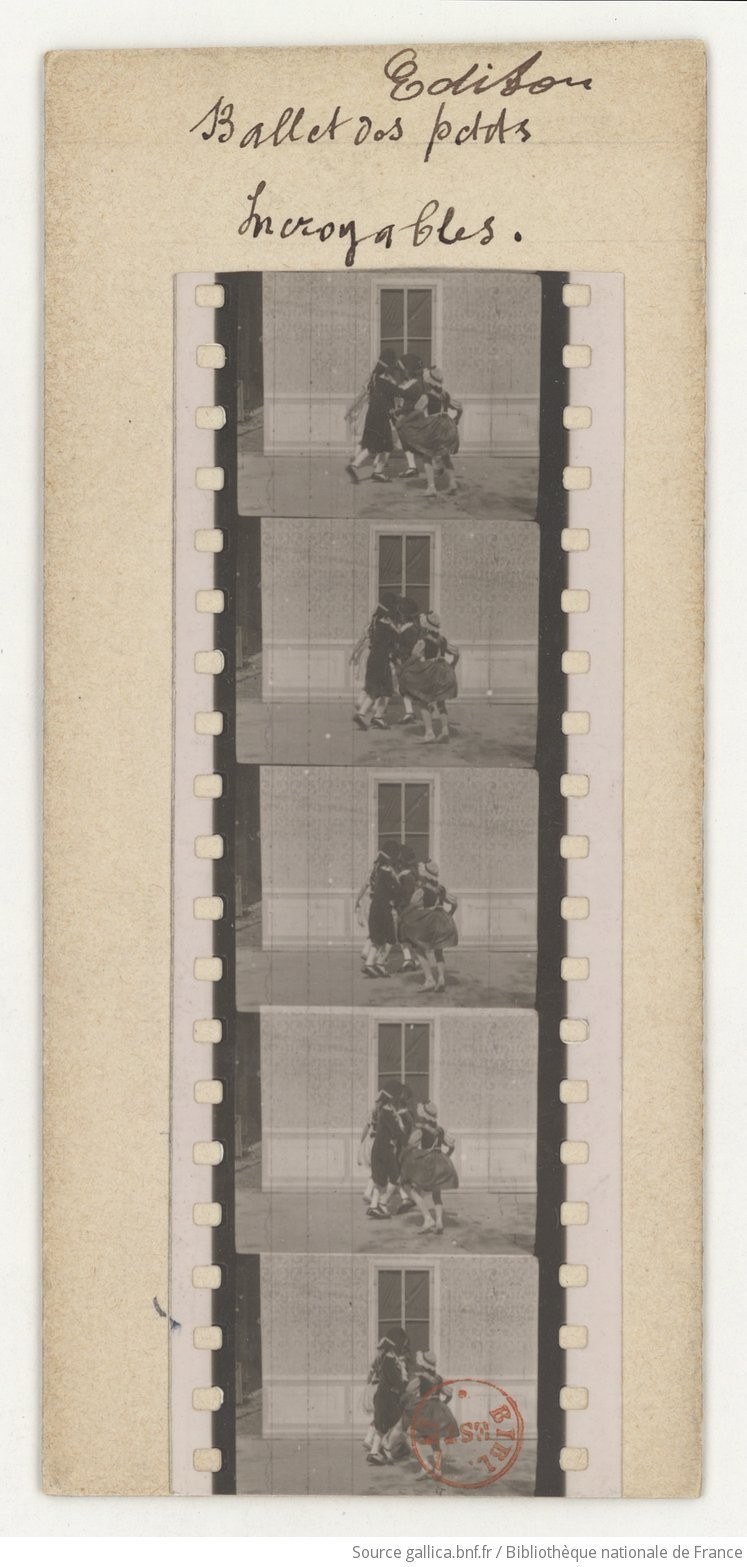
[Recueil. Le Ballet des petits Incroyables, production d'Eugène Pirou. Paper prints]
Unknown artist
- Dance:
- Ballet
- Era:
- Late 1800s (Victorian Ballroom)
- Source:
- Bibliothèque nationale de France (Gallica)
- Rights:
- Public domain — free to use, share and adapt.
- Recorded as:
- domaine public
This is one of the earliest motion picture records of ballet performance, predating most surviving dance film by decades and offering direct visual evidence of how tutus, pointe work, and corps formations appeared in live practice. It documents a moment when cinema was beginning to function as a preservation medium for ephemeral performance, solving a problem that had haunted dance documentation for centuries.
What you are looking at
This is a film strip — five frames from an early motion picture — showing a small group of young dancers in classical ballet dress performing indoors. The setting is a plain studio or rehearsal room with a large window and white wainscoting visible behind them. The dancers wear dark, short tutus and pointe shoes in a style consistent with late 19th-century ballet practice. Each frame captures them in a similar pose, clustered together in the center of the floor, suggesting either a repeated movement or consecutive moments from a single phrase. The lighting is uniform and even, characteristic of early film stock. The handwritten inscription at the top reads 'Coédition / Ballet des petits / Incroyables' — indicating this documents a work called the 'Ballet of the Small Incredibles' made for or distributed by Eugène Pirou, a pioneer of dance cinematography.
The dancing
The dancers are arranged in a tight group occupying the frame's center. At least three or four young female figures are visible in each frame, wearing tutus that fall to mid-thigh and displaying the upright carriage expected of classical ballet. Their heads are held high and their arms are held in positions suggesting either a preparation or a moment of held balance. The repetition across frames — same position, same grouping, same studio space — suggests either a looped action or the choreography's emphasis on formation work rather than rapid traveling steps. The bodies appear to be in a closed grouping, possibly a tableau or a formal entrance.
The dance depicted
This is a documentary record of early theatrical ballet, almost certainly from the 1890s based on costume and studio practice. The work is identified as the Ballet des petits Incroyables — a piece likely intended for a Parisian stage and documented by Eugène Pirou, who was known for filming dance performances and rehearsals in the 1890s. The title's reference to 'petits' (small) and 'Incroyables' (a term from Revolutionary France meaning remarkable or audacious people) suggests this was either a comic or satirical ballet, or one featuring young or child dancers. The film stock shows the dancers in what appears to be rehearsal or performance practice: a formal grouping held across multiple frames rather than evolving action, which may indicate either a tableau moment or the technical limitations of early motion capture.
How it was made
This is a paper print of a film strip — a method by which early motion pictures were reproduced as sequences of still photographs adhered to paper backing. The perforations along both edges are the registration holes characteristic of 35mm film stock. This format was used to archive, distribute, and study early films before preservation methods advanced; paper prints survive in greater numbers than the original nitrate film stock, which was chemically unstable. The uniformity of lighting and the absence of outdoor or artificial theatrical lighting suggests Pirou filmed this in a controlled studio environment, likely using natural light from the window visible in the frames. This technique placed the work in circulation among collectors, archivists, and researchers rather than limiting it to theater exhibition.
About this work
This paper print preserves five frames from an early motion picture documenting the Ballet des petits Incroyables, a small-scale theatrical ballet filmed in the 1890s by Eugène Pirou. The work is a rare visual record of late 19th-century ballet practice: the costume, carriage, studio setting, and group formation all speak to the conventions and methods of ballet in the closing decades of the century. It sits at the intersection of dance history and cinema history—a moment when the two practices were just beginning to intersect, and when photography could capture what painting and notation alone could not: the actual movement of dancers in time.
The film survives because Pirou, a pioneering cinematographer, recognized that dance was a subject worth documenting. The paper print format ensured its preservation through the Library of Nationalefrancaise and its availability to later researchers. For students of ballet, this is evidence of how the form was actually practiced and performed; for film historians, it is an early example of dance as cinema subject matter.
How to look at it
Watch how the pose repeats across frames without apparent variation. This is not because the dancer is motionless, but because the film stock captures only a handful of moments per second—what a moving camera and multiple angles would later reveal as a continuous action here appears frozen or looped. Notice the studio window and wainscoting: Pirou chose to film in a working rehearsal or practice space, not a theatrical stage. The tutus and pointe shoes are the evidence of ballet authority; the small group and tight framing suggest a modest production, not a grand opera spectacle. The inscription at the top is the original catalog or identification—how early cinema was tracked before systematic archiving existed.
The artist
Eugène Pirou was a French cinematographer and one of the pioneers of motion picture technology in the 1890s. He was among the first to recognize dance as a compelling subject for the moving image, and he filmed multiple ballet and music-hall performances. His work predates the Lumière brothers' dance films and represents an early commercial venture into dance documentation. Pirou's films were preserved as paper prints, a format that became standard for archiving early cinema before nitrate film preservation advanced.
The period
The 1890s were a transitional moment for both ballet and cinema. In ballet, the late Romantic era was giving way to new forms; Russian Imperial ballet was consolidating classical technique under teachers like Cecchetti, while Parisian opera ballet was fragmenting into smaller, often satirical or music-hall productions. The 'petits Incroyables' suggests a comic or popular entertainment rather than a grand opera ballet. In cinema, these years saw the medium shift from curiosity to commercial art form; by the late 1890s, filmmakers were actively seeking out performance subjects—music halls, acrobats, dancers—to fill out programs of shorts. Dance on film was novel enough to be worth documenting, yet the technology was still too slow and too constrained by studio lighting to capture anything but static groupings and basic movement.
Where it lives
This paper print is held by the Bibliothèque nationale de France (BnF) through its Gallica digital library. Paper prints were the standard preservation medium for early nitrate films; they represent a crucial survival strategy before modern film archiving. The object type indicates this was a distributed, reproducible copy rather than a unique artifact—evidence of early cinema's industrial and commercial circulation.
Dance in this work
Questions about this work
How do we know what this ballet looked like if the film is so short and the frames so similar?
We don't, fully—this is one of the limitations of very early dance film. The paper print preserves five moments, which may represent a tableau or a pose held across multiple frames rather than a full phrase of movement. Combined with the written title and any playbills or reviews that survive, historians reconstruct a rough picture. The costume and carriage tell us about training standards; the grouping tells us about formation work. But the actual choreography—the entry, the steps, the exit—remains partly invisible.
Why film a ballet in a studio rather than on stage?
Studio filming offered better lighting and control. Early films required more light than theater stages could provide, and the cameras were too cumbersome and slow to follow action across a large space. Pirou may have filmed rehearsals or specially arranged performances. The presence of the window suggests he was using natural light, which meant working during daylight hours and in a space that could not be darkened.
What does 'Incroyables' mean in the title?
The Incroyables were an extravagant youth subculture in Revolutionary Paris, known for extreme dress and affected manners. By the 1890s, the term had become a historical reference used for comic or satirical works that evoked that era or that spirit of audacious performance. The 'petits Incroyables' likely signals either a ballet about young people or a work with comic or satirical intent.
More Ballet artwork