26 works in this view — arrow keys or swipe to move between them.
Dance in Art
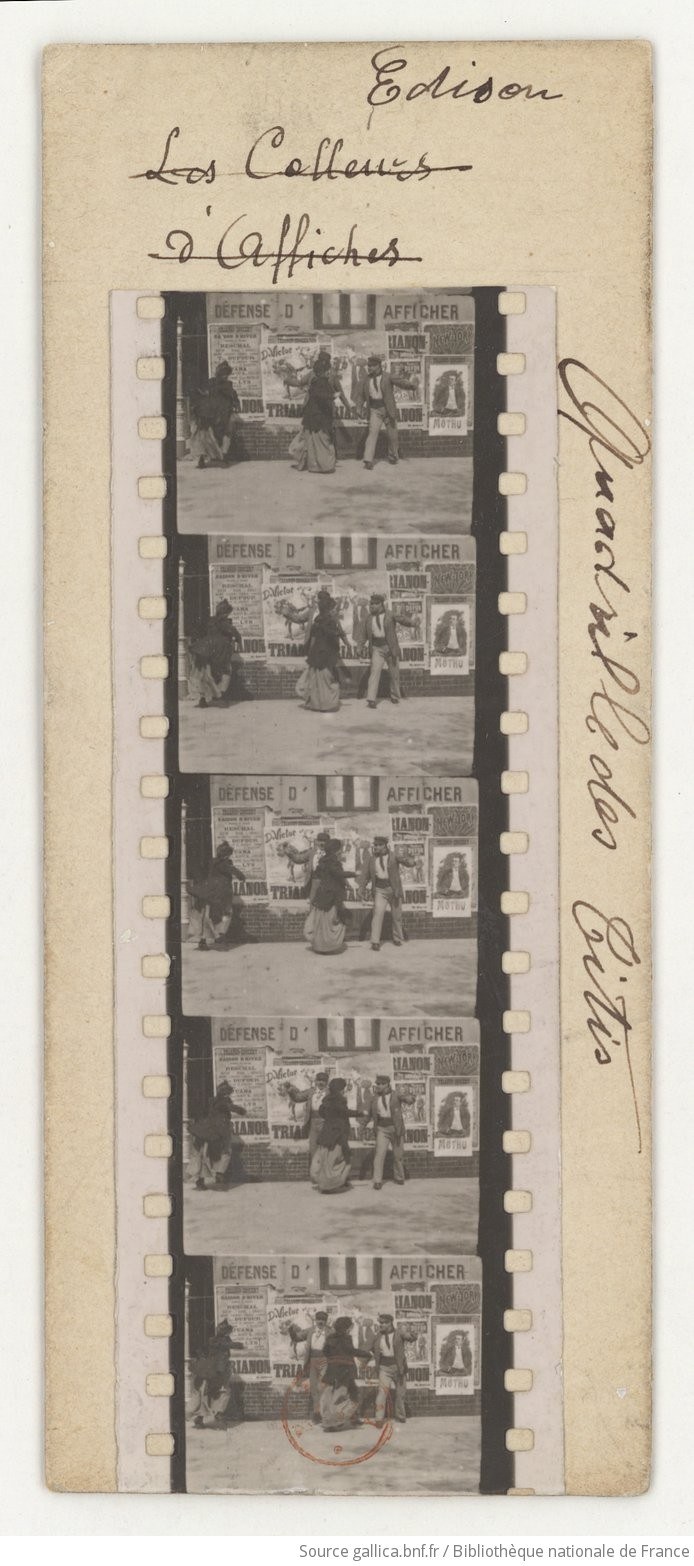
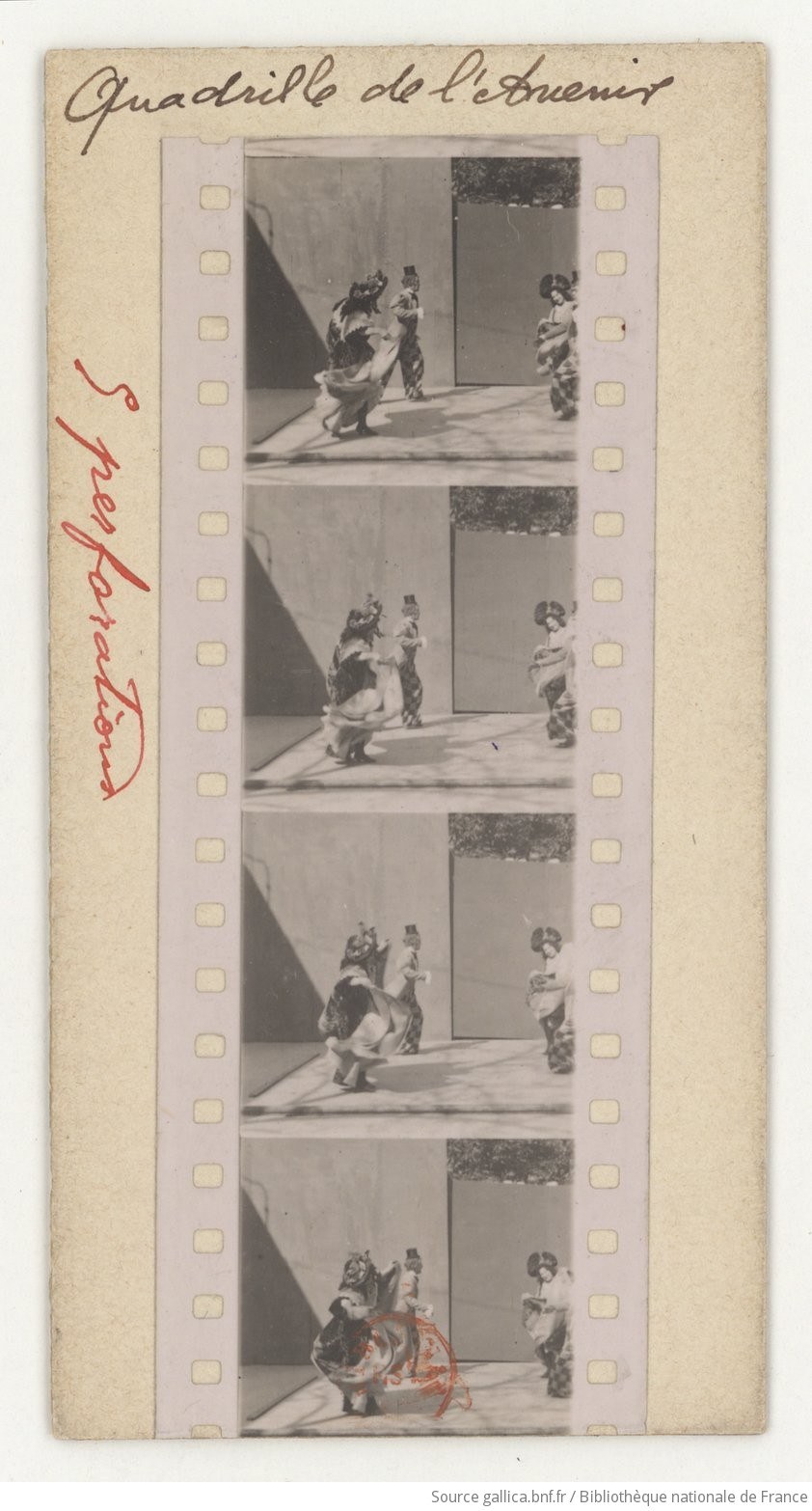
[Recueil. Quadrille de l'avenir, production d'Eugène Pirou. Paper prints]
Unknown artist
- Dance:
- Quadrille
- Era:
- Late 1800s (Victorian Ballroom)
- Source:
- Bibliothèque nationale de France (Gallica)
- Rights:
- Public domain — free to use, share and adapt.
- Recorded as:
- domaine public
This is rare evidence of late-nineteenth-century ballroom choreography and theatrical dance practice captured in motion. The quadrille was ubiquitous in ballrooms across Europe and the Americas, but surviving records of how it was actually performed—with what timing, partnering, and spatial phrasing—are scarce. The film strip format and the deliberate staging also document how early cinema understood its role in preserving performance, offering insight into the transition between theatrical and cinematic ways of seeing dance.
What you are looking at
A four-frame film strip showing a staged dance scene, likely from an early cinema production. Each frame captures sequential moments of the same choreography, shot against a simple interior with a plain back wall and a doorway or window at stage right. The setting is sparse and theatrical, suggesting a studio or stage set rather than a naturalistic space. Two figures occupy the scene throughout: a woman in a full-skirted costume with what appears to be a corseted bodice, and a smaller figure (possibly a child or second dancer) in lighter dress. The woman's silhouette and the volume of her skirt dominate the composition. Strong directional light rakes across the stage from the left, creating sharp shadows and definition. The sequential framing suggests this is documentation of a choreographed piece, with each frame capturing a different moment in the movement phrase as the figures shift position and orientation across the stage.
The dancing
The woman maintains an upright, formal carriage throughout, her body oriented toward the camera or stage-right. Her skirt is full and moves as she shifts weight, suggesting the movement is deliberate and controlled rather than rapid or fluid. The smaller figure at stage right remains relatively stationary across the frames, suggesting a secondary or supporting role. In the lower frames, the woman appears to be in a position of address or presentation toward the other figure—her posture suggests formality and a courtly bearing. The framing and stillness suggest this is not an acrobatic or athletic dance, but rather one organized around pose, carriage, and the presentation of the body and costume.
The dance depicted
This appears to be documentation of a theatrical quadrille, likely the novelty piece titled 'Quadrille de l'avenir' (Quadrille of the Future) produced by Eugène Pirou. The quadrille was a standard European ballroom dance of the nineteenth century, performed in sets of four couples, but the 'de l'avenir' (of the future) title suggests this was a contemporary novelty or satirical version, possibly with exaggerated or unusual choreography. The recording as film strip indicates this is early cinema documentation—Pirou was an early French filmmaker active in the 1890s. The formal dress, the stagey lighting, and the sequential framing all support that this is a theatrical interpretation of the quadrille rather than a naturalistic social-dance recording. The small scale of the companion figure and the hierarchical framing suggest this may be a burlesque or comedic treatment of the form.
How it was made
This is a photographic film strip on what appears to be glass or gelatin plate, printed or adhered to card stock. The notation and title at top, together with the red wax seal visible on the lower frame, indicate this is an archival print or documentation sheet created after filming, possibly for distribution or preservation purposes. The format—multiple frames shown together on a single mount—was a standard way of distributing and studying early film content before projection became the norm. The monochromatic photographic process and the quality of the image suggest this dates to the 1890s-early 1900s. The mounting and archival treatment indicate this object has been preserved as a document of early cinema and theatrical practice, not primarily as a work of art for display.
About this work
This is a film strip documenting a stage performance of 'Quadrille de l'avenir' (Quadrille of the Future), a theatrical dance piece produced by Eugène Pirou, a pioneering French filmmaker. The work captures four sequential moments of the choreography in monochromatic photography, showing two figures in formal theatrical dress against a simple stage interior. It belongs to the brief early period when cinema served primarily as documentation of live theatrical performance, before film developed its own aesthetic and syntax.
As both a dance record and a cinema artifact, this strip sits at a crucial historical intersection. The quadrille itself was already becoming a historical form by the 1890s, but the novelty title 'de l'avenir' and the theatrical staging suggest Pirou was engaging in contemporary commentary—possibly satire—about ballroom dance and modernity. The work shows how early cinema was used to preserve and distribute choreography and performance, a practice that would largely disappear as film moved toward narrative and away from theatrical documentation.
How to look at it
Follow the woman's movement across the four frames: notice how her position and orientation shift subtly from frame to frame, and how the volume and fall of her skirt changes with her weight and stance. The small companion figure remains relatively fixed, inviting the eye to see the choreography as a solo or showcase for the woman's body and dress. The strong side lighting emphasizes the three-dimensionality of the skirt and the silhouette of the body. The sequential framing asks you to imagine the movement between frames, to reconstruct the dance from these still photographs—a practice that was common when film was studied frame by frame or when film strips were used for distribution before projection. Notice also the theatrical formality of the setting and the presentation: this is not a social dance captured incidentally, but a performed and staged piece.
The artist
Eugène Pirou was a French photographer and pioneering filmmaker active in the 1890s. He was among the earliest producers of moving-picture films in France, working in the years immediately following the Lumière brothers' public screening of the cinématographe in 1895. Pirou produced actualities, satirical pieces, and recordings of theatrical performances. The 'Quadrille de l'avenir' appears to be a theatrical work staged and filmed by Pirou, likely as a novelty or commentary on contemporary dance. His work exemplifies the documentary impulse of early cinema—the desire to record and preserve live performance, theatrical and social, before the medium developed its own narrative grammar.
The period
The quadrille was the dominant ballroom dance of the nineteenth century, performed in sets of four couples in formal dress. By the 1890s, it was already becoming old-fashioned among the urban avant-garde, as the waltz and other dances ascended; the title 'de l'avenir' (of the future) may be ironic or satirical, suggesting either a futuristic reinvention or a comic commentary on the form's obsolescence. The rise of early cinema in the mid-1890s coincided with a moment of self-conscious historical awareness about ballroom dance—a recognition that these forms were being displaced and should be recorded. Theatrical dance was at this same moment becoming increasingly professionalized and separated from social dancing. Pirou's filming of this piece sits within that broader transition: early cinema as archivist of a dance culture already understood as historical.
Where it lives
This object is held in the Bibliothèque nationale de France and is available through their Gallica digital library. It is catalogued as a film strip or print from a collection of photographic documentation, labeled as a production by Eugène Pirou. The archival mounting, notation, and wax seal indicate it has been preserved as a historical artifact and document of early cinema.
Dance in this work
Questions about this work
What is a quadrille?
A quadrille is a ballroom dance performed by four couples arranged in a square, popular throughout the nineteenth century in Europe and the Americas. It consisted of five figures or sections, each with prescribed steps and formations. By the 1890s it was becoming old-fashioned, displaced by the waltz and other dances.
Why was this dance filmed?
Early cinema was understood partly as a tool for documenting and preserving live performance—theatrical dances, vaudeville acts, and notable performers. Filming the 'Quadrille de l'avenir' served both as entertainment (cinema was still a novelty) and as a record of the choreography and performance style.
Who was Eugène Pirou?
Pirou was a French photographer and early filmmaker active in the 1890s. He produced actualities (brief films of real events), satirical pieces, and recordings of theatrical performances in the years immediately following the Lumière brothers' invention of the cinématographe.
What does 'de l'avenir' mean, and why is it ironic?
'De l'avenir' means 'of the future.' The title may be satirical, suggesting either a futuristic reinvention of the outmoded quadrille or a comic commentary on the form's obsolescence. It reflects a moment when ballroom dance culture was becoming self-consciously historical.
More Quadrille artwork