31 works in this view — arrow keys or swipe to move between them.
Dance in Art
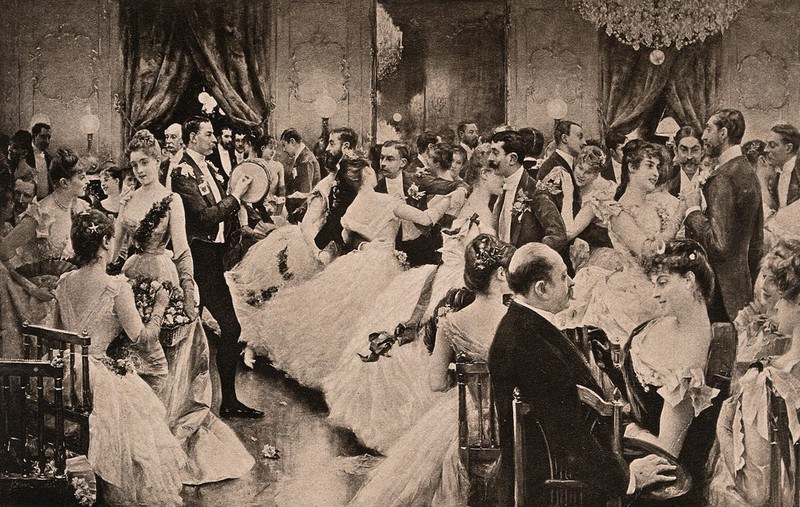
A man is playing a tambourine as couples are dancing in a ballroom. Process print after J.L. Stewart.
Unknown artist
- Dance:
- Ballroom
- Source:
- Wellcome Collection
- Rights:
- Rights vary by item — check the source record before reusing this image. Source record ↗
- Recorded as:
- Check
This image is crucial evidence for understanding how ballroom dancing looked and was valued in its moment of greatest social prestige. The photograph-derived process print format itself tells us about the audience: such images were produced for illustrated publications and books aimed at educated, fashionable readers who wanted to see how society danced. For dance historians, the visible hold, frame, and figures of turn provide direct information about technique; for social historians, the crowd, the dress code, and the formal setting confirm that ballroom dancing was a centerpiece of upper-class ritual.
What you are looking at
A formal ballroom scene of considerable social grandeur, rendered in sepia tones characteristic of early photographic reproduction. The composition is crowded and animated: dozens of figures in evening dress fill an ornate interior with draped curtains visible at the back. In the foreground, a musician in formal tailcoat plays a tambourine, his figure anchoring the left side of the frame. Multiple couples are in motion across the floor—some mid-turn with the woman's voluminous skirts caught in swirl, others in close conversation or waiting their turn. The women wear high-necked, long white or cream gowns with fitted bodices and elaborate trains or draping; the men are uniformly in black tailcoats and white shirts. The lighting is even and cool, flattening the scene slightly as photographic process prints do, which reads as intimate documentation rather than theatrical dramatization. The overall impression is of a fashionable social event captured at its full liveliness.
The dancing
The dancers visible are in closed ballroom hold—men with one hand at the woman's back, the other holding her hand at chest height; women's free arms are raised or curved gracefully. Several couples are in the characteristic frame of the waltz or foxtrot, bodies tilted forward together, moving through the space with the controlled sway of formal ballroom technique. One woman's skirt is actively caught mid-rotation, suggesting a turning figure executed with some momentum. The musician stands apart, clearly marking the beat; his posture and the position of his instrument suggest he is not dancing but leading the dancers musically. The supporting figures—those not actively dancing—are scattered through the composition in attitudes of watching, waiting, or conversing, a convention of social dance documentation.
The dance depicted
This is social ballroom dancing of the Gilded Age or Edwardian era, most likely a waltz or foxtrot given the formal close hold, the flowing skirts, and the apparent turning motion of the visible couples. The presence of a live musician with tambourine (keeping rhythm) rather than a string ensemble is notable and suggests either a secondary musical source or artistic choice to emphasize percussion. The scale and formality of the event—the number of dancers, the grandeur of the setting, the strict codes of dress—mark this as upper-class or aristocratic society dancing, not popular or vernacular ballroom. The image captures the conventions of partner dancing as it was practiced in elite social contexts during the late nineteenth or early twentieth century.
How it was made
This is a process print—specifically, the record notes it is 'after J.L. Stewart,' indicating it was made from a work by that artist, likely an illustration or painting. The sepia and monochromatic palette, the softened detail, and the even tonal range are characteristic of photomechanical reproduction processes common in the early twentieth century. Such prints were affordable and circulated widely in journals, books, and popular publications, making images of fashionable society accessible to a broad audience. The technique itself—photographic reproduction of an drawn or painted image—creates a documentary quality even though the original may have been a composed studio work, collapsing the distinction between reportage and artistic interpretation in ways typical of the period.
About this work
A reproduction print of a ballroom scene in formal evening dress, showing multiple couples in social waltz or foxtrot with a live musician keeping time. The work is a record of Gilded Age or Edwardian ballroom culture at its most opulent and codified. The image belongs here because it documents a specific historical moment in dance: the era when ballroom dancing was both an elite social practice governed by strict rules of hold, position, and decorum, and a subject of artistic and popular interest worth illustrating and circulating. The formality and scale of the event, the precision of the dancers' deportment, and the presence of the musician all testify to the seriousness with which such dancing was undertaken—it was not mere entertainment but a performance of social class and refinement.
How to look at it
Attend to the hold and frame: the visible couples demonstrate the close, formalized partnership that defines ballroom dancing of this period. The woman's voluminous skirt caught mid-turn shows the silhouette of Edwardian fashion and also the momentum of the waltz or foxtrot. Notice the musician's placement and posture—he is integral to the scene, not background, which reflects the importance of live music to social dancing at this time. The crowd of figures in the background, many not actively dancing, demonstrates that ballroom dancing was as much a social gathering and display as an actual dancing event; being seen and seeing others was part of the experience.
The artist
J.L. Stewart is recorded as the artist of the original work from which this print derives. No other biographical information is available. The practice of commissioning or producing ballroom and society scenes for reproduction was common in the Gilded Age and Edwardian periods, and such images were typically made by illustrators specializing in fashionable life rather than fine artists. Stewart's work circulated in print form, reaching audiences through publications rather than through direct sale or exhibition.
The period
This image dates to the era of high formality in ballroom dancing—roughly the 1890s through 1920s—when the waltz and foxtrot were the dominant partner dances of elite society. This was also the period when dance was increasingly subject to codification: formal dancing schools taught specific holds, positions, and footwork patterns that distinguished correct (and thus socially acceptable) dancing from vulgar or improper movement. Simultaneously, the rise of photomechanical reproduction meant that images of fashionable life could be mass-produced and circulated, making ballroom dancing visible not just to participants but to the broader public as an object of fascination and aspiration. The image sits at the intersection of these two forces: the formalization of dance technique and the democratization of access to images of upper-class culture.
Where it lives
This work is held by the Wellcome Collection, a medical and scientific archive and museum in London. The presence of this ballroom scene in a medical and scientific collection is not immediately obvious and may reflect interest in social customs, public health, or the physiology of dance; without further documentation, its inclusion in the Wellcome holdings cannot be explained from the image alone.
Dance in this work
Questions about this work
What dance is being performed?
The visible couples are most likely performing a waltz or foxtrot. The close hold, the tilted frame, and the apparent turning motion of the dancers are all consistent with these formal ballroom dances of the late nineteenth and early twentieth centuries. The tambourine player and the formal setting confirm that this is elite social dancing rather than popular or vernacular forms.
When was this image made?
The catalogue record does not provide a date, but the style of the women's dress—high-necked gowns with fitted bodices and elaborate skirts—suggests the 1890s through 1920s. The technique of the print (photomechanical reproduction) also places it in the early twentieth century or slightly earlier. Closer dating would require additional research.
Why is there a musician in the foreground?
Live musicians were essential to social ballroom dancing; the orchestra or band kept time and set the mood for the dancers. The prominence of this tambourine player in the composition suggests the artist or illustrator wanted to emphasize the musical dimension of the event. Percussion instruments like the tambourine were sometimes used to reinforce the beat or to mark transitions between dances.
How do I know this is a Gilded Age ballroom scene?
The formal dress code (men in tailcoats, women in high-necked gowns with elaborate trains), the opulent interior with draped curtains, the large number of formally dressed guests, and the style of the women's hair and silhouettes all point to elite society of the late 1800s or early 1900s. The closed ballroom hold and the apparent dancing technique are also consistent with the ballroom dancing practices of that era.
More Ballroom artwork