30 works in this view — arrow keys or swipe to move between them.
Dance in Art
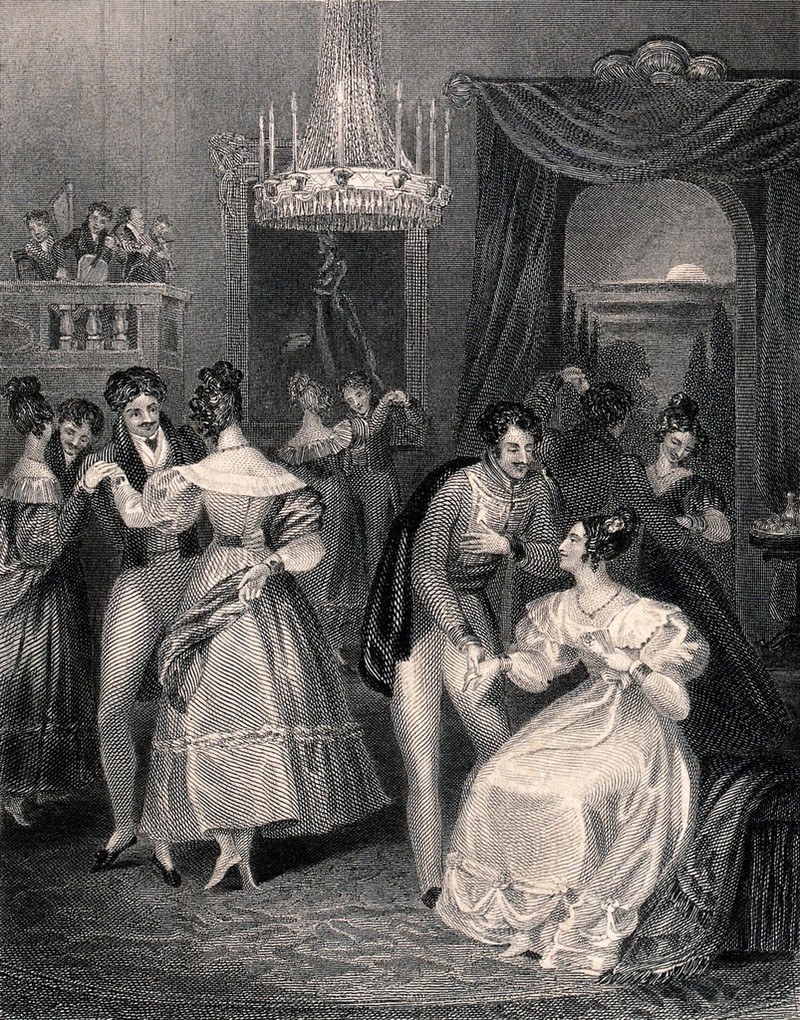
A young lady is being asked by a young man to join the other couples on the dance floor. Engraving by S.S. Smith after J. Stephanoff.
Unknown artist
- Dance:
- Ballroom
- Source:
- Wellcome Collection
- Rights:
- Rights vary by item — check the source record before reusing this image. Source record ↗
- Recorded as:
- Check
This work is essential evidence for understanding the Regency ballroom as a site of social negotiation where dance, courtship, and propriety intersected. The image shows not just how people danced but how the invitation to dance was choreographed as a moment of social ceremony—the formal gesture, the posture of the woman, the presence of observers—all governed by strict convention. For dance historians, it documents the closed-position frame and upright carriage of the period's ballroom forms and reveals the degree to which 19th-century ballroom dance was embedded in codes of gender, class, and courtship.
What you are looking at
A ballroom scene of the early 19th century, rendered in fine engraving. A young woman in a white Empire-waist gown sits in the foreground at right, her posture upright and composed, while a young man in dark formal dress bends toward her with an extended hand in invitation. Behind them, three couples occupy the dance floor in various stages of movement across a grand interior lit by a massive chandelier hung with candles. The space is defined by tall architectural elements—fluted columns or pilasters—and rich drapery swaged overhead in dark fabric. Spectators line the left side, seated on a raised platform or balcony, observing the proceedings. The engraving technique renders the scene in precise parallel lines and crosshatching, giving the fabric, light, and spatial depth a luminous quality characteristic of high-quality reproductive prints of the Regency era.
The dancing
The seated woman maintains an erect, formal posture with her hands in her lap, her expression calm and slightly downturned in the modest convention of the period. The man leans forward at the waist in a gesture of courteous supplication, his arm extended with palm upward—a posture of formal request rather than presumption. In the background, the dancing couples hold closed positions with the man's right hand at the woman's waist and her left hand on his shoulder or arm, their bodies aligned in the upright, restrained frame typical of Regency-era ballroom dance. The observers seated above gesture and converse, engaged in the social spectacle.
The dance depicted
This depicts the moment of invitation to dance in a formal ballroom setting of the Regency period (c. 1811–1820). The scene illustrates the social protocol of partner selection, which was a significant moment in the evening's choreography and often charged with social meaning. The couples already dancing appear to be executing a waltz or a quadrille—the two dominant ballroom forms of the era—characterized by their closed positions and upright carriage. The dance itself is not the subject; rather, the image captures the social negotiation and courtship ritual that framed ballroom dancing, making it as much a document of manners as of movement.
How it was made
This is an engraving, executed with fine parallel lines and careful cross-hatching to create tone and volume. The technique is identified in the title as the work of engraver S.S. Smith after a design by J. Stephanoff, a common arrangement for reproductive prints of the period. Engravings of this quality required significant skill and time; they were valuable objects intended for collectors, illustrators, and the educated public. The precision and luminosity of the medium made it ideal for documenting both social behavior and interior architecture, and such prints often served as records of contemporary fashion, manners, and ballroom practice.
About this work
A finely executed Regency-era engraving depicting a pivotal moment in ballroom etiquette: a young man's formal request for a dance. The work functions as both a record of early 19th-century ballroom fashion and an index of the social choreography that surrounded partner selection. The engraving shows the contrast between the formal invitation scene in the foreground and the measured, closed-position dancing of couples already on the floor, revealing how ballroom dance was inseparable from courtship ritual and social hierarchy. For historians of dance, costume, and Regency society, it is a precise visual document of how bodies moved and positioned themselves within the constraints of etiquette.
How to look at it
Attend first to the foreground: the woman's composed, downturned gaze and the man's formal, almost supplicatory bend. This is not a moment of movement but of negotiation—the grammar of an invitation. Then observe the contrast between this still moment and the dancing couples behind, whose bodies are in motion but similarly restrained and upright. Notice the role of the architectural space and the light from the chandelier; the ballroom itself is a character in the scene. Finally, consider the presence of observers: the seated figures on the platform and the musicians—the ballroom is a public stage, and even the private moment of invitation is witnessed and governed by social spectacle.
The artist
The engraver S.S. Smith and the designer J. Stephanoff are not fully identified in the record, but Stephanoff may be related to the Stephanoff family of theatrical and social illustrators active in England in the early 19th century. Prints of this type were commonly produced by collaborative teams: the designer provided the composition, and a skilled engraver rendered it for publication. Such reproductive prints were circulated as illustrations in books, annuals, and collected series documenting contemporary social life and fashion.
The period
This engraving dates to the Regency era or early Georgian period, when the waltz was beginning to displace older forms like the cotillion and quadrille in English ballrooms, though all three dances coexisted. The image reflects the Regency ideal of restrained, upright carriage and closed-position dancing; the waltz had generated controversy for its close contact and relative freedom of movement, but by this date it was becoming fashionable among the younger set. Ballroom dancing was central to the marriage market and social calendar of the gentry and aristocracy, and images of ballroom scenes were popular subjects for prints, paintings, and narrative illustrations. The engraving's attention to interior architecture, lighting, and the social hierarchy of the room (dancers, musicians, seated observers, spectators in the balcony) reflects the cultural importance of the ballroom as a stage for social display.
Where it lives
The work is held in the Wellcome Collection, which holds prints and images related to the history of medicine, science, and social life. This engraving appears to be catalogued as a social document rather than a medical one, suggesting it was acquired for its value as a historical record of Regency society and manners.
Dance in this work
Questions about this work
What dance are they doing?
The couples on the floor appear to be dancing either a waltz or a quadrille, the two most popular ballroom dances of the Regency era. Both were performed in closed positions with upright, formal carriage. The image does not show the footwork clearly enough to distinguish between them, but the closed hold and posture suggest one of these two forms.
Was it normal for a man to ask a woman to dance like this?
Yes. The formal gesture of request—often made with a bow and an extended hand—was the obligatory protocol for inviting a woman to dance in ballroom society. Refusing an invitation could cause social offense, and accepting was a significant moment in the evening, often freighted with romantic and social implications. The image captures this moment of negotiation.
Why is everyone so stiff and formal?
The upright posture, closed frame, and restrained movement were the aesthetic and social ideal of Regency ballroom dance. Dancers prided themselves on elegance, composure, and refinement; exaggerated movement or expressiveness would have been considered vulgar. The formal bearing reflected the class status and propriety of the dancers and their families.
What is the engraving technique and why does it look different from a painting?
An engraving is made by incising lines into a metal plate (usually copper), inking the plate, and printing it onto paper. The technique creates a precise, linear image built up from parallel lines and cross-hatching. Engravings could be reproduced many times and were less expensive than paintings, making them ideal for mass distribution to a wide audience. The technique is highly skilled and was used for both artistic and documentary purposes.
More Ballroom artwork