36 works in this view — arrow keys or swipe to move between them.
Dance in Art
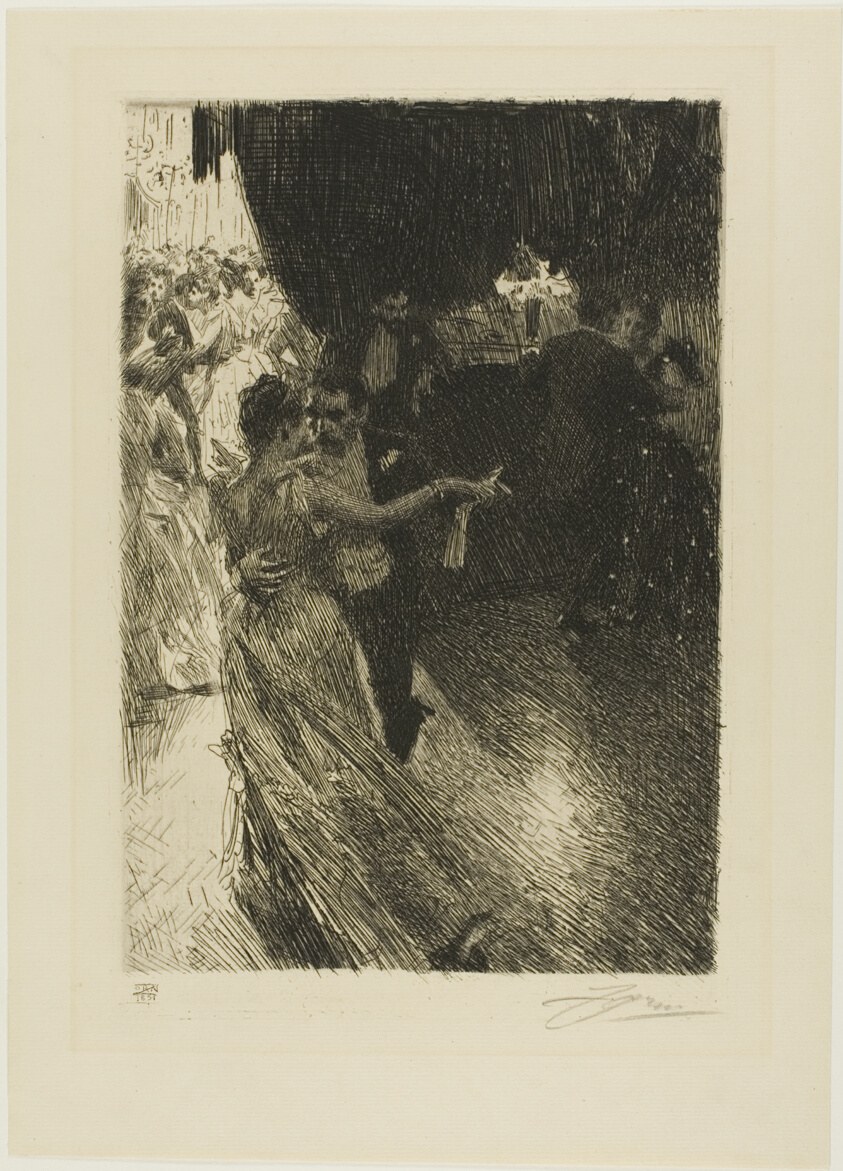
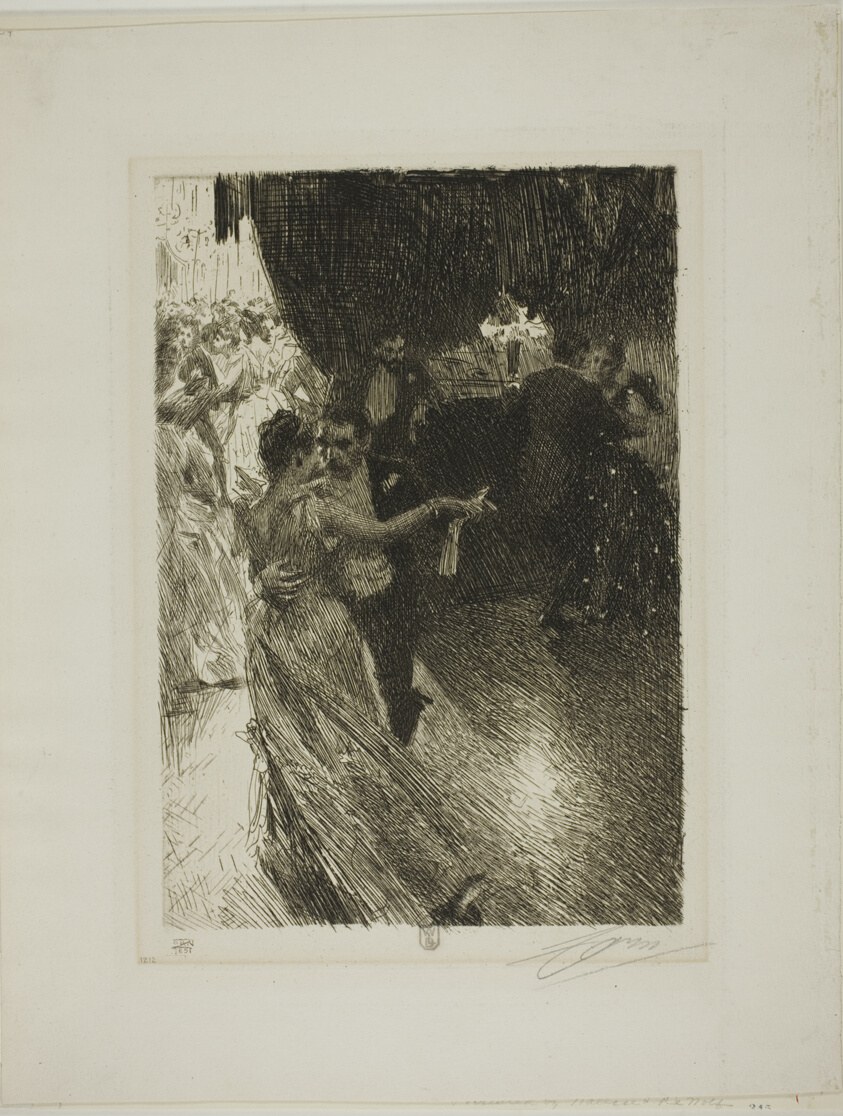
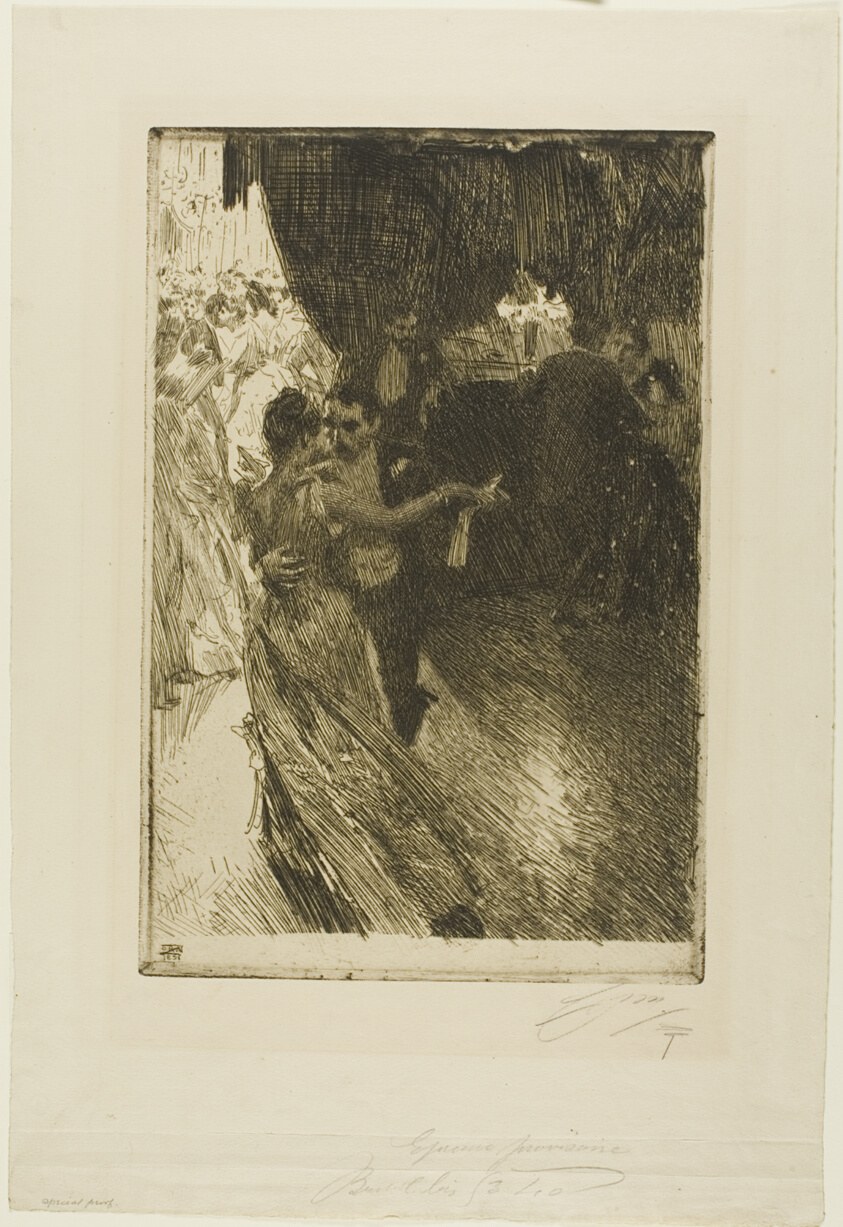
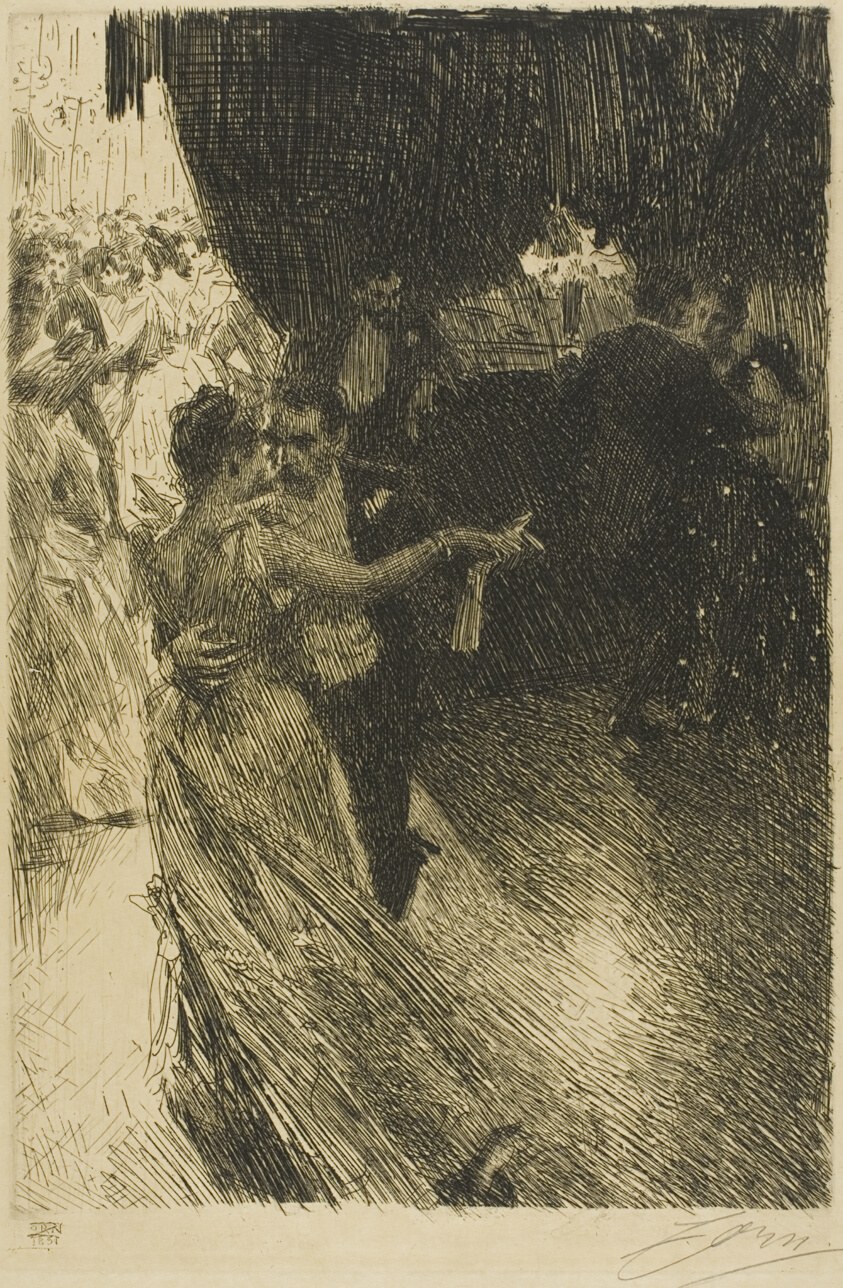
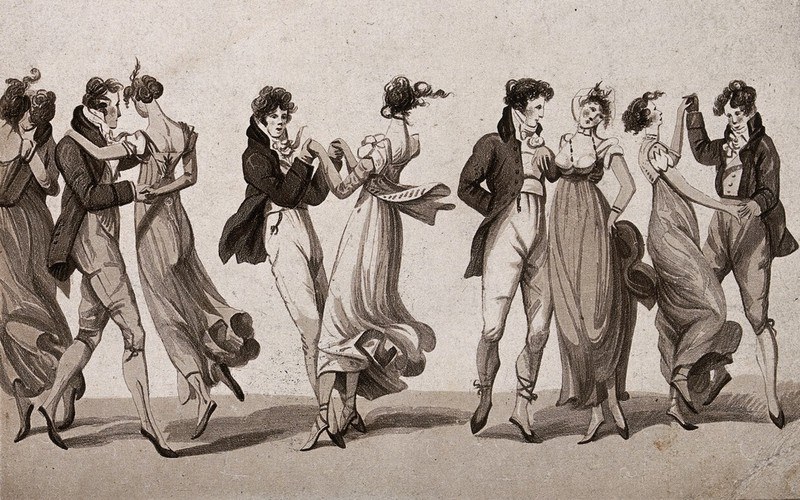
Couples dancing the waltz. Aquatint.
Unknown artist
- Dance:
- Waltz
- Source:
- Wellcome Collection
- Rights:
- Rights vary by item — check the source record before reusing this image. Source record ↗
- Recorded as:
- Check
This is primary visual evidence for the aesthetics and social practice of the waltz at the moment of its rapid uptake in European and American society (roughly 1810s–1830s). It shows how dancers actually moved together—the hold, the frame, the turning—and captures the cultural energy and slight transgression the dance represented. For dancers and historians, it is a rare record of a historic ballroom dance in motion, made by an artist observing the dance as social practice rather than as formal theater.
What you are looking at
An aquatint showing a lively social dance scene with five couples arranged across the composition. The figures are rendered in a light, satirical style typical of early 19th-century social commentary prints. The dancers wear high-waisted regency-era dress: the women in long, columnar gowns with high necklines and short puffed sleeves, their hair in the cropped or ringletted styles of the period; the men in dark coats, breeches, and formal dress shoes. The couples occupy a shallow, neutral space with minimal setting—a thin ground line suggests a ballroom floor, but there is no architectural detail or furniture to anchor the scene. The composition reads as a frieze or series of vignettes, with figures overlapping slightly to suggest depth and movement. The mood is one of exuberant, almost comical abandon: bodies lean, twist, and arc in various states of momentum. Some dancers appear mid-pivot; others seem to be executing high steps or momentary lifts. The aquatint technique renders the scene in warm sepia tones, with subtle cross-hatching to model form and movement.
The dancing
The dancers demonstrate a closed-hold partnership typical of early ballroom dance, with men and women in close proximity throughout. Arm positions vary across the couples: some show the extended frame of a formal ballroom hold, with arms at shoulder height; others display more relaxed or playful positioning. Several figures are caught mid-stride with one leg lifted or extended behind; the exaggerated positions and animated postures suggest the artist was capturing the dynamic, flowing motion of turning and traveling steps. Weight appears to shift fluidly from one foot to the other across multiple couples, consistent with the continuous rotation and forward motion of the waltz. The women's long skirts billow and curve, following the twist and tilt of their bodies, which would be the visual result of rapid turning in a voluminous gown.
The dance depicted
The catalogue identifies this as couples dancing the waltz, and the visual evidence strongly supports that reading. The closed partner hold, the emphasis on turning and traveling motion, and the period dress all align with early 19th-century waltz practice. The waltz was revolutionary in its day, requiring close physical contact between partners and rapid turning in triple time—both evident here in the animated, tightly paired figures. This appears to be a social waltz scene rather than a staged theatrical performance, reflecting the dance's rapid adoption in fashionable society. The satirical or observational tone of the composition—the exaggerated energy, the variety of expressions and postures across the couples—suggests this may be social commentary on the dance's popularity and the sometimes undignified or overly enthusiastic manner in which dancers threw themselves into it.
How it was made
The work is an aquatint, a printmaking technique in which acid bites a copper plate to create areas of tone rather than line. Aquatint allowed artists to achieve subtle gradations of color and shadow, making it ideal for rendering fabric, movement, and the play of light across bodies in motion. The warm, uniform sepia tone and the soft modeling of form are characteristic of the technique. Aquatints were typically hand-colored or printed in colored inks, circulated as affordable prints for middle-class audiences, and collected in folios on social, satirical, or instructional themes. This work's accessible style and social subject matter suggest it was made for a broad audience interested in dance, fashion, and manners rather than as a fine art object.
About this work
This aquatint documents the early 19th-century waltz in its moment of greatest novelty and social impact. It captures not just the dance itself—the closed hold, the rapid turning, the traveling motion—but also the atmosphere of enthusiasm and slight absurdity that surrounded its adoption in fashionable circles. The print is a historical record of how the waltz was performed, dressed for, and understood as a social act: energetic, modern, slightly transgressive in its intimacy, and executed with the kind of wholehearted commitment that invited mockery from observers. For a dance historian or enthusiast, this work is invaluable as documentation of early waltz practice, showing the relationship between partners, the role of costume, and the spatial dynamics of a social dance in a ballroom setting.
How to look at it
Notice the variety of moments across the five couples: the artist has not frozen a single instant but rather shown the range of positions and attitudes a waltz couple might occupy during a dance—the preparatory lean, the moment of fullest turn, the traveling step, the recovery. Look closely at the relationship between the partners in each couple: the closeness of the hold, the way the woman's body curves into the man's frame, and how the man's body angle supports and enables her turning. The exaggerated, almost comedic energy of some figures—the lifted legs, the arched backs—suggests an observational or satirical intent, perhaps gently mocking the enthusiastic abandon with which dancers threw themselves into this new, thrilling dance. The layering and overlap of couples suggests the crowded, bustling atmosphere of an actual ballroom rather than a posed, staged scene.
The period
The waltz emerged in Vienna and spread across Europe and North America in the early 19th century, arriving in London and Paris as a sensation around 1810–1815. It was revolutionary: unlike earlier country dances and quadrilles, which involved multiple couples in set formations, the waltz required only two dancers in an intimate closed hold, turning rapidly to triple-time music. It was also modern: it displaced the older, more formal dances that had dominated the 18th century. Contemporary observers were often scandalized by the closeness of the hold and the speed of the turning, which could make dancers dizzy or disheveled. Aquatints and colored engravings documenting the waltz and other fashionable dances were produced in quantity during this period, serving as both satire and instruction for the expanding middle-class ballroom audience. This print belongs to that tradition of social observation through dance imagery.
Where it lives
The work is held by the Wellcome Collection, a historical medical and scientific image archive. Its presence there reflects the Wellcome's broad collecting practice in social and cultural history; dance imagery was of interest both for its documentary value and for what it revealed about historical fashion, manners, and public health (overcrowding, physical exertion, hygiene).
Dance in this work
Questions about this work
Was the waltz really considered shocking?
Yes. The waltz required a close hold between partners and rapid turning, both of which were novel and controversial. Conservative observers worried about the indecorum of the close contact and the potential physical effects of the turning. Medical writers commented on the heat, exertion, and breathlessness waltz dancing could induce, especially in women in tight corsets. The dance was both exhilarating and genuinely transgressive for its time, which may explain the slightly mocking tone of this print.
How do I know this is meant to be the waltz and not another dance?
The catalogue record identifies it as the waltz, and the visual evidence supports that: the closed-partner hold, the emphasis on turning and traveling motion, and the period dress (regency era, roughly 1810–1830, which is when the waltz was at its height) all match waltz practice. The rapid, fluid motion suggested by the arched bodies and lifted limbs also suggests the fast turning characteristic of the waltz in triple time, rather than the more stately or geometrical motion of a quadrille or cotillion.
Could this be a theater scene rather than a social dance?
Unlikely. There is no stage, scenery, or audience visible; the setting is a simple, neutral ballroom floor. The dress is fashionable street and ballroom wear, not theatrical costume. The variety and informal arrangement of the couples, and the observational or satirical tone, all suggest this is a document of social practice—a print made to record and comment on how people actually danced in ballrooms, not a representation of a staged theatrical scene.
Why is the artist unknown?
Many early 19th-century aquatints and prints, especially those produced in quantity for commercial sale, were not signed or their signatures have been lost to time or poor documentation. Without a signature, inscription, or documented provenance, the artist cannot be identified from the image alone. The Wellcome Collection's records do not indicate an attribution.
More Waltz artwork